
Beyond the Graph: Quantifying Social Influence via Maximum Entropy
Entropy based evaluation of net structures – deployed in Social Network Analysis
This paper introduces an Information Theoretic framework for Social Network Analysis (SNA), moving beyond classical graph-based metrics. By modeling network relations as logic conditionals within the SPIRIT expert system, the authors utilize Maximum Entropy and Minimum Cross-Entropy to quantify actor influence (Diffusion, Reception) and integration (Embeddedness) in bits.
TL;DR
In the world of Social Network Analysis (SNA), we are used to counting arrows and measuring "distances" between nodes. However, a graph is often an oversimplification. This paper argues that Information Theory is the superior tool for measuring social fabric. By treating social relations as logical conditionals and applying the Principle of Maximum Entropy, the authors transform "networks" into "knowledge bases," allowing us to measure power and embeddedness in bits rather than simple degrees.
The Problem: The Mathematical Trap of Graph Theory
For decades, SNA has used metrics like Betweenness or Closeness because they are mathematically tidy. However, as sociologists have noted, mathematical concepts are often applied because they exist, not because they are adequate.
Classical graphs struggle with:
- Redundancy: Adding redundant paths in a graph suggests higher density, but in information terms, it adds zero new knowledge.
- Information Flow: A node might have many connections but reach only "central" nodes, whereas another might reach "mavericks," providing higher Diffusion Potential.
The authors suggest we stop looking at where a node is and start looking at how much information it resolves for the entire system.
Methodology: The Entropy-Driven Logic
The researchers utilize the expert system shell SPIRIT. The core idea is to translate a sociogram into a set of probabilistic conditionals:
- Syntax: If Actor A has an attribute (knows a message), then Actor B likely does too: .
- Maximum Entropy: The system finds a probability distribution () that satisfies all these "rules" without assuming any extra, hidden dependencies.
Key Information Metrics
By using this distribution, we can calculate three powerful new metrics:
- I-Density: The total knowledge contained in the network structure (measured in bits).
- I-Diffusion: How much "uncertainty" in the network is killed when we realize Actor has the information ().
- I-Reception: The impact on the network if Actor does not receive the information.
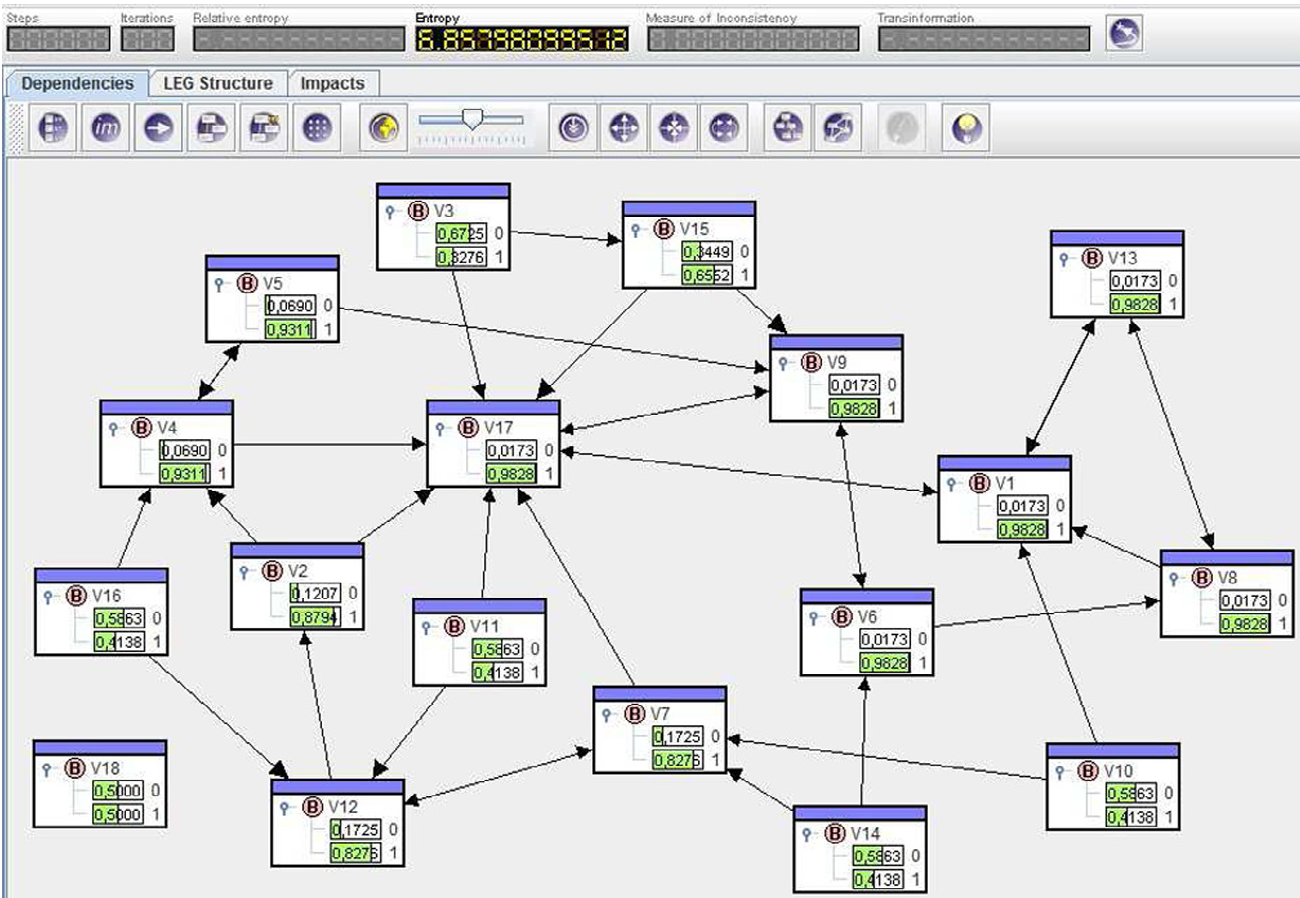 Figure 1: The dependency graph in SPIRIT, where each bar represents the marginal probability of an actor being "informed" based on the network structure.
Experiments: The Newcomb Fraternity Analysis
The authors applied this to the famous Newcomb Fraternity dataset (17 students).
The "Black Hole" Effect
One of the most striking findings involves I-Embeddedness. In classical theory, central actors are highly embedded. In Information Theory, actors 1, 6, 8, 9, 13, and 17 (a strongly connected group) have high probabilities of being informed a priori. Because they are expected to know everything, learning that they do know provides almost zero new information. They become an "Information Theoretical Black Hole"—integral to the flow, but low in marginal impact.
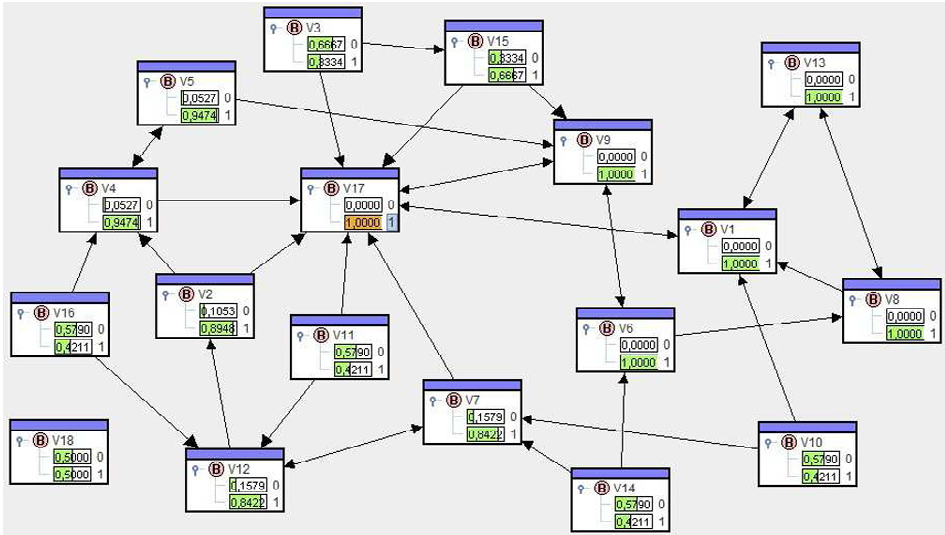 Figure 2: Visualizing the flow of a commodity (message) when Actor 17 is evidenced (informed), showing the transient knowledge shift across the network.
Comparison with SOTA
The paper calculates Kendall’s (correlation) between classical rankings and entropy-based rankings.
- Classical metrics (In-degree, Closeness, Katz) correlate strongly with each other ().
- I-Diffusion and I-Reception are perfectly inverse, providing a directional symmetry that graph theory lacks.
Critical Analysis & Conclusion
This work represents a paradigm shift. It moves SNA from Geometry (distances and paths) to Epistemology (what we know and how we know it).
Strengths:
- Naturally handles transitivity and uncertainty.
- Distinguishes between "redundant connections" and "new information."
- Identifies groups of actors who are "informationally equivalent" (forming super-actors).
Limitations:
- The computational cost of solving Maximum Entropy on huge datasets (millions of nodes) remains a challenge compared to simple graph traversals.
- Requires a predefined "type" of relation (e.g., parallel duplication) to be accurate.
Future Work: The authors plan to explore Bonacich’s Power Approach—where having "weak" neighbors actually increases your own power—within this information-theoretic lens. This could redefine how we identify "Influencers" in the age of algorithmic feeds.