
Enchilada: Scaling Atmospheric Data Analysis for the Big Data Era
Environmental chemistry through intelligent atmospheric data analysis
This paper introduces Enchilada (Environmental Chemistry through Intelligent Atmospheric Data Analysis), an open-source Java-based software designed for the high-throughput analysis of single-particle mass spectrometry (SPMS) data. It integrates various data mining techniques, including K-means and Art-2a clustering, with temporal aggregation capabilities to handle millions of atmospheric aerosol spectra.
TL;DR
Enchilada is an open-source, GUI-driven software package designed to help environmental chemists process millions of single-particle mass spectra. By leveraging SQL-based data management and optimized clustering algorithms, it allows researchers to synthesize complex chemical signatures with temporal atmospheric data without requiring advanced programming skills.
Context: The Multi-Dimensional Challenge of Aerosol Science
Atmospheric aerosol particles are complex mixtures of metals, organics, and inorganic ions. Instruments like the Aerosol Time-of-Flight Mass Spectrometer (ATOFMS) provide a wealth of information by generating mass spectra for individual particles in real-time.
The scientific bottleneck isn't just the volume (GBs per day) but the heterogeneity. Because particles vary from second to second, averaging data during acquisition destroys critical chemical insights. However, analyzing millions of individual spectra to find patterns is computationally expensive and historically required custom MATLAB scripts that were difficult for non-programmers to use.
Methodology: The "Collection" and SQL Backbone
Unlike prior tools that relied on system RAM, Enchilada is built on Microsoft SQL Server. This architectural choice ensures that the dataset size is limited only by disk space, not memory.
1. The Recursive Collection Structure
A standout feature is the Windows-Explorer-like interface for "Collections." Users can group spectra into folders and sub-folders. From a technical standpoint, Enchilada uses recursive membership tables in SQL. When a particle is added to a sub-folder, the software "recurses" upward, updating all parent folders. This allows "nearly instant" retrieval of data across any level of the hierarchy.
2. Intelligent Data Mining
Enchilada implements several clustering algorithms to group similar particles into chemical "families":
- K-means & K-medians: Optimized for scalability to handle millions of rows.
- Art-2a: An adaptive resonance theory algorithm common in aerosol science for rapid category learning.
 The Enchilada workspace showing the hierarchical collection pane (left) and the mass spectrum of a single particle (center).
Results & Scientific Evidence
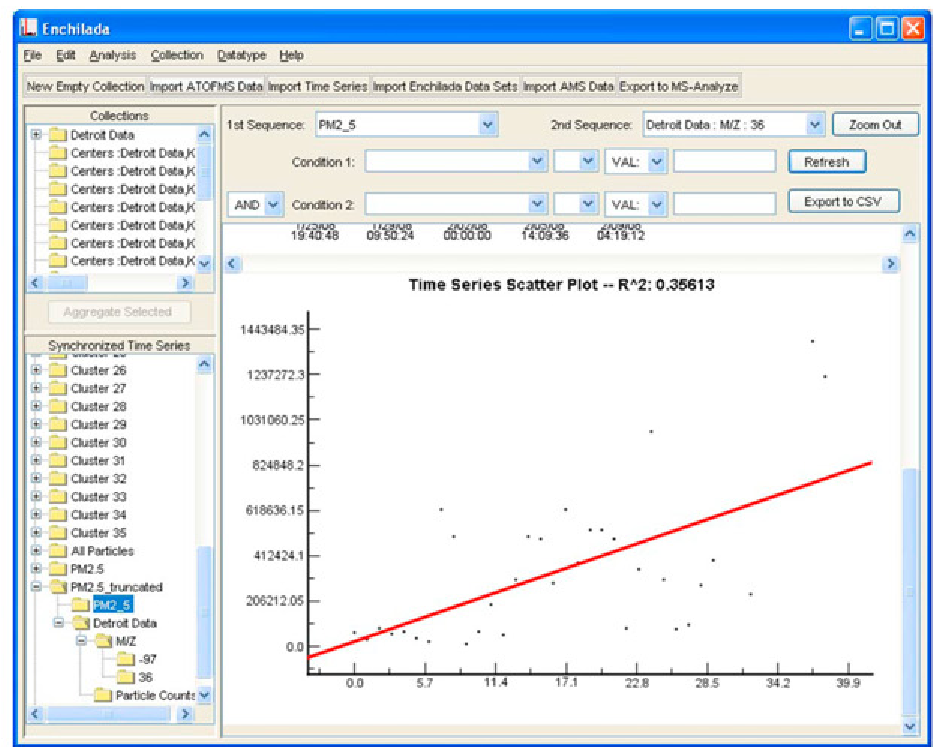
The power of Enchilada is best seen in its Temporal Aggregation. Scientists can take discrete particle events and "bin" them into hourly averages to compare with other pollutants like PM2.5.
In the Dearborn, MI experiment (345k spectra), Enchilada allowed researchers to visualize how specific chemical signatures (like C3+ carbon clusters) correlated with overall air quality.
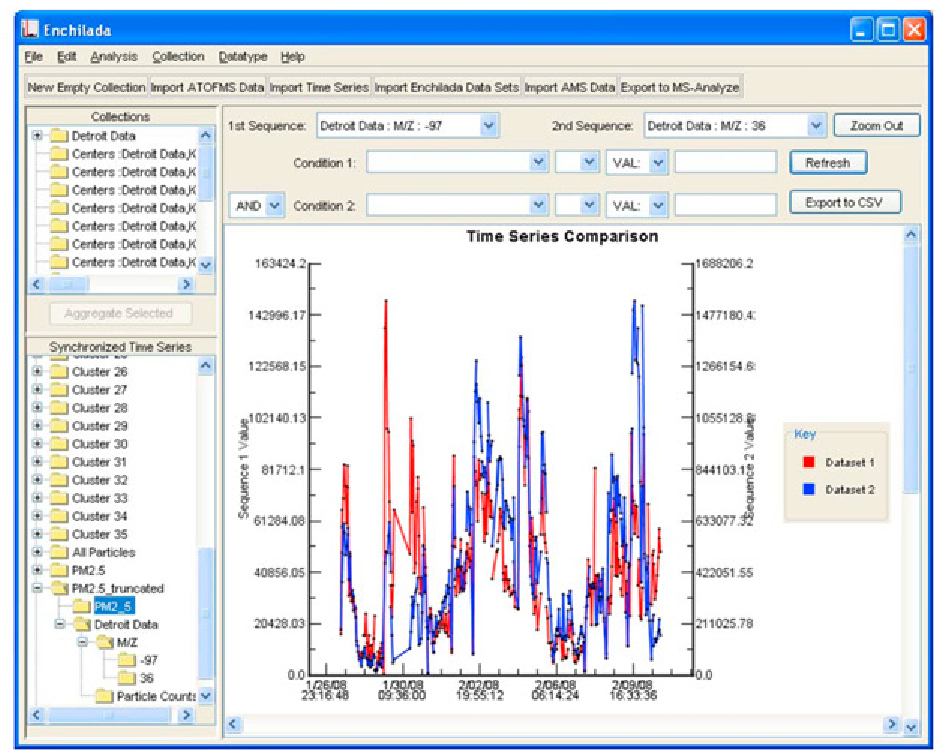 Case study: Scatter plots and time-series comparisons generated within Enchilada, showing the relationship between PM2.5 mass and specific mass spectral peak areas.
Scalability Performance
The K-means implementation is highly optimized. Benchmarks show:
- Small Scale: 3,140 particles clustered in ~2 minutes.
- Large Scale: 1.34 million particles clustered into 10 groups in ~12.7 hours.
Critical Insights: Comparison with YAADA
The paper draws a sharp comparison with YAADA, a MATLAB-based framework.
- YAADA is for programmers who need flexibility and are comfortable writing scripts.
- Enchilada is for users who need a complete, GUI-driven environment. The authors argue that by providing a "bridge" between raw data and multivariate models (like Positive Matrix Factorization), Enchilada democratizes high-end atmospheric data mining.
Conclusion & Future Outlook
Enchilada marks a shift in environmental chemistry toward "Intelligent Data Analysis." Its primary contribution is not a new algorithm, but a scalable system architecture that brings big-data capabilities to the bench scientist's desktop.
The future of this work lies in "on-the-fly" analysis, where Enchilada could potentially interface directly with mass spectrometers during flight or field deployments to provide real-time source apportionment and plume detection.
Keywords: Single-particle mass spectrometry, Aerosol analysis, K-means clustering, SQL database design, Environmental Data Mining.