
Unmasking the Environment: How Weather Logic Dictates Forest SAR Coherence
14989_Environmental effects on the interferometric repeat-pass coherence of forests.
This paper investigates the environmental drivers of C-band one-day repeat-pass interferometric coherence in forests using ERS tandem data. By coupling a Soil-Vegetation-Atmosphere Transfer (SVAT) model with radar backscatter models, the authors quantify how moisture dynamics and wind conditions cause significant temporal decorrelation.
Executive Summary
TL;DR: This study deconstructs the "black box" of temporal decorrelation in forest SAR interferometry. By linking specialized environmental models (SPA) with radar physics (IWCM), the authors reveal that C-band coherence is not just a proxy for biomass, but a sensitive thermometer for canopy moisture and wind-induced motion.
Background: Within the academic coordinate system, this work moves beyond simple empirical "coherence-to-biomass" curves. It acts as a rigorous theoretical validation and diagnostic study, explaining why certain satellite acquisitions fail to provide accurate biomass maps and how we might fix them using meteorological data.
Problem & Motivation: The Variability Crisis
The SIBERIA-I project famously mapped Siberian forests using ERS tandem coherence. However, the "coherence-biomass" relationship shifted drastically between images. Traditionally, researchers attributed this to "met_conditions" without knowing why.
The author's insight is that forests are living, breathing hydraulic systems. Current radar models often treat the canopy as a static dielectric slab. In reality, photosynthetically active radiation (PAR) and soil moisture gradients cause the canopy's dielectric constant—and thus its transparency to radar—to fluctuate rapidly throughout the day.
Methodology: Coupling Biology with Physics
The core of the paper lies in the integration of the Soil-Plant-Atmosphere (SPA) model with the Interferometric Water Cloud Model (IWCM).
- Hydraulic Simulation: The SPA model calculates leaf water potential and soil moisture at 30-minute intervals based on solar radiation, temperature, and rainfall.
- Dielectric Transformation: These moisture values are fed into dielectric mixing models to estimate the complex permittivity () of the soil and canopy.
- Radar Mapping: The IWCM separates the return into soil (), canopy (), and double-bounce () components, assigning a temporal decorrelation factor to each.
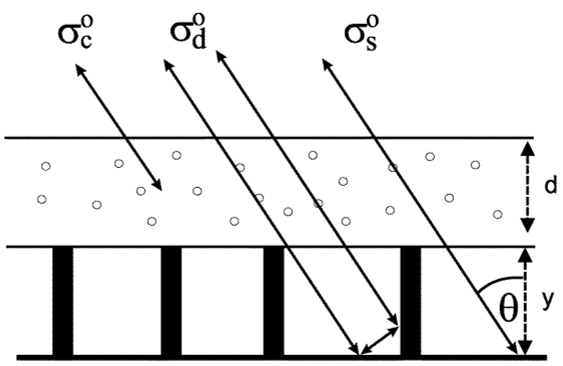 Figure: The scattering geometry illustrating how the radar signal interacts with different forest layers.
Experiments & Results: The Diurnal Trap
The study utilized 12 ERS tandem scenes over Kielder Forest, UK. A striking finding was the August 1995 acquisition, which showed unusually high coherence even in mature stands.
Key findings:
- The 11:00 AM Problem: ERS overpasses occur when photosynthesis is peak, meaning canopy moisture is changing at its fastest rate. A 30-minute difference in acquisition can lead to measurable coherence shifts.
- Wind vs. Rain: While rainfall increases soil moisture (theoretically increasing soil return), it also increases canopy attenuation and motion, typically resulting in a net decrease in coherence.
- Underestimation: Even with the best SVAT models, the simulated variability was lower than the observed satellite data. This suggests that "solute concentration" in leaves (which changes dielectric properties independently of water volume) is a missing variable in current SAR theory.
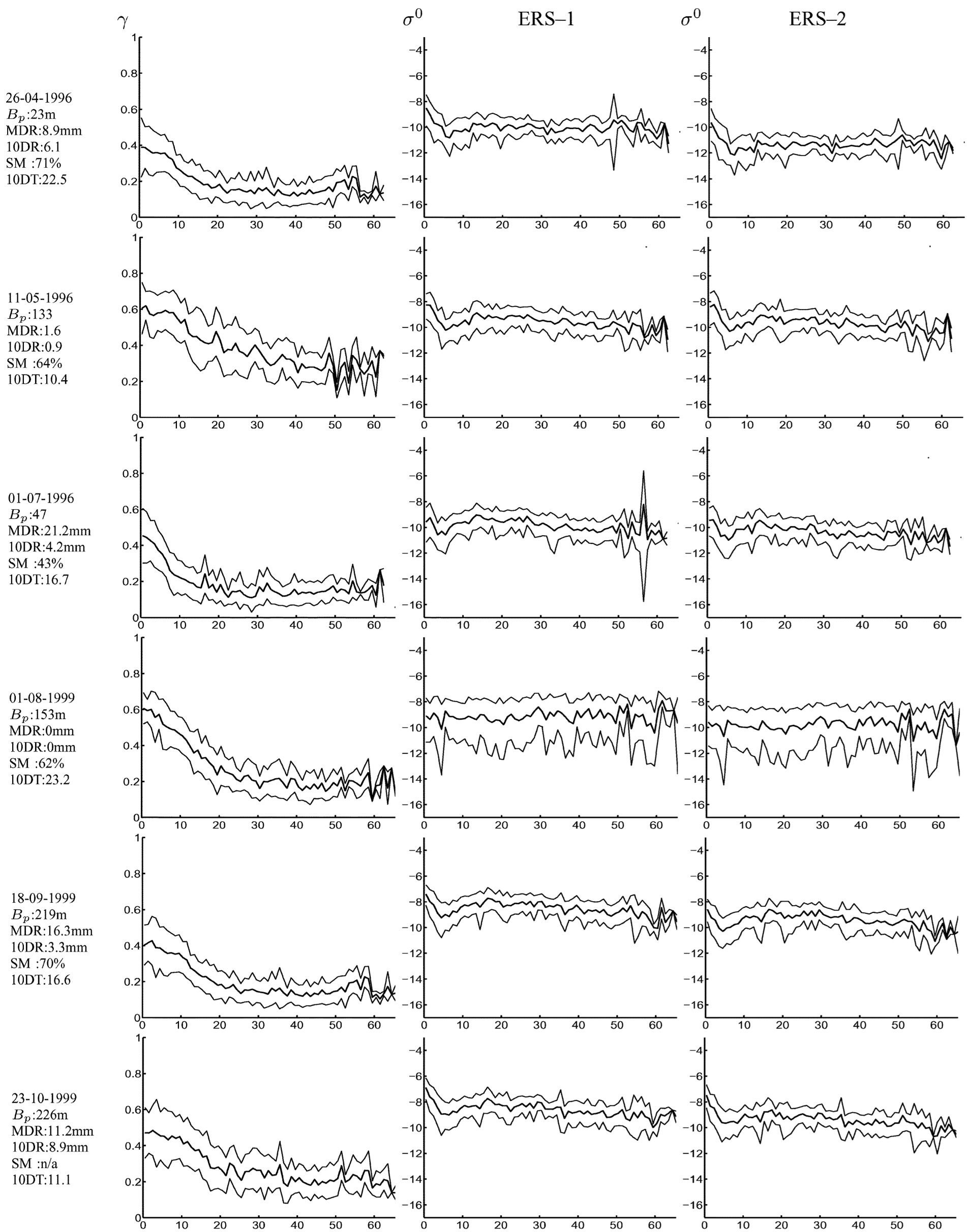 Figure: Observed coherence vs. stand age across different dates. Note the massive variation in "saturation levels" (the bottom of the curves).
Critical Analysis & Conclusion
Takeaway
The paper proves that one-day coherence is a "mixture" signal. In mature forests, the observed interferometric height (around 5m for a 25m tree) confirms that we are seeing a blend of canopy and ground returns.
Limitations
- Wind Data Resolution: Standard meteorological "daily average wind" is insufficient; sub-hourly gusts are likely responsible for much of the unexplained decorrelation.
- Dielectric Models: Existing models like Hallikainen’s are too "static" for the dynamic needs of repeat-pass interferometry.
Future Outlook
To achieve "all-weather" biomass monitoring, we must move toward Polarimetric Interferometry (PolInSAR). By separating the volume (canopy) and surface (ground) more effectively, we can isolate the biophysical parameters from the environmental noise that this paper so clearly identifies.