
NoiseMonitor: Revolutionizing Urban Acoustic Mapping via VGI and Machine Learning
Environmental Noise Sensing Approach Based on Volunteered Geographic Information and Spatio-Temporal Analysis with Machine Learning
This paper presents a framework for urban noise monitoring using 'NoiseMonitor', a mobile application that leverages Volunteered Geographic Information (VGI). The system integrates mobile sensing with Machine Learning (SVM and ANN) to generate predictive spatio-temporal noise maps for Mexico City.
TL;DR
Environmental noise is a "silent killer" in megalopolises like Mexico City, linked to high blood pressure and sleep loss. This paper introduces a methodology that turns citizens into "human sensors" using the NoiseMonitor app. By combining Volunteered Geographic Information (VGI) with Support Vector Machines (SVM), the researchers created a predictive system that generates real-time noise heat maps with 30x the training efficiency of standard neural networks.
Problem & Motivation: Beyond Static Sensors
The primary challenge in urban computing is the sheer scale and heterogeneity of the environment. Official noise maps are typically static, updated infrequently, and based on mathematical simulations rather than real-world data. Prior work in VGI helped gather data but often struggled with "spatial sparsity"—gaps where no one has measured the noise. The authors' intuition was to bridge these gaps using contextual predictors: if we know the density of businesses and the type of residential settlements in an area, can we predict the noise without a physical sensor being present?
Methodology: The Context-Aware Prediction Model
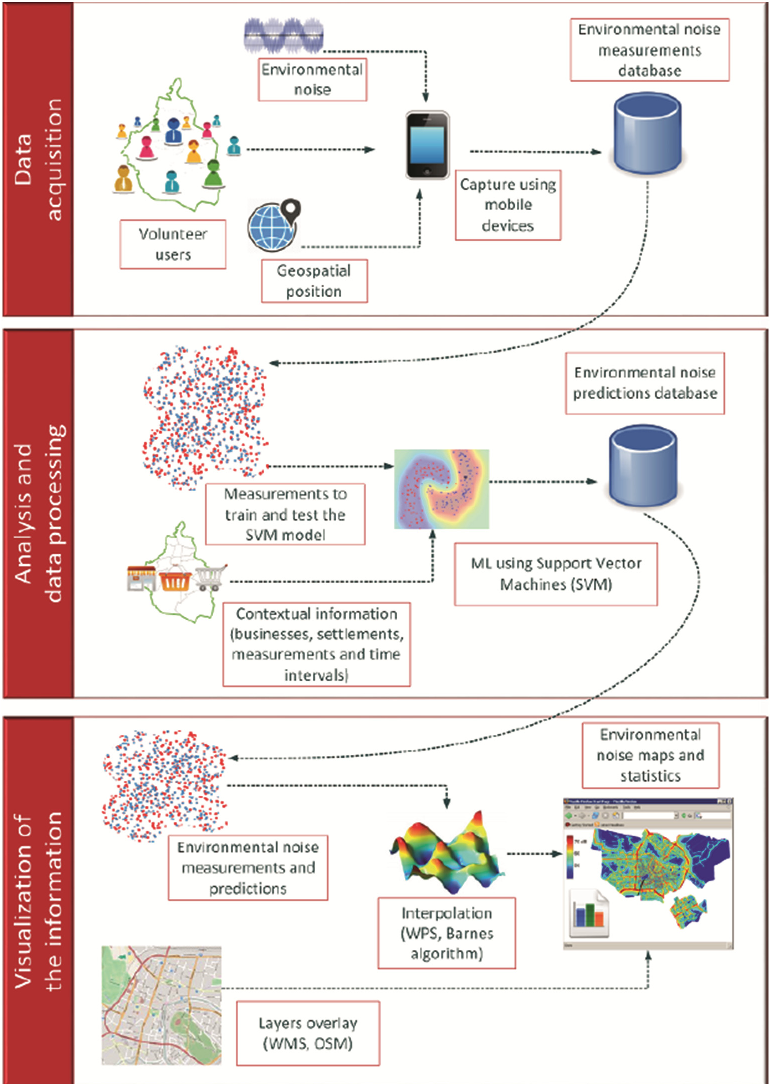
The core of the methodology lies in its three-stage pipeline: Data Acquisition, Analysis/Processing, and Visualization.
The Architecture
The system doesn't just record decibels; it cross-references GPS coordinates with the DENUE (a Mexican economic database). This allows the model to calculate "Business Density" as an inductive bias for noise levels.
Feature Engineering
The prediction model at the geographic neighborhood level relies on five distinct factors ( through ):
- (Business Density): Based on the inverse square law of sound pressure.
- (Settlements): Proximity to residential vs. commercial zones.
- & : Historical averages and measurement frequency within a specific radius (e.g., 1000m).
- (Temporal Intervals): Categorized into four shifts (Wee hours, Morning, Afternoon, Night) to account for urban metabolic cycles.
Experiments & Results: Efficiency vs. Accuracy
The study focused on the Cuauhtémoc District and the Historic Center of Mexico City. The researchers performed a head-to-head comparison between Support Vector Machines (SVM) and Artificial Neural Networks (ANN).
Key Findings:
- Accuracy: ANN (specifically a 10-10 node configuration) showed slightly lower Mean Absolute Error (MAE) and higher Correlation (CORR) than SVM.
- Efficiency (The Deciding Factor): The SVM using a Gaussian Kernel (rbfdot) trained in just 6 seconds. In contrast, the optimal ANN took 3.3 minutes.
- Spatio-Temporal Insights: The highest noise levels were recorded during the "HNL-12" interval (holidays/weekends afternoon), primarily driven by street vendors and crowds rather than just vehicular traffic.
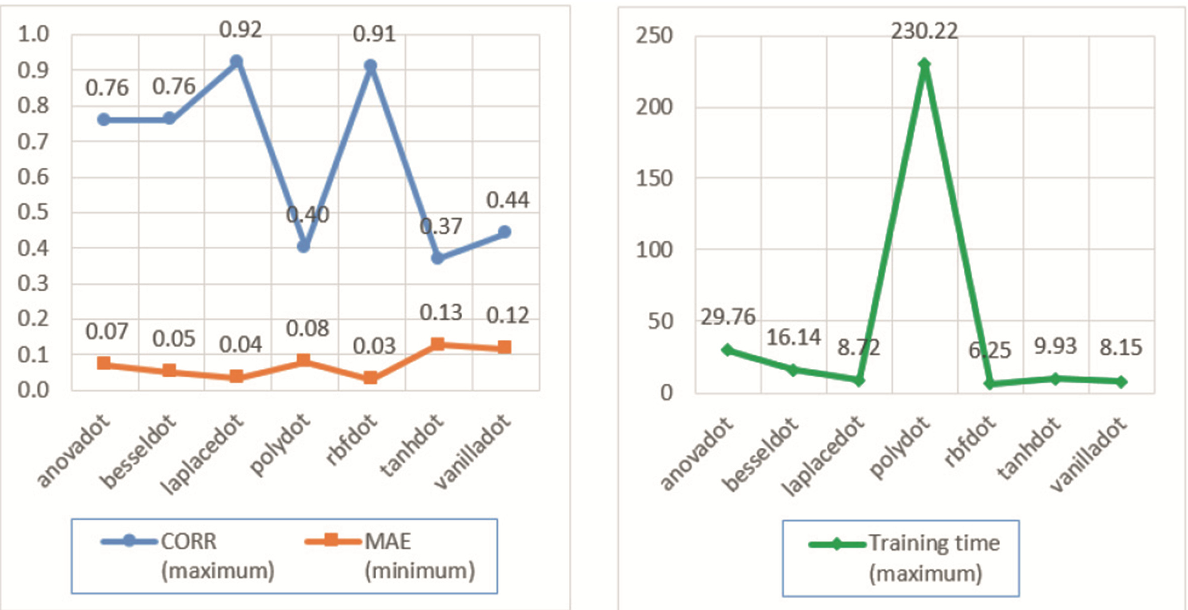 Figure: The Pareto trade-off between training time and prediction accuracy across different kernels and architectures.
Critical Analysis & Conclusion
This work highlights the power of VGI (Volunteered Geographic Information) in democratizing urban data. By choosing SVM over ANN, the authors prioritize system scalability and real-time responsiveness—crucial for a city-wide deployment.
Limitations & Future Work
While the SVM model is efficient, the current approach relies heavily on the microphone quality of varying Android devices, which introduces "hardware noise." Future iterations could benefit from sensor calibration algorithms to normalize data across different smartphone models. Moreover, integrating traffic flow data or real-time event feeds could further sharpen the spatio-temporal resolution of the predictions.
Takeaway: The "Citizen as a Sensor" model, when backed by efficient ML like SVM, provides a viable roadmap for sustainable, data-driven Smart City management.