
Nanotechnology and the TSCA: Navigating the Regulatory "Small" Gap
15648_Environmental Regulation of Nanotechnology and the TSCA.
This paper investigates the regulatory challenges posed by nanomaterials within the U.S. legal framework, specifically analyzing the Toxic Substances Control Act (TSCA). It proposes "Earth Systems Engineering Management" (ESEM) as a proactive, adaptive governance model to manage the unique environmental and health risks of nanotechnology.
TL;DR
As the global investment in nanotechnology exceeds billions, our regulatory "safety net"—the Toxic Substances Control Act (TSCA)—is showing signs of structural failure. This paper argues that because nanomaterials behave differently than their bulk counterparts, we need to move from a static, reactive legal framework to an Earth Systems Engineering Management (ESEM) model: a proactive, adaptive, and stakeholder-driven approach to environmental safety.
Context: A Billion-Dollar Revolution on a Nanoscale
We are currently witnessing a technological revolution where matter is manipulated at the scale of less than 100 nm. However, the legal framework governing these materials was designed in 1976. The central irony? A material that is perfectly safe at the macroscale (like carbon) can become potentially toxic or exhibit quantum properties at the nanoscale (like carbon nanotubes).
The Problem: The "List-Based" Blind Spot
The TSCA's primary tool is the Chemical Substance Inventory. If a substance is on the list, it’s considered "existing" and often escapes rigorous new-chemical review.
The authors point out three fatal flaws in applying this to nanotech:
- Nomenclature Confusion: Many nanomaterials are treated as "equivalents" to macroscale chemicals. For example, graphite is often used as an alias for carbon nanoparticles, ignoring the radical differences in surface reactivity and biological penetration.
- The "Toxic Ignorance" Loop: The EPA often waits for industry to provide testing data, but industry is not required to test unless the EPA proves a risk—a regulatory "Catch-22."
- The Low-Volume Loophole: The Low-Volume Exemption (LVE) bypasses substances produced at less than 10,000 kg/year. In nanotech, a few grams can be enough to power millions of devices, meaning highly active materials could saturate the market without ever triggering a review.
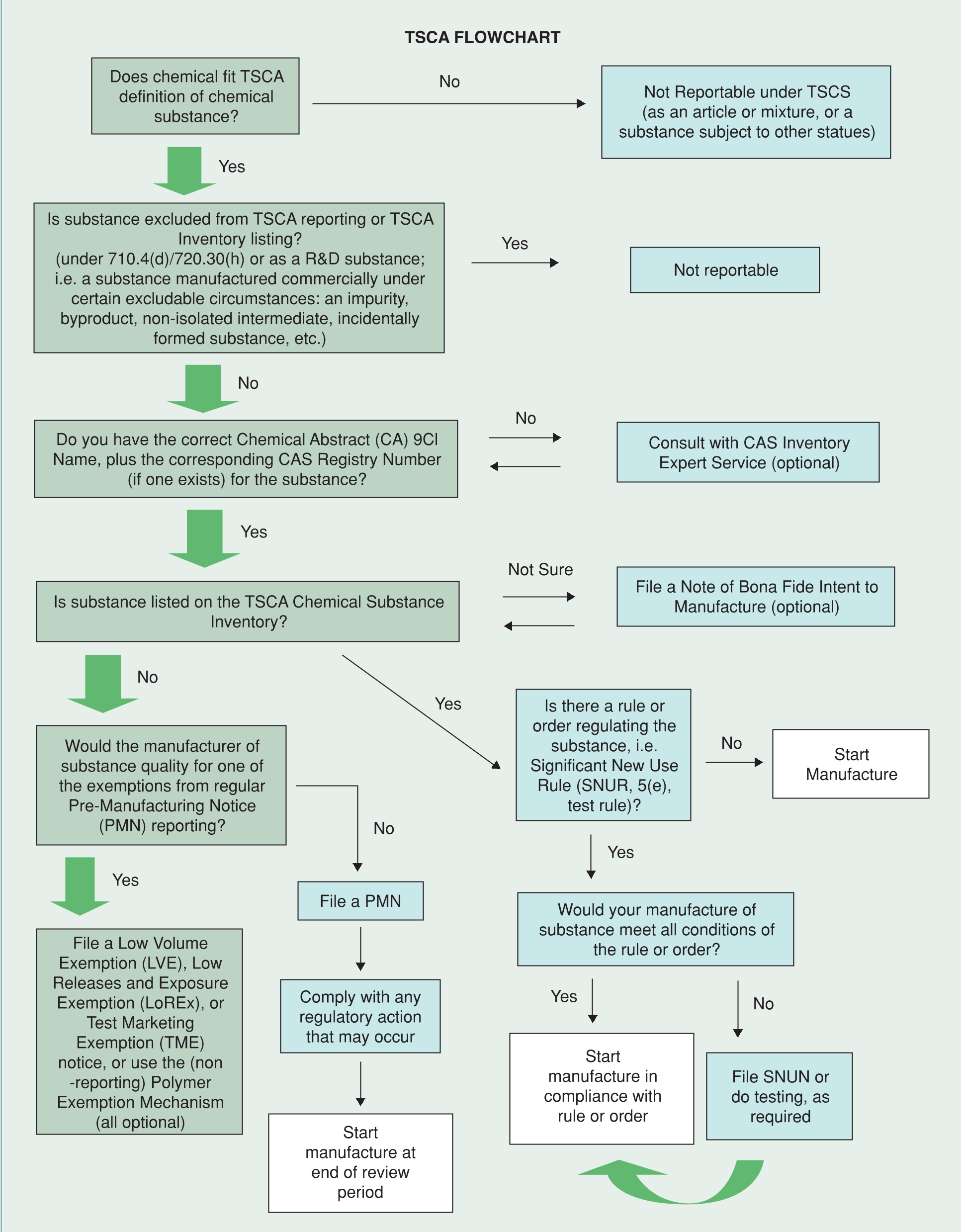 Fig. 1: The complex and often ambiguous path manufacturers must navigate under current TSCA regulations.
Methodology: From Adversarial to Adaptive
The authors propose a shift toward Earth Systems Engineering Management (ESEM). Unlike traditional regulation, which is often an "adversarial proceeding" between industry and government, ESEM envisions a "Trading Zone."
4 Pillars of the New Framework:
- Continuous Stakeholder Dialogue: Bringing scientists, ethicists, and NGOs into the room upstream during the R&D phase.
- Proactive Risk Regulation: Setting constraints based on early "warning signals" rather than waiting for confirmed environmental damage.
- Adaptive Solutions: Implementing pilot experiments and "reversible" nanotechnology applications that can be pulled from the market if new risks emerge.
- Constant Monitoring: Utilizing the best possible science to track how nanomaterials interact with complex ecosystems in non-linear ways.
Critical Results & Case Study
The paper highlights the case of Carbon Nanotubes (CNTs). Currently, some CNT manufacturers provide Material Safety Data Sheets (MSDS) with no CAS Registry Number, effectively operating in a regulatory vacuum.
The data shows a worrying trend:
- 80,000 chemicals in the TSCA inventory.
- Only 5,000 have undergone rigorous testing.
- 35,000 were assessed only as part of the Pre-Manufacturing Notice (PMN) program, which is often criticized for being superficial.
Deep Insight: Why Why it Matters
The core insight of this work is that nanotechnology isn't just a "new product"; it's a systemic perturbation. The "precautionary principle" is often criticized for stifling innovation, but the authors argue that uncertainty works both ways. We don't know the full benefits, and we don't know the full harms. The only logical path is Adaptive Management—regulating in a way that learns as the technology grows.
Conclusion: A 21st-Century Governance
We have a responsibility to imagine the impact of our current decisions a century from now. The TSCA served its purpose in the age of bulk chemicals, but the "Small Revolution" requires a more sophisticated, iterative, and transparent governance system. The transition to an ESEM/Trading Zone model isn't just an administrative change—it's a fundamental shift in how society negotiates the risks of its own progress.
Takeaway for Researchers: Expect future regulations to focus less on "mass and composition" and more on "size, shape, and surface reactivity" as the primary metrics for toxicity.