
EPF: Leveraging Social Bio-Events for Privacy-Preserving Healthcare Networking
EPF: An Event-Aided Packet Forwarding Protocol for Privacy-Preserving Mobile Healthcare Social Networks
EPF (Event-aided Packet Forwarding) is a novel networking protocol designed for Mobile Healthcare Social Networks (MHSNs) that leverages "illness-related events" to guide message routing. By combining social-aware forwarding with predicate encryption, it achieves high target patient coverage while strictly protecting patient identity and illness privacy.
TL;DR
The Event-aided Packet Forwarding (EPF) protocol transforms sensitive "illness" data from a privacy liability into a routing asset. By predicting where patients will "cluster" based on their medical needs and protecting that data with Predicate Encryption, the protocol achieves near-flooding performance with a fraction of the overhead.
Background & Motivation: The "Illness" as a Social Hub
Most Mobile Healthcare Social Networks (MHSNs) treat patient movement as random or interest-based. However, the authors observe a unique phenomenon in healthcare: Illness-related events. Patients with diabetes or arthritis don't just move randomly; they gather for inspections, therapy, and support groups.
The core challenge is: How do we use this predictable social gathering to forward messages efficiently without leaking who has what illness?
Methodology: Dual-Layer Predicate Security
The EPF protocol handles the trade-off between utility and privacy through a sophisticated 4-phase architecture: Initialization, Generation, Forwarding, and Receiving.
1. The Social Intuition
EPF defines a probability , where the likelihood of a patient visiting an event increases with the number of "matching" illnesses they share with the event's theme.
2. The Cryptographic Shield
The protocol uses Predicate Encryption (Inner Product) in two distinct layers:
- Routing Layer: Protects the packet's metadata. Only potential "relay" patients who meet a broad illness criteria can see the timestamp and destination type.
- Message Layer: The innermost encryption. Only the specific target patients can unlock the actual medical content.
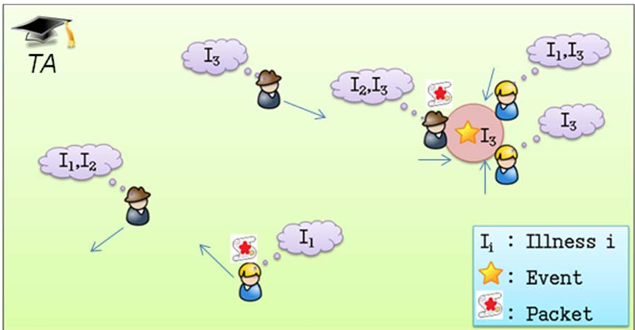 Fig 1: The MHSN System Model showing the interaction between the Trusted Authority (TA), Patients, and illness-related Events.
Experiments: Flooding Performance without the Flood
The researchers compared EPF against a standard flooding-based random walk.
- Efficiency: In "Case 3" (Event-aided EPF), the protocol achieved a Target Patient Coverage Ratio (TPCR) nearing that of flooding, but with a massive reduction in the Number of Packet Copies (NPC).
- Latency: When events are active, the "Average Delay" drops significantly because relay nodes efficiently carry packets to "social sinks" where target patients are guaranteed to appear.
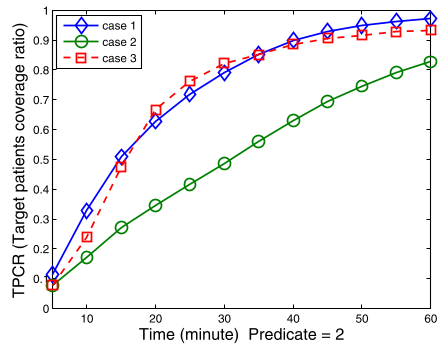 Fig 2: Comparison of Coverage Ratio (c) and Packet Copies (d) for Predicate P2. Note that EPF maintains high coverage while keeping traffic load low.
Critical Insight & Conclusion
EPF’s brilliance lies in its Attribute-Hiding property. Because the encryption itself is "predicate-based," an adversary eavesdropping on the network cannot tell what illness a relay node has, or even what illness the packet is looking for, unless they possess the corresponding keys.
Takeaway for Future Research:
The shift from "Random Walk" to "Social Clustered Walk" in MHSNs is essential. While EPF works brilliantly in a structured "beadhouse" (senior living) environment, the next frontier will be scaling these predicate-based social networks to wider, city-scale healthcare applications where storage constraints and heterogeneous device capabilities become the primary bottlenecks.
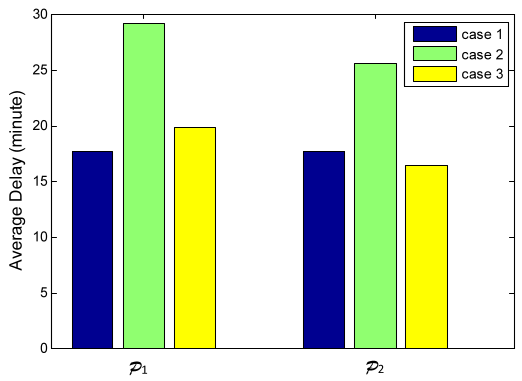 Fig 3: Average Packet Delay across cases, demonstrating the temporal benefit of event-aided forwarding.