
Decoding the Struggle: Automated Erasure Detection in Children's Essays
Erasure Detection and Recognition on Children's Manuscript Essays
This paper presents a machine learning framework for detecting and classifying "erasures" (manual corrections like scratching or overwriting) in children's handwritten essays. By combining traditional image descriptors like Edge Orientation Histograms (EH), Hierarchical Centroids (HC), and Zernike Moments (ZM), the authors achieve a State-of-the-Art (SOTA) accuracy of 98% using SVM and Deep Learning approaches.
TL;DR
Researchers have developed a highly accurate machine learning system (98% accuracy) to detect "erasures"—scratched-out or overwritten words—in children's handwritten essays. By treating these corrections as data rather than noise, the study provides a technological bridge to understanding the cognitive conflicts children face during the writing process.
Background & Motivation: Erasures as Cognitive "Conflicts"
In the field of pedagogy, an erasure is more than a mistake; it is a "place of conflict" where a child's spoken language negotiates with their literate output. Traditional Optical Character Recognition (OCR) focuses on cleaning text, but for educators, the act of erasing reveals where a student struggles.
The technical challenge lies in the heterogeneity of handwriting. Children use different stroke pressures, character sizes, and styles. A robust system must therefore be scale-invariant and capable of distinguishing intentional text from the chaotic, parallel-line patterns typical of a manual scratch-out.
Methodology: The Power of Feature Fusion
The authors didn't rely on a single "silver bullet" feature. Instead, they employed a multi-faceted extraction strategy to handle the variability of handwriting:
- Edge Orientation Histogram (EH): Using Sobel operators to detect the specific angles of strokes. Erasures often consist of dense, parallel lines that create unique directional signatures.
- Hierarchical Centroid (HC): This technique recursively divides the word image into sub-regions, calculating the "center of mass" for strokes at multiple levels of granularity.
- Zernike Moments (ZM): These are used to provide rotation invariance, ensuring that a slanted erasure is recognized just as easily as a horizontal one.
Model Architecture
The system processes scans through a morphological segmentation pipeline before feeding feature vectors into various classifiers.
 Figure 1: Hierarchical Centroid subdivisions (depth 2 vs. depth 7) used to localize stroke density in erasures.
Experiments & Results: Pushing to 98%
The authors benchmarked several classical Machine Learning algorithms (KNN, Naive Bayes, Logistic Regression) against Support Vector Machines (SVM) and Deep Learning (CNN).
- Baseline Performance: Individual descriptors like EH (using a Log of Gaussian filter) were surprisingly strong, hitting 95.5% accuracy.
- The Fusion Breakthrough: When all three features (EH + HC + ZM) were combined, the SVM with a Quadratic or Cubic kernel reached 98%.
- CNN Performance: A 6-layer CNN (including MaxPooling and Dropout) achieved 95% testing accuracy, proving that deep learning can autonomously learn these descriptors, though the feature-engineered SVM currently holds the edge on this specific dataset size.
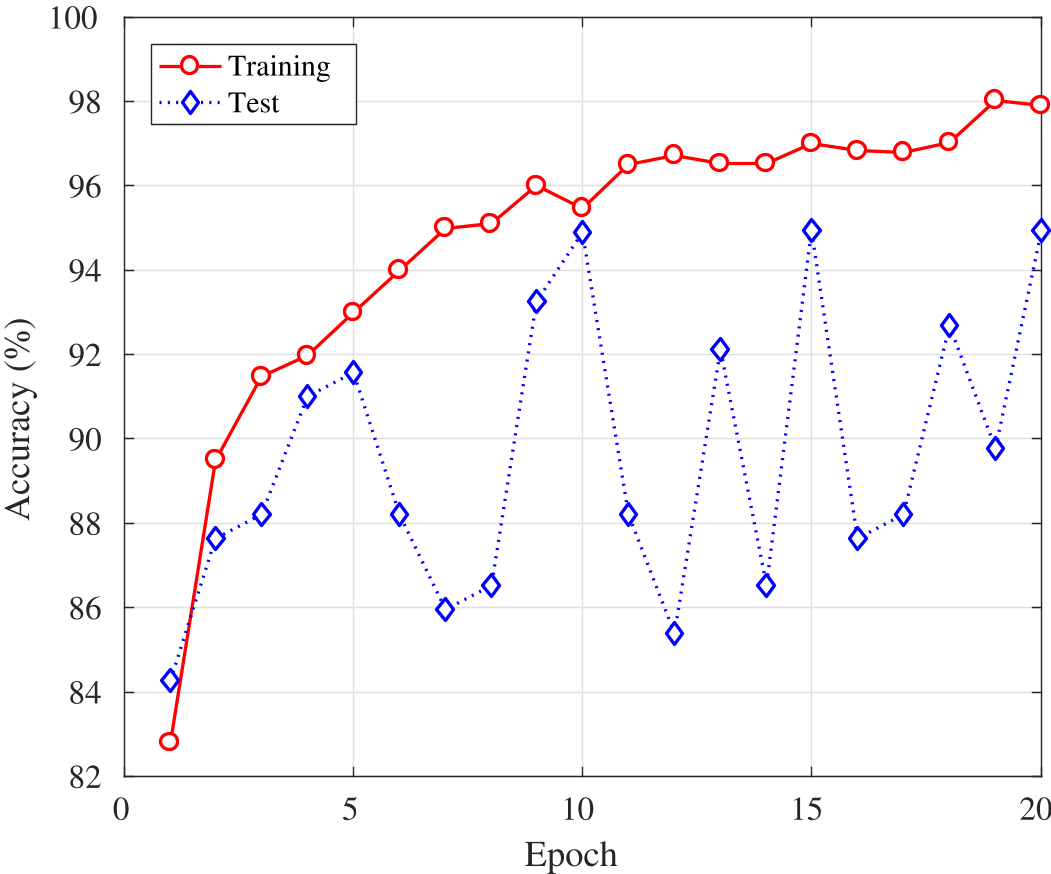 Figure 2: Training vs. Testing accuracy for the CNN approach, showing rapid convergence and high generalization.
Critical Insight: Beyond Accuracy
The significance of this work isn't just the 98% accuracy—it's the inductive bias of the features selected. By focusing on "stroke directions," the researchers successfully bypassed the need for massive datasets of every possible handwriting style.
Limitations & Future Work
While the system is highly effective at binary classification (Clean vs. Erasure), it does not yet "read through" the erasure to see what was originally written. The next logical step is using this detection as a pre-processing layer for diagnostic tools aimed at identifying early signs of dyslexia or dysgraphic disorders.
Conclusion
By mapping the "heterogeneity of writing," this research moves AI beyond simple transcription and into the realm of behavioral analysis. It proves that the "mistakes" we make on paper are just as informative as the final words we choose to leave behind.