
To Err is Human, to Innovate is Divine: How Social Error Correction Breeds Diversity
Error correction mechanisms in social networks can reduce accuracy and encourage innovation
This study investigates how human fallibility and error-correction mechanisms influence information diffusion in social networks. Using a randomized laboratory experiment (N=490), the authors demonstrate that standard English (low entropy) preserves meaning better than text-messaging pidgin (high entropy), and that while active error correction improves average accuracy, it paradoxically drives the diversification of messages into novel "mutant" forms.
TL;DR
In the game of "Telephone," we expect messages to degrade into gibberish. However, a landmark study by Matthew Brashears and Eric Gladstone reveals that when humans try to fix those mistakes, they don't just restore the original—they create entirely new, grammatically correct "mutants." This mechanism suggests that innovation is often the accidental child of failed imitation, and our social networks are active processors of information rather than passive conduits.
The "Perfect Relay" Fallacy
For decades, sociologists and network scientists modeled information diffusion as if humans were copper wires—perfectly conducting ideas from one node to the next. They focused on who talks to whom (the topology) but ignored what happens to the message when the receiver is tired, distracted, or just confused.
Brashears and Gladstone argue that humans are "noisy" nodes. We make mistakes, but crucially, we are self-aware entities that hate nonsense. When we receive a garbled message, we don't just pass the trash; we attempt to reconstruct the intended meaning. This study asks: does this "repair" work actually save the message, or does it lead us further away?
Methodology: Information Theory Meets the Lab
The researchers used Shannon’s Information Theory to frame their experiment. They look at "Entropy"—the measure of uncertainty/redundancy in a message.
- Low Entropy (Standard English): Highly redundant. Even with typos ("Th sme lgc..."), you can guess the meaning.
- High Entropy (Text Pidgin): "C u l8r." Minimalist and efficient, but if you lose one character, the message collapses.
They ran a multi-generational experiment (linear chains of 11 people) where participants had to read and retransmit sentences. They divided groups into "Correction" (paraphrase the meaning) and "No Correction" (retype exactly).
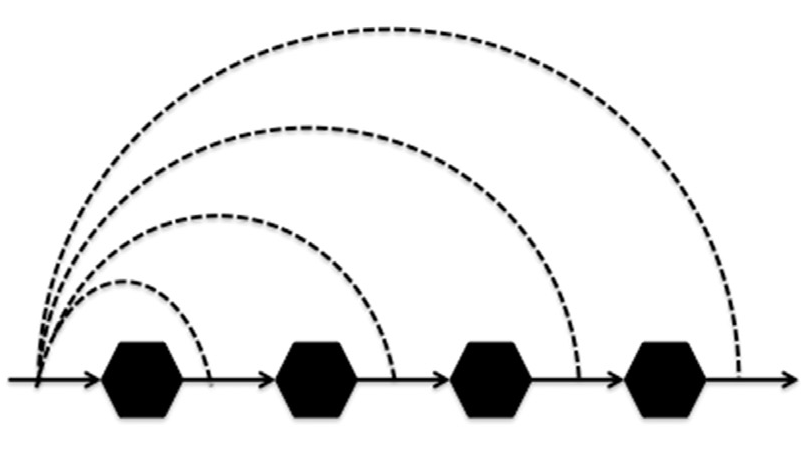 Figure 1: Comparison of Consecutive (parent-to-child) vs. Evolutionary (seed-to-child) fidelity.
The Paradox of Correction
The results yielded a fascinating dual discovery:
1. Entropy Matters
Standard English is 75% redundant for a reason. The study found that English lineages were much more robust than text-pidgin. As digital communication leans toward "higher entropy" (shorter, faster messages), our social contagions may actually become less stable and more prone to rapid, irreversible mutation.
2. Diversification vs. Corruption
This is the paper’s "Aha!" moment.
- Without Correction: Messages suffer from Corruption. They eventually turn into garbled text that no one believes.
- With Correction: Messages stay "legible," but they undergo Diversification. Because the human "correction" is just a best guess, they occasionally jump into a new semantic state.
For example, a sentence about "philanthropy and volunteering" might silently mutate into a sentence about "philosophers discussing differences." Both are valid sentences, but they are entirely different "mutants" competing for survival in the network.
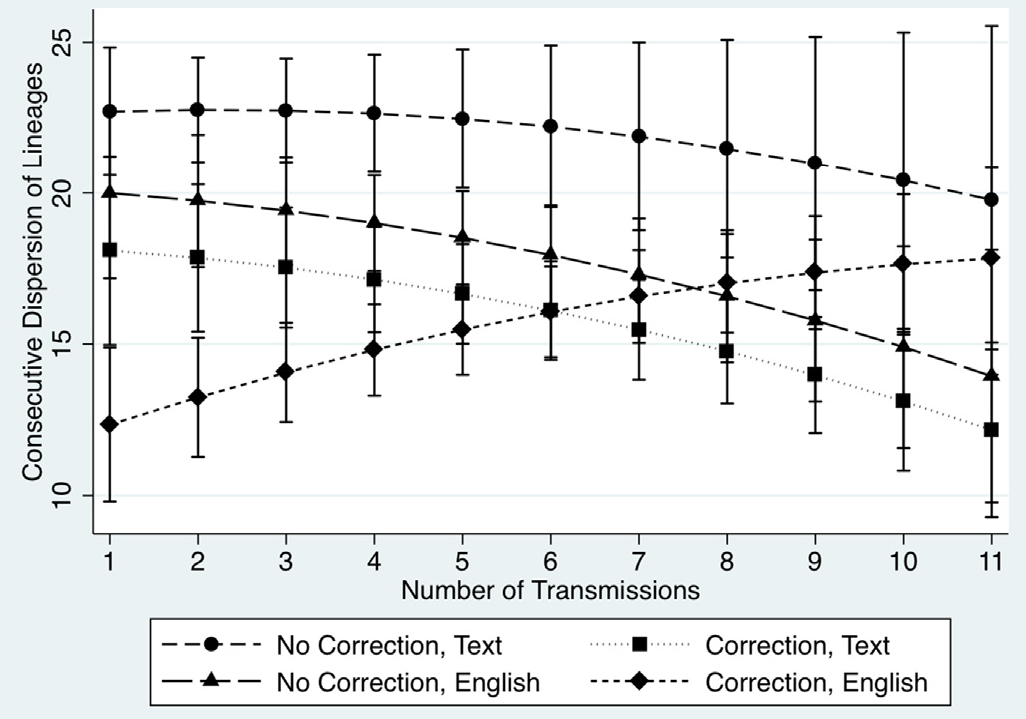 Figure 2: Marginal plots showing how Error Correction maintains higher fidelity in English but struggles with High-Entropy formats.
Deep Insight: Networks as Processors
The authors propose a shift in how we view social structures. If networks are just "pipes," the message shouldn't change. If they are "prisms," they might bias the view. But if they are "processors," the network itself is a machine that iterates, edits, and evolves the information as it flows.
This explains a long-standing sociological mystery: why does cultural diversity persist even in a globalized "small world"? If we all catch the same "contagion," shouldn't we eventually all believe the same thing? Brashears and Gladstone suggest that because we are constantly failing to imitate each other perfectly, we are inadvertently generating diversity through our very attempts to conform.
Critical Analysis & Future Outlook
While the study elegantly uses linear chains, real-world networks are web-like clusters. In a cluster, you might receive three different versions of the same rumor. Does that help you triangulate the truth, or does it just create a "hybrid mutant"?
Furthermore, in an age of AI, where LLMs act as nodes in our social networks, the "Error Correction" mechanism is now automated. AI is optimized for "grammatical validity" but often "hallucinates" semantic shifts—exactly the diversification mechanism described here. The study warns us that our move toward high-entropy digital formats may be making our shared cultural truths more fragile than we realize.
Conclusion
Innovation isn't always a stroke of genius; sometimes, it's just a well-meaning person trying to fix a typo and accidentally inventing a new idea. To understand how ideas spread, we must stop looking for the "perfect relay" and start studying the creative power of the human mistake.