
Decoding Digital Bonds: Why We Misjudge Friendships in a Single Tweet
Can We Estimate Others' Friendships with a Single Interaction Features on Twitter?
This paper investigates whether third-party observers can accurately estimate friendships between Twitter users based on a "single interaction" (a tweet and its reply). Using a dataset of Japanese tweets, the authors trained SVM models to distinguish between "familiar" and "unfamiliar" relationships, comparing human perceptions against actual interaction frequency.
TL;DR
Can you tell if two people are best friends or mere acquaintances just by looking at one "tweet and reply" exchange? This research reveals that while we think we can tell, we are usually wrong. By comparing human estimates with actual interaction data on Twitter, researchers found that we rely too heavily on surface-level cues like honorifics, which leads to a massive gap between perceived and actual social relationships.
Context & Positioning
In the hierarchy of social computing, this paper moves beyond simple sentiment analysis to Social Tie Estimation. While previous work has mastered facial expressions and vocal tones in physical spaces, this study positions itself in the more ambiguous realm of text-only SNS communication. It challenges the assumption that digital interactions mirror face-to-face social signaling.
The Problem: The "Textual Blind Spot"
In a physical room, non-verbal cues (mimicry, proximity, eye contact) allow us to gauge a relationship almost instantly. On Twitter, we are limited to text. The authors argue that this leads to frequent "misunderstandings"—where observers misidentify lovers as friends or friends as strangers because they lack the requisite social context.
Methodology: The Feature Engineering of Intimacy
The researchers meticulously categorized 50 features from a single "Tweet-Reply" pair to see what drives our judgment.
Feature Categories:
- Colloquial & Honorific expressions: Use of "Dash" (—), non-standard writing, and Japanese honorifics (e.g., -san, -kun).
- Reference Terms: Usage of "this," "it," or "that."
- Mechanical Features: Number of exclamation marks, question marks, and character counts.
- Semantics: Keywords related to food, organizations, or abstract objects.
- Timing: The latency between the original tweet and the reply.
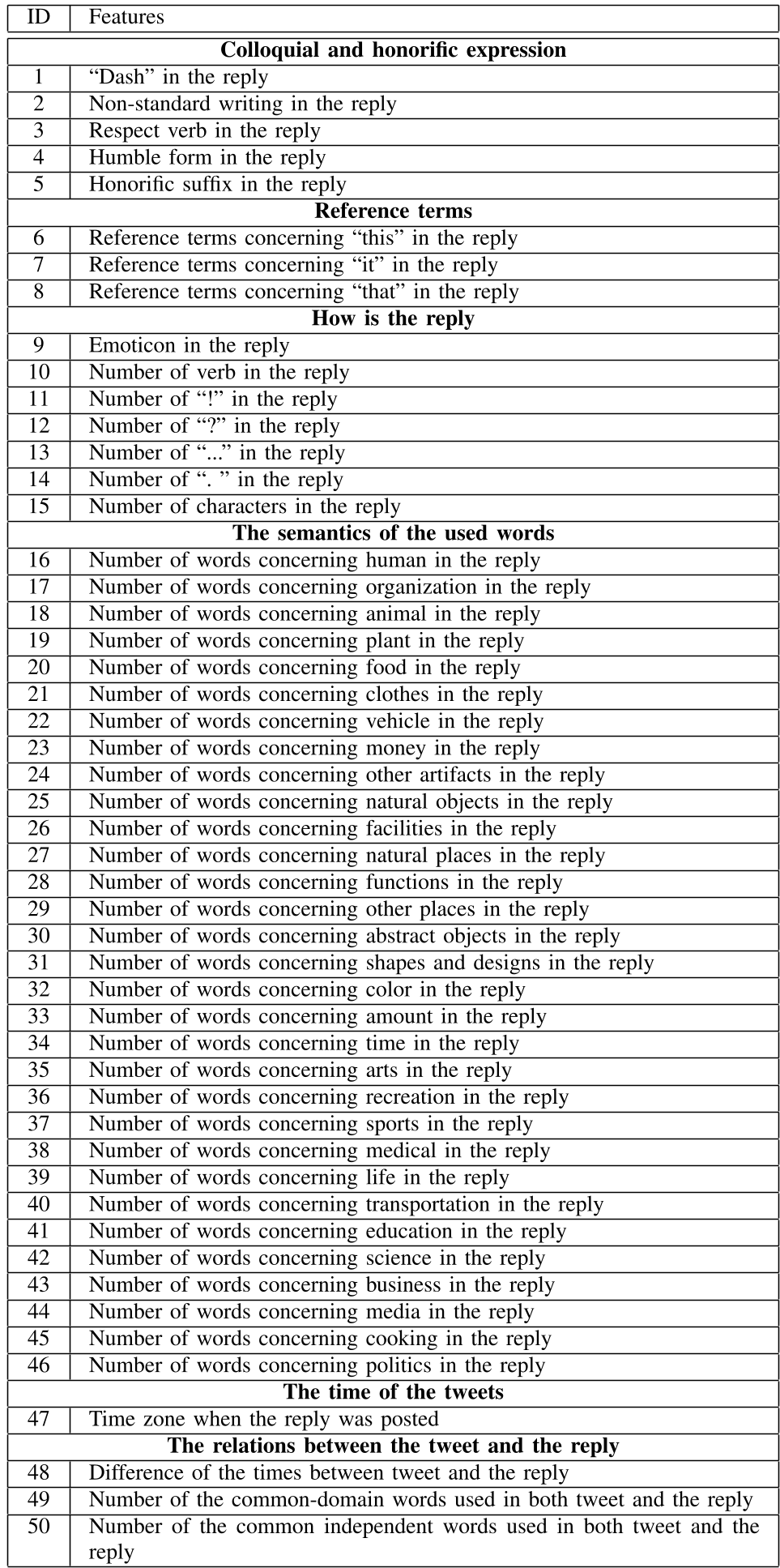
The authors used a Support Vector Machine (SVM) with an RBF kernel to classify these features into two categories: "Familiar" and "Unfamiliar."
Experiments and Results: Perception vs. Reality
The study produced a startling contrast.
1. Estimating "What People Think" (Estimated Friendship)
When the model was trained to mimic human observers, it was quite successful (67% accuracy). The standout feature was Feature ID 5 (Honorific Suffixes). If a reply contained an honorific, humans almost always labeled the relationship as "unfamiliar." In fact, using only this one feature, the model reached 82% accuracy in matching human judgment.
2. Estimating "What Is True" (Actual Friendship)
However, when the model tried to predict actual friendship (based on whether the users interacted frequently in real life), the accuracy plummeted to 49.5%—essentially a coin flip.

Deep Insight: The Honorific Trap
The core takeaway is that human intuition is "fooled" by politeness. In Japanese culture, honorifics specify hierarchical positions (boss/assistant or senior/junior), but these positions do not necessarily dictate the emotional depth or frequency of the friendship. Close friends might still use certain formal markers out of habit or public persona, while strangers might use casual "broken" language.
Critical Analysis & Future Directions
Limitations
- Single Interaction Constraint: The study intentionally limited itself to one interaction to mirror "first impressions." However, the results prove that social ties are temporal and require a longitudinal view.
- Cultural Specificity: The heavy reliance on honorifics is a nuance of the Japanese language. It remains to be seen if "politeness markers" in English (like "Please/Thank you" or the absence of profanity) create a similar bias.
Conclusion
The study concludes that Estimated Friendship and Actual Friendship are entirely different dimensions in the digital world. For researchers and developers building "Social Recommendation" or "Relationship Recognition" systems, the message is clear: do not trust a single interaction. To truly understand human bonds online, we must look at the "flow" of conversation over time rather than the "snapshot" of a single reply.
Takeaway for the Future
The next frontier in computational linguistics isn't just detecting what is being said (sentiment), but who is saying it to whom and how their history shapes the syntax. Future models must integrate "interaction accumulation" to bridge the gap between human perception and social reality.