
EBDI: Modeling the "Cool Down" – How AI Learns to Manage Human Emotions
Estimating emotion regulation capabilities
The paper presents a computational model for estimating and reasoning about human emotion regulation within ambient intelligence systems. By integrating BDI (Belief-Desire-Intention) reasoning with a dynamic emotion regulation framework, the system can predict a user's emotional state and provide adaptive support to maintain optimal performance.
TL;DR
Researchers have developed a computational bridge between rational reasoning (BDI) and emotional recovery (Emotion Regulation). The proposed EBDI model allows ambient systems to not only detect if you are angry but also predict how long you will stay that way and intervene before your performance collapses. In simulations, the model estimated user emotional traits with over 93% accuracy.
Background: Beyond Simple Emotion Recognition
Most "affective" AI is reactive: it sees a frown and assumes the user is sad. However, in high-stakes environments—like a naval command center or a surgical suite—knowing current emotion is insufficient. An intelligent environment needs to understand Emotion Regulation: the conscious and unconscious strategies humans use to return to a baseline state.
The core insight of this paper is that an ambient system must possess a Theory of Mind (ToM)—a mental model of the user's internal emotional "thermostat" and "recovery speed."
The Problem: The Irrational Gap
Current BDI (Belief-Desire-Intention) models are too rational. They assume humans act based on logical goals. But when Emotional Response Levels (ERL) cross a certain threshold, "rational reasoning is bypassed, and the person acts emotionally." Prior work lacked a mechanism to predict when this bypass happens and how quickly the user returns to a rational state.
Methodology: The EBDI Model
The authors integrate three distinct pillars:
- BDI Architecture: Handling the logical flow from observation to action.
- Difference Equations: Modeling the ERL as a value between [0, 2] that fluctuates based on events and a "Regulation Speed" ().
- Theory of Mind: Allowing the AI to represent the user's mental states nested within its own beliefs.
Architecture Overview
The system observes environmental events (e.g., a stressful task) and the user's facial/behavioral reactions. If the user's behavior deviates from what a "rational" model predicts, the system updates its estimation of the user's Baseline ERL and Regulation Speed.
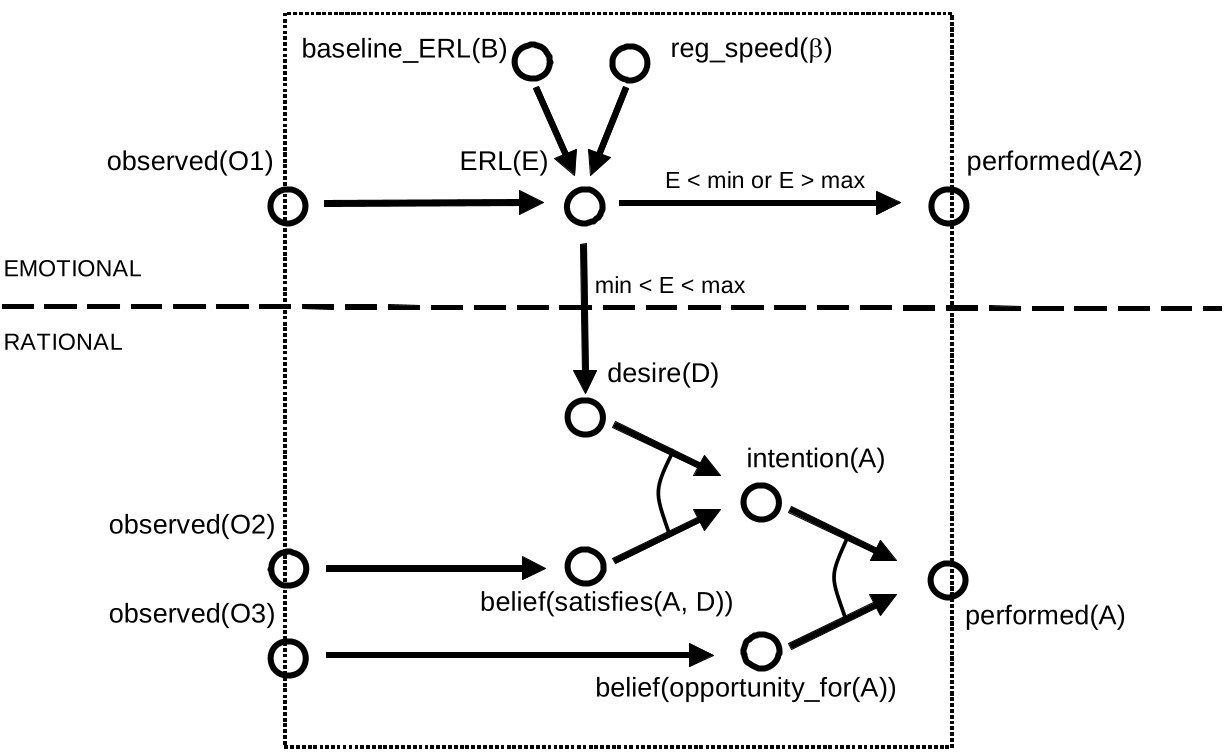 Figure 1: The EBDI architecture showing the interplay between emotional triggers and BDI-driven actions.
The Dynamic Recovery Formula
The heart of the regulation is captured in this logic:
ERL(X) ∧ baseline_ERL(Y) ∧ reg_speed(β) → ERL(X + (Y - X) * β)
This captures the "physical intuition" of emotion: your current state () constantly gravitates back toward your baseline () at a speed determined by your personality ().
Experiments & Results
The model was tested using LEADSTO, a modeling language that handles both qualitative logic and quantitative math. The simulation focused on "Anger."
Performance Highlights:
- Accuracy: The estimation of the "Baseline ERL" (how prone to anger a person is) reached a 93%+ accuracy rate (error < 7%) across diverse scenarios.
- Robustness: Even when initialized with incorrect assumptions, the system "learned" the user's profile within 5 to 10 events.
- Predictive Intervention: Because the system knows the user's (speed), it can predict when an upcoming task will push the user into a "high-error" emotional zone and proactively choose to "calm them down" or delay the task.
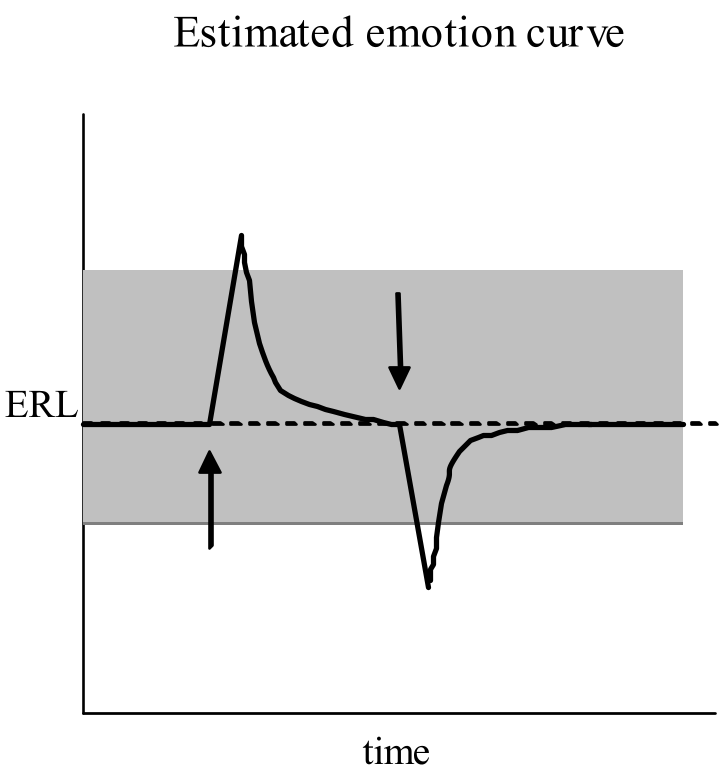 Figure 2: A comparison of the Actual vs. Estimated emotion curves. Note how the "Estimated" line (dotted) converges to the "Actual" line (solid) over time.
Critical Analysis & Takeaways
The EBDI model is a vital step toward Proactive Ambient Intelligence.
Strengths: It moves AI from being a "sensor" to a "reasoner." By understanding individual regulation speeds, the AI avoids "one-size-fits-all" interventions.
Limitations: The paper relies on simulated data. In the real world, "observing emotions" (via facial recognition or heart rate) is noisy. Furthermore, the model assumes a single regulation speed (), whereas real humans might regulate anger differently than they regulate grief.
Future Outlook: This framework provides the "logic" for future AI assistants. Imagine a coding IDE that knows you are frustrated and suggests a coffee break exactly because it "calculates" that you won't recover your focus for another 20 minutes.
Summary by Senior Academic Tech Editor