
How Smart Does Your Profile Image Look? Unveiling the Science of Intelligence Estimation
How smart does your profile image look? Estimating intelligence from social network profile images
The paper introduces a computational framework to estimate both Measured Intelligence (MI) and Perceived Intelligence (PI) from social network profile images. Using a dataset of 1,122 Facebook users, the authors demonstrate that machine learning models can equal human accuracy in intelligence estimation while identifying visual features that lead to biased human judgments.
TL;DR
Can an algorithm tell how smart you are just by looking at your Facebook profile picture? This research suggests that it can. By analyzing 1,122 users, researchers found that while humans and computers have similar accuracy in guessing IQ, humans are easily fooled by "stereotypes" like glasses and smiles. Computers, however, can see past the clutter to find subtle structural cues that correlate with real cognitive ability.
Context: Beyond the "Face" of Intelligence
For decades, psychologists have known that first impressions matter, particularly for employment and social standing. However, most research was confined to "Passport-style" headshots. This study shifts the paradigm to General Profile Images, which capture behavioral cues: your hobbies, your friends, and your aesthetic choices. Is a clear, minimalist background a sign of high IQ, or is it just a preference? This paper attempts to decode these visual signals.
The Core Conflict: Measured (MI) vs. Perceived (PI) Intelligence
The researchers highlight a fascinating gap between reality and perception:
- Measured Intelligence (MI): Your actual score on a standardized IQ test (Raven’s Matrices).
- Perceived Intelligence (PI): How smart others think you are based on your photo.
The "Holy Grail" of this study is finding the intersection—and the disconnect—between these two metrics.
Methodology: How the Machine "Sees" IQ
The framework uses a sophisticated multi-layered feature extraction process:
- Low-level features: Color diversity, HSV statistics, and "Dark Channel" (image clarity).
- Texture & Composition: Global structures (GIST) and local patterns (LBP) that define if an image is "noisy" or "organized."
- High-level semantic features: Detection of faces, bodies, glasses, and poses.
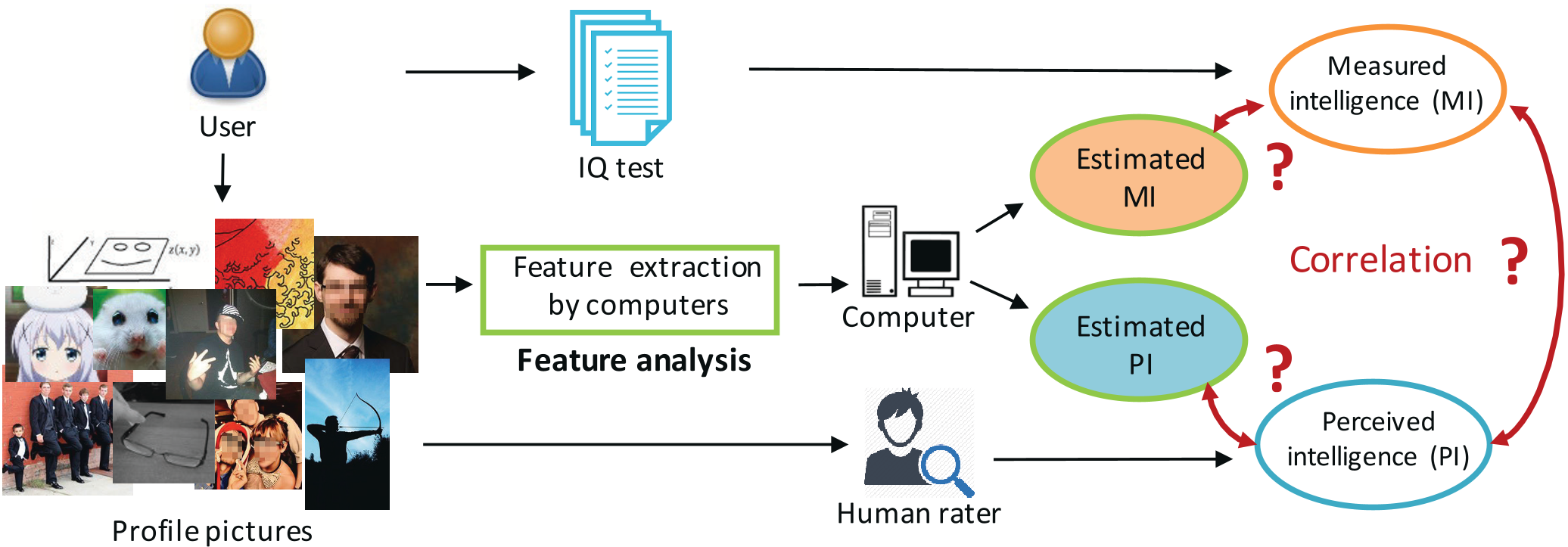
The researchers used Support Vector Regression (SVR) to find the mapping between these pixels and cognitive scores.
Key Findings: The Stereotype Trap
The most provocative part of the results is the Correlation Analysis.
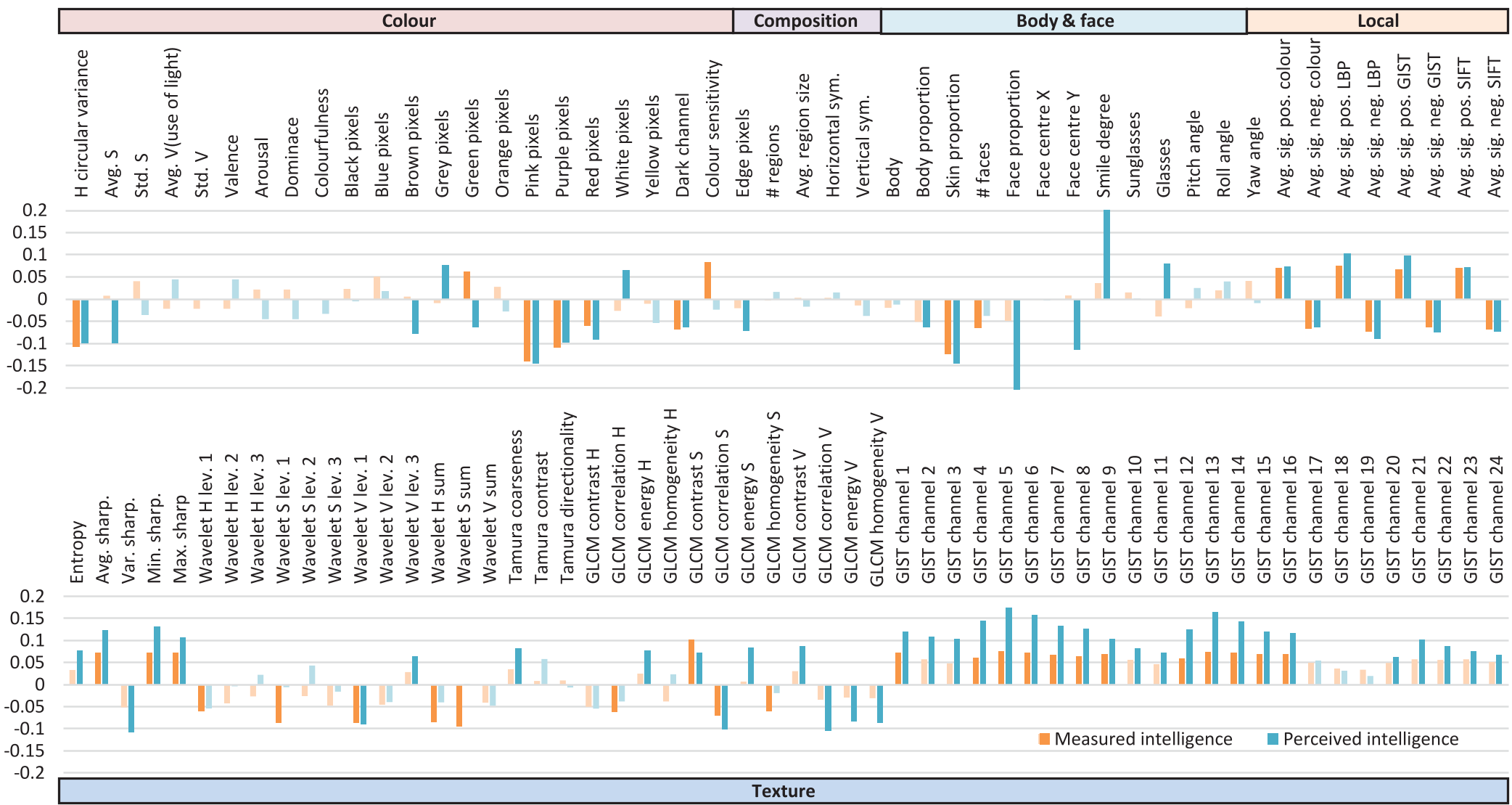
What actually correlates with high IQ (MI):
- Clarity: High sharpness and minimal "graininess."
- Simplicity: Not using too much red, pink, or purple/dark colors.
- Focus: Images with a single person rather than crowded group shots.
- Color Tone: A preference for green (likely reflecting nature/outdoor settings).
The "Goggles" of Deception (PI):
Human raters consistently rated people as smarter if they:
- Wore glasses (The most classic stereotype).
- Smiled (Perceived as social competence).
- Used White/Grey backgrounds (Perceived as "professional").
The Catch? None of these three features (glasses, smiling, white backgrounds) had a statistically significant correlation with actual Measured Intelligence. Humans are biased; the machine, if trained correctly, is not.
Comparative Performance
The study proved that algorithms (ρ = 0.27) could slightly outperform human intuition (ρ = 0.24) when it comes to guessing someone's real IQ. While neither score is high enough to replace a real test, it is high enough to prove that privacy is a concern. A "public" profile picture is not just a picture; it’s a data leak of your cognitive traits.
Critical Insight & Future Outlook
This work serves as a double-edged sword:
- For Users: It provides a "guidebook" for self-presentation. If you want to look intelligent for a LinkedIn recruiter, wear glasses and keep the background clean.
- For Privacy: It warns that companies could theoretically "pre-screen" candidates for intelligence without ever giving them an interview or a test.
As we move into the era of Generative AI, the question shifts from "How smart do you look?" to "How smart can an AI make you look?"
Takeaway: The most intelligent people seem to understand that a profile picture is most effective when it is focused, uncluttered, and professional—a visual reflection of an organized mind.