
What is he/she like?: Enhancing Twitter Attribute Estimation via Blog-Linkage and Social Neighbors
What is he/she like?: Estimating Twitter user attributes from contents and social neighbors
The paper proposes a novel framework for estimating Twitter user attributes (gender, age, occupation, and interests) by leveraging a "TwiBlo" dataset (users with linked blog accounts) for automatic labeling. It introduces a multi-level feature fusion method that combines a target user's content with the profile data of their social "neighbors" identified via mentions.
TL;DR
Understanding "who" a user is on Twitter remains a challenge due to privacy settings and the brevity of tweets. This paper introduces a scalable method to automatically label thousands of users by linking Twitter accounts to their blog profiles. By combining a user's own tweets with the structured profile information of their "mention" neighbors, the authors achieved significant accuracy boosts in predicting gender, age, occupation, and interests.
Background & Motivation: The Sparsity Trap
In the world of WOM (Word-of-Mouth) marketing, knowing your audience is everything. However, Twitter users rarely specify their demographics in their bios. Researchers face a "Sparsity Trap":
- Labeling Bottleneck: Manually labeling users is slow. Pattern matching (e.g., searching for "I am 25 years old") catches only a tiny, biased fraction of users.
- Information Poverty: The average user posts very few tweets, and each is limited to 140 characters (at the time of the study), providing very limited "Bag-of-Words" features.
The authors' insight was twofold: use cross-platform identity to solve the labeling problem and use the social graph (homophily) to solve the information poverty problem.
Methodology: TwiBlo and Neighbor Adjustment
The researchers proposed a systematic pipeline to build a robust classifier without the need for manual intervention.
1. Automatic Labeling via "TwiBlo"
Many Twitter users include a link to their personal blog in their URL field. Unlike Twitter's free-form bios, blog platforms often have structured fields for Gender, Age, and Occupation. By scraping these, the authors collected a massive, high-fidelity dataset of ~86,000 users.
2. Social Neighbor Feature Fusion
The study leverages the concept of Homophily—the idea that "birds of a feather flock together." If your friends are interested in "Gaming," you likely are too. However, the authors asked a critical question: How much of a neighbor's info should we use?
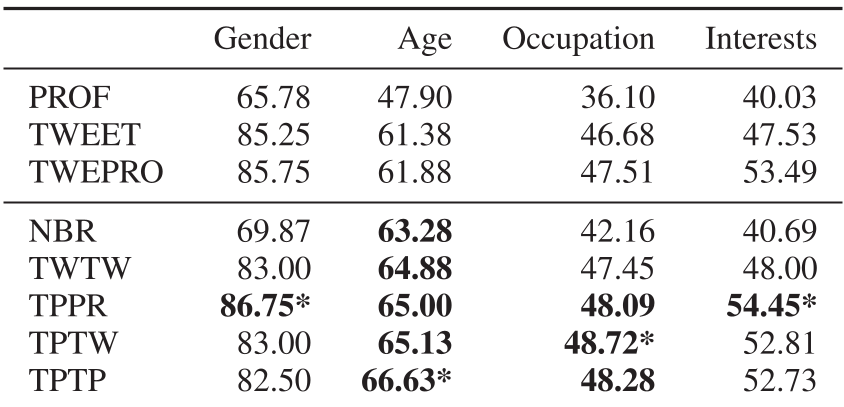
They tested combinations of:
- PR: Profile documents (Bio).
- TW: Tweets.
- TP: Both Profile and Tweets.

Experiments and Results
The authors compared their DIRECT (automatic) labeling against HUMAN (manual) and REGEXP (regex) methods. The results were clear: More data beats "cleaner" manual data. Because the automatic method could scale to 70k+ users, the resulting model was far more robust.
Key Finding: The "TPPR" Sweet Spot
One of the most interesting discovers in the paper is the comparison of neighbor information levels. They found that the TPPR configuration (Target User's Tweets/Profile + Neighbors' Profiles) yielded the best results.
- Why? Neighbors' tweets are often "noisy" and may not reflect their core attributes. However, a neighbor's Profile/Bio is a distilled summary of their identity, providing a strong, clean signal to supplement the target user's data.
Critical Insight & Conclusion
This work demonstrates that for social media tasks, breadth (dataset size) and context (social neighbors) are more valuable than the depth of individual user posts. By utilizing the structured nature of blogs to label the unstructured mess of Twitter, the authors created a "silver bullet" for data collection.
Takeaway for Today's Researchers: While modern LLMs have replaced simple Bag-of-Words models, the core strategy of using cross-platform linkages and filtering neighbor information remains a vital "Inductive Bias" for any social graph problem.
Limitations
- Temporal Decay: The data is from 2013; Twitter's population and blog usage have shifted dramatically.
- Bag-of-Words: The study relies on L2-regularized logistic regression. Modern embeddings or Graph Attention Networks (GATs) would likely capture these relationships even more effectively.