
Decoding Ethnicity: How Iris Texture Reveals Biological Heritage via Gabor Filters
Ethnicity Distinctiveness Through Iris Texture Features Using Gabor Filters
This paper presents an automated method for ethnic distinction between African Black and Caucasian subjects using iris texture analysis. By leveraging a bank of Gabor filters to extract global features, the authors achieve an ethnic Correct Classification Rate (CCR) of 93.33%.
TL;DR
While iris recognition is globally synonymous with identity verification, its potential for "soft biometrics" remains under-explored. Researchers Gugulethu Fulufhelo Nelwamondo et al. have developed a method using Gabor Filter Banks to distinguish between African Black and Caucasian ethnicities with 93.33% accuracy, proving that our ocular "fingerprints" carry deep genetic signatures beyond simple identification.
Motivation: Moving Beyond Identity
Current Iris Recognition Systems (IRS) like India's Aadhaar or UAE's border controls are binary: they either match you to a database or they don't. If you aren't enrolled, the system learns nothing about you.
The authors argue that iris textures contain "soft biometrics"—attributes like gender and ethnicity—that are currently entered manually. Automating this could:
- Accelerate Search: Drastically filter large databases by demographic categories.
- Imposter Detection: Flag individuals whose physical attributes don't match their enrolled digital profile.
- Anonymous Statistics: Collect demographic data without needing to store PII (Personally Identifiable Information).
Methodology: The Gabor Filter Bank
The core of this research rests on the Gabor Filter, a Gaussian kernel modulated by a sinusoidal plane wave. Its brilliance lies in its ability to mimic the human visual system’s perception of frequency and orientation.
1. Segmentation & Enhancement
Before extraction, the iris is localized using Bresenham’s circle algorithm and segmented via the Chan-Vese algorithm (an energy-minimization model). To make the texture "pop," the team applied Contrast Limited Adaptive Histogram Equalization (CLAHE).
2. Feature Extraction
The researchers designed an array of 15 filters:
- 3 Wavelengths (λ): 3, 5, and 7 pixels per cycle.
- 5 Orientations (θ): 0°, 30°, 60°, 90°, and 120°.
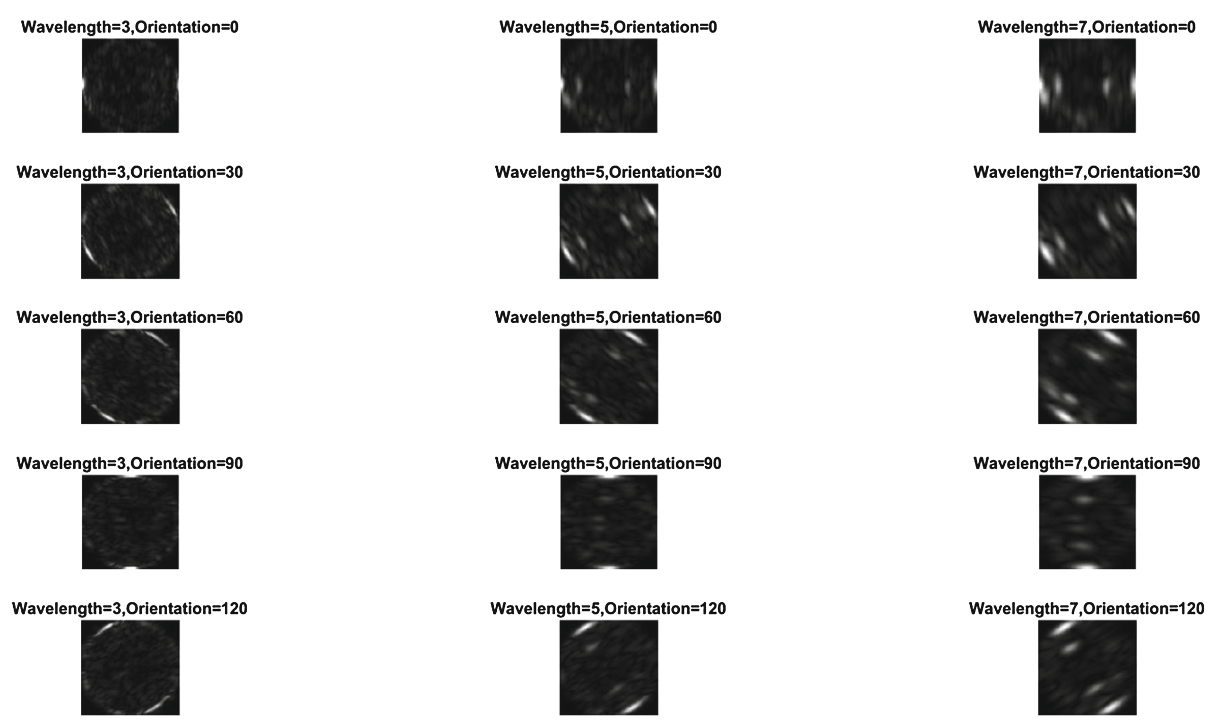 Figure: The convolution process where the raw iris image is filtered through multiple orientations to highlight specific directional textures.
The outputs generated Mean Amplitude (MA) and Local Energy (LE). Notably, they found that the "Mean Amplitude" at lower wavelengths was the "smoking gun" for ethnic distinction.
Experimental Results: The Genetic Signature
The study used a self-acquired database of 30 subjects (15 Black males, 15 Caucasian females).
Key Insights:
- The Z-Plane Split: A fascinating discovery was the spatial distribution of the feature vectors. Black subjects consistently fell on the negative side of the z-plane, while Caucasians occupied the positive side.
- Performance: Achieving a 93.33% CCR, the method outperformed previous benchmarks by Qui et al. (89.95%) and Lagree & Bowyer (90.58%).
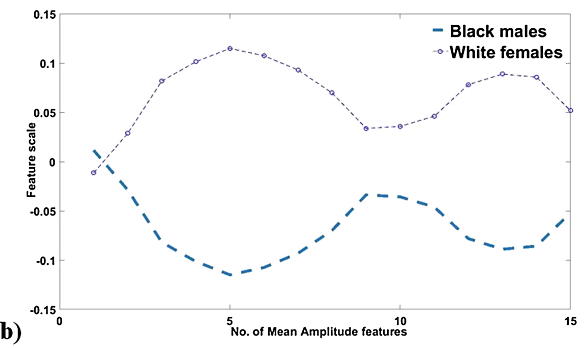 Figure: The clear separation of ethnic groups based on Mean Amplitude Gabor features.
| Authors | Technique | Accuracy (CCR) |
|---|---|---|
| Qui et al. | Iris Textons | 89.95% |
| Lagree & Bowyer | Law's Texture Filters | 90.58% |
| Proposed Method | Gabor Filters (MA/LE) | 93.33% |
Critical Analysis & Future Outlook
The study confirms that ethnic markers are encoded in the coarse-scale texture of the iris, rather than the minute local variations used for traditional "Iris Codes."
Limitations
- Dataset Diversity: The study compared Black males vs. Caucasian females. This introduces a "gender confounder"—is the system detecting ethnicity or gender-specific texture differences? Future work should disentangle these variables by using same-gender groups across ethnicities.
- Environmental Sensitivity: While Gabor filters are robust, near-infrared (NIR) illumination intensity can affect magnitude responses.
The Takeaway
This research highlights that the iris is not just a barcode for ID; it is a complex biological map. As we integrate these "soft biometrics" into existing IRS architectures, we move toward smarter, faster, and more context-aware security systems.
References
- Daugman, J. (2004). How iris recognition works.
- Qiu, X., et al. (2006). Global texture analysis of iris images.
- Chan, T., & Vese, L. (2001). Active contour models without edges.