
Dynamic Competition: Beyond Static Targeting in Social Networks
European journal of operational research
The paper introduces a two-player zero-sum stochastic game to model dynamic influence maximization and competition over social networks. It proves the existence of a "uniform value," indicating that patient players can guarantee a specific mean-average opinion regardless of the game's duration, and characterizes equilibrium strategies ranging from backward-looking (retaliatory) to forward-looking (centrality-based) approaches.
TL;DR
This research moves influence maximization from a "one-shot" optimization problem to a sophisticated dynamic stochastic game. It proves that in a competitive social network, there exists a stable "uniform value" that players can achieve. Key takeaway? The best strategy isn't always to target the most popular person—it's a delicate trade-off between spreading your own message (Forward-Looking) and sabotaging your opponent’s progress (Backward-Looking).
The "Right Time" vs. The "Right Person"
Most existing literature on social influence asks: Who is the best person to target? This is a static view. In reality, influence is a marathon. A political campaign or a brand war involves constant adjustments. The authors argue that the temporal dimension—when to target and how to react to an opponent's move—is just as vital as the network structure itself.
The core challenge lies in the dynamic trade-off:
- Backward-looking perspective: You aim to counteract the opponent's previous actions.
- Forward-looking perspective: You aim to maximize the future spread of your opinion.
Methodology: The Stochastic Opinion Game
The researchers model the network as a set of non-strategic agents who update their opinions based on a weighted average of their neighbors (the classic DeGroot model). Two strategic players (1 and -1) intervene by targeting specific nodes to shift their opinions.
The Formal Framework
The state of the game is the vector of opinions . The dynamics are governed by: Where represents the network's natural evolution, and represent the direct influence of the players.
Key Breakthrough: The Uniform Value
One of the most significant theoretical contributions is proving the existence of the Uniform Value. Using the concept of a primitive matrix (where every node eventually influences every other node), the authors show that as players become more "patient," they can guarantee a certain average opinion, regardless of the exact length of the competition.

Strategy Characterization: When to Attack or Defend
The paper categorizes equilibrium strategies based on network topology:
- Symmetric Networks (The Circle/Complete Graph): In these environments, players should adopt a backward-looking strategy. Since no node is inherently more powerful, the game becomes about "shadowing" your opponent. If they target node , you target its "predecessor" to nullify the spread.
- Hierarchical Networks (Star/Rooted Trees): Here, forward-looking strategies dominate. Players should focus on high-impact nodes (like the center of a star) independently of what the opponent does.
- Low Influence Regime: When the ability of players to move the needle is small, the game collapses into a static one based on Eigenvector Centrality. You target nodes that have the most long-term "reach."
Experiments: Dynamic vs. Static
The authors conducted simulations comparing their dynamic approach against the static strategies proposed in prior SOTA (like Grabisch et al., 2017).
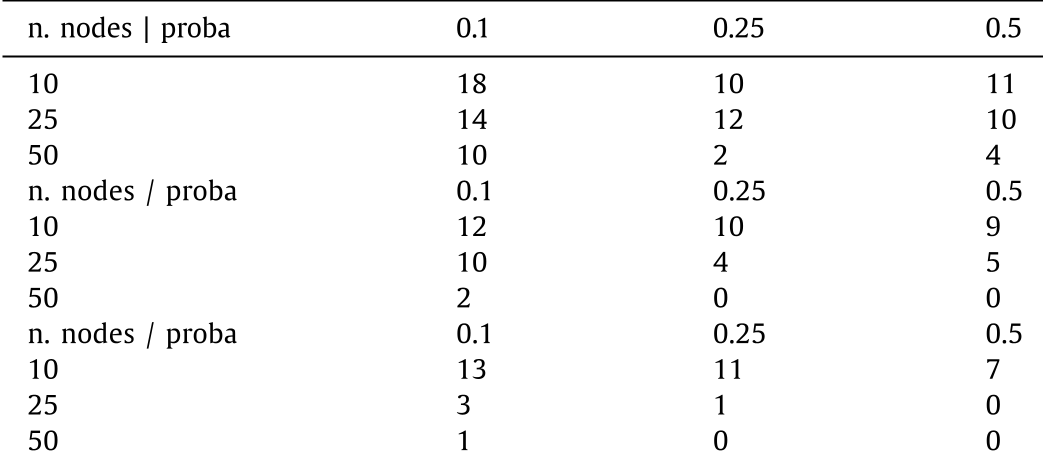
The results (shown in the table above) indicate that dynamic strategies provide a significant advantage (represented by positive payoffs for the dynamic player) particularly in smaller or sparser networks. However, as networks become extremely dense, the "best" nodes become so obvious that the gap between static and dynamic targeting narrows.
Critical Insight & Conclusion
This paper effectively shifts the academic coordinate system for influence maximization. By moving from Absolute Centrality to Intertemporal Impact, it provides a more robust framework for real-world scenarios like marketing wars and election cycles.
Limitations: The model assumes a zero-sum game and perfect/blind information extremes. Real-world influence is often non-zero-sum (both brands can gain market share at the expense of a third) and operates under "noisy" observations.
Future Work: The integration of computational complexity in finding these dynamic strategies is the next frontier. As shown by the genetic algorithm simulations, finding a "best response" in a massive network is a heavy lifting task that requires efficient heuristic development.