
From Particles to People: Modeling Trust and Cognitive Leadership in Emergency Evacuations
Evacuation Simulation Based on Cognitive Decision Making Model in a Socio-Technical System
This paper introduces a cognitive decision-making model for crowd evacuation within a Socio-Technical System (STS), integrating psychological and neurological theories into a Cellular Automata (CA) simulation. It demonstrates how a small percentage of "AmI-assisted" agents—individuals guided by intelligent technology—can emerge as social leaders, effectively steering the wider population toward optimal, under-utilized exits.
TL;DR
Researchers have moved beyond simple "boids" movement to create a Socio-Technical System (STS) simulation where agents possess cognitive states. By integrating theories of neurology and trust, the study shows that equipping just 1% to 10% of a crowd with intelligent guidance technology (Ambient Intelligence) can lead the entire group to safety, effectively turning assisted agents into "emergency leaders."
The Gap Between Socio and Technical
In the event of a fire at a crowded train station, most people instinctively run for the nearest exit, often leading to lethal "clogging" or "crushes." Traditional simulations often model humans as simple particles or robots. However, real human behavior is governed by Trust, Emotions (Fear/Hope), and Social Influence. Prior works failed to account for how a person’s internal cognitive state changes when they see others moving with purpose or when they receive conflicting information from a technical device.
Methodology: The "Brain" Inside the Agent
The core of this work is a Cognitive Agent Model that bridges the gap between biological intuition and computer science.
1. The Emotional Engine
Using the OCC (Ortony, Clore, and Collins) model and Damasio’s neurological principles, each agent calculates "Hope" and "Fear" for various exit options. These aren't just variables; they are dynamic states influenced by the agent's "body" and "perceptions."
2. Trust and Social Contagion
The model features a formal mathematical representation of Trust. If an agent (A) observes another agent (B) who seems knowledgeable or is equipped with AmI (Ambient Intelligence), agent A may update its belief about which exit is best. This is "information contagion."
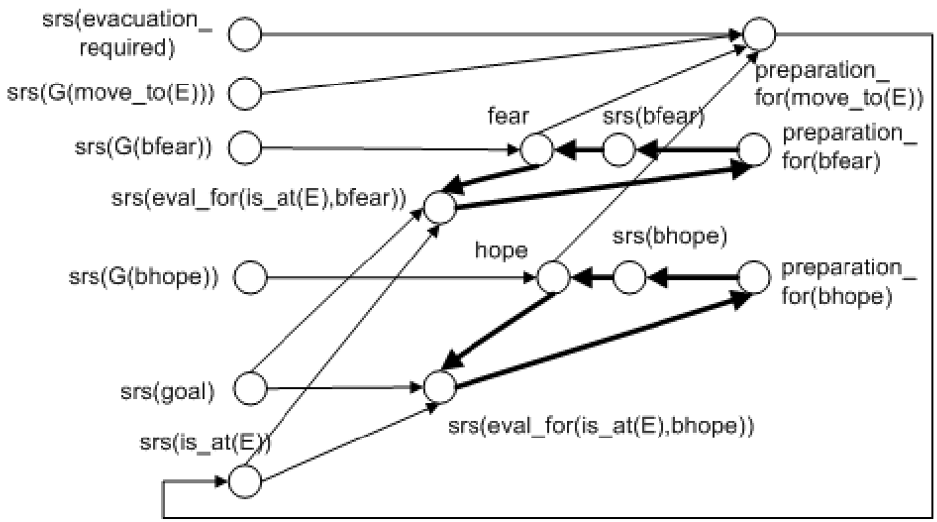 Above: The architecture showing how sensory representations (srs) and action preparations are filtered through emotional states like Hope and Fear.
3. The LifeBelt Experiment
To ground the model in reality, the authors conducted experiments with the LifeBelt, a wearable vibro-tactile device. They found that in high-stress environments, 88% of participants trusted the technology even when it told them to move in a direction that seemed counter-intuitive, providing empirical proof for high "Initial Trust" in expert-aligned technology.
Simulation: The Linz Railway Station
The team modeled the three-story Linz Railway Station using Cellular Automata (CA), where each cell represents a 0.5x0.5m space.
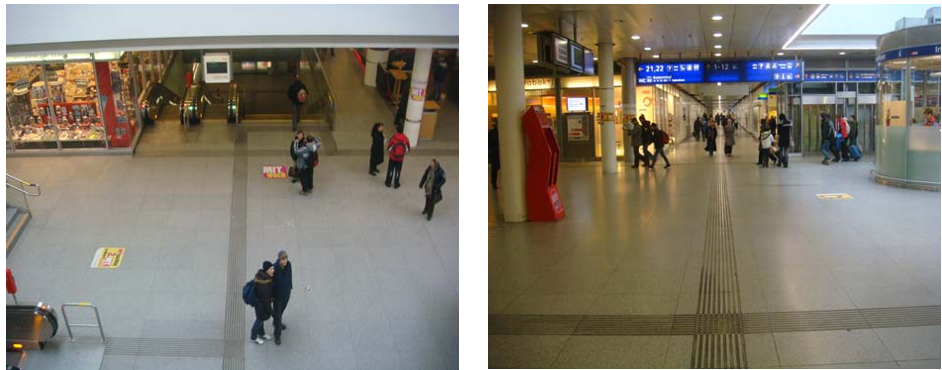 Figure: Incoming and outgoing commuter flow logic at the Linz station testbed.
Key Findings: The Power of Few
The simulation compared three scenarios: Nearest Exit (chaos), Optimal Exit (all-knowing), and Following (cognitive leadership).
- Sparse Populations (1,000 agents): Leadership has little effect because agents are too far apart for "contagion" to work.
- Dense Populations (3,500 agents): The results were transformative. When only 10% of the crowd was "AmI-assisted" (knowing the optimal path), the entire group reached a level of exit utilization nearly identical (within 2.5%) to a scenario where 100% were assisted.
- The "Leader" Effect: Assisted agents naturally emerge as leaders. As they move toward under-utilized exits, they "infect" surrounding agents with their confidence and belief, effectively balancing the load across all available exits.
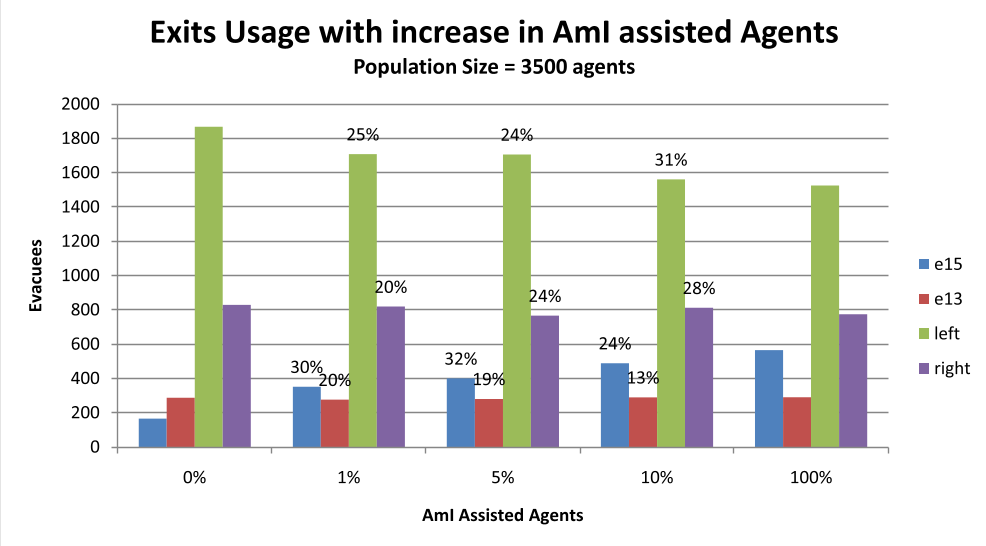 Above: Case study results showing how even a 1% or 5% deployment of assisted agents (red/blue markers) shifts the evacuation efficiency toward the optimum (100% benchmark).
Conclusion and Future Outlook
This research proves that inside a Socio-Technical System, the "Socio" (human influence) is just as important as the "Technical" (sensors/signs). By understanding the cognitive mechanics of trust and leadership, we can design smarter cities where a few well-informed individuals (like trained staff or commuters with apps) can save thousands simply by being "visible" and "trustworthy."
Future Work: The authors aim to introduce more heterogeneity—modeling different personality types (e.g., the elderly, the highly panicked) to further refine these lifelike simulations.