
Beyond Common Friends: Evaluating Social Connection Quality via Multi-Label Flow
Evaluating Connection Quality between Two Individuals in Social Networks
The paper introduces the Multi-label Independent Cascade (MIC) model and the Maximum Uni-color Flow (MUF) problem to evaluate connection quality in social networks. It proposes a heuristic based on Shortest Augmenting Path (SAP) and an optimal Linear Programming (LP) approach to maximize flow across paths where all nodes share common labels.
TL;DR
This research moves beyond simple link prediction by treating social connection quality as a Maximum Uni-color Flow (MUF) problem. By modeling individuals with multiple "personality labels" (colors), the authors provide a mathematical framework—incorporating both a fast heuristic and an optimal Linear Programming (LP) solution—to quantify how strongly two people are connected through shared interests and traits.
Background: The Limits of Topology
Most recommendation engines (like early Facebook) suggest friends based on "mutual friends." However, sociology suggests that deep, stable connections are actually forged through shared lifestyles, tastes, and moral standards.
The challenge is that these traits are multi-dimensional. A person isn't just a "Golfer"; they might be a "Golfer," "Engineer," and "Jazz Lover" simultaneously. Previous "Independent Cascade" (IC) models didn't account for this multi-label reality.
Methodology: The Multi-label Independent Cascade (MIC) Model
The authors propose that two individuals and have a stable connection for a specific topic (color) only if they both share that label.
1. Defining the MUF Problem
The goal is to find the maximum number of paths between source and sink where each path is "uni-color"—meaning every node on that specific path shares at least one common label.
2. The Algorithmic Divergence
- Shortest Augmenting Path (SAP): A greedy heuristic. It simplifies the graph for each color and finds the max flow. While fast, it is prone to local optima because choosing a path for Color A might "waste" a node that could have been used more efficiently by Color B and C simultaneously.
- Linear Programming (LP): An exact approach. By defining decision variables (flow of color on edge ), the model optimizes the global flow across all possible color intersections.

Why SAP Fails in Multi-label Contexts
A fascinating insight from the paper is the non-optimality of greedy approaches in colored graphs. In a single-label world, SAP is optimal. But when nodes have multiple labels, a "short" path for one color might block multiple "longer" paths for other colors that could have collectively contributed more to the total connection quality.
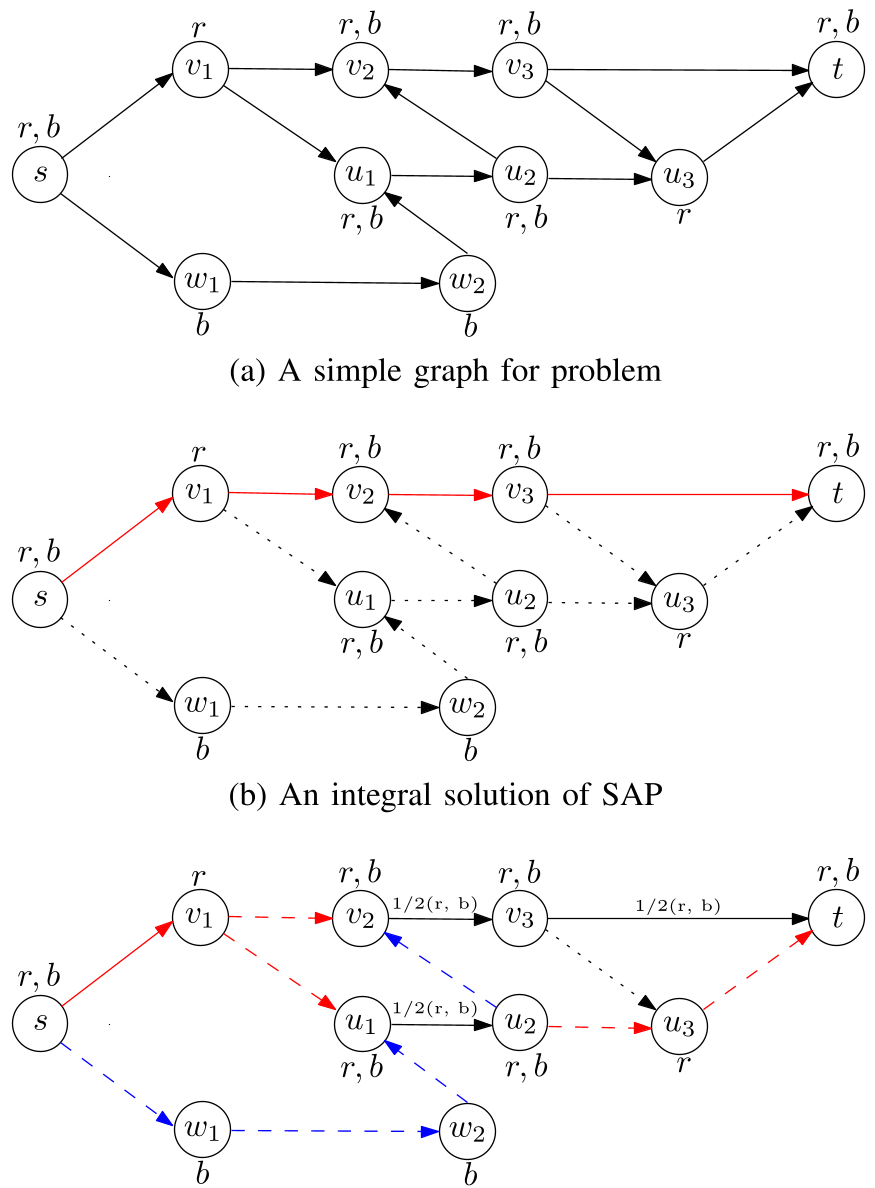 Fig 2: A case where SAP (greedy) finds 1 path, while the optimal solution is 2.
Experimental Insights
The researchers tested their algorithms on random graphs simulating 1000 individuals with 200,000 edges.
- Efficiency: SAP is remarkably efficient. As the number of "Same Color Nodes" (SCN) increases, SAP’s runtime remains nearly flat, while LP’s runtime grows exponentially.
- Effectiveness: In multi-label scenarios, the performance gap is stark. The LP-based algorithm consistently discovers higher connectivity values because it manages the "overlapping labels" bottleneck more effectively than the heuristic.
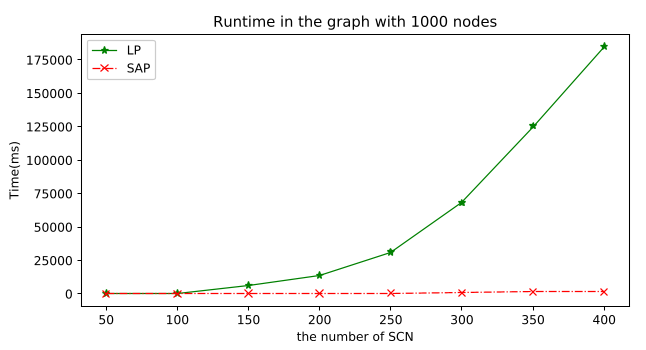 Fig 4b & 5b: Showing the performance gap between LP and SAP as the network density/complexity increases.
Critical Insight & Future Outlook
The core takeaway is that connection quality is a flow problem, not just a connectivity problem. By using uni-color paths, we ensure that the "influence" or "friendship" has a consistent semantic basis.
Limitations: The current model assumes a success rate of 1 for shared labels and 0 otherwise. Future work could integrate probabilistic weights within the multi-label framework to represent varying degrees of influence, or utilize Distributed Computing to solve the LP scale issues for massive networks like Twitter or WeChat.
Takeaway for Practitioners: When building recommendation systems, don't just look at who a user knows; look at the "color" of the paths between them. A single strong "uni-color" path might be worth more than ten mismatched connections.