
Beyond Digital Links: Evaluating Geo-Social Influence in LBSNs
Evaluating geo-social influence in location-based social networks
This paper introduces a unified geo-social influence metric to quantify user interaction in Location-Based Social Networks (LBSNs). It combines "Penalized Hitting Time" (PHT) for social proximity with a power-law distribution for geographical mobility, enabling the efficient discovery of influential users and events via the Global Iteration (GI) and Dynamic Neighborhood Expansion (DNE) algorithms.
TL;DR
Quantifying influence in Location-Based Social Networks (LBSNs) like Foursquare or Facebook Places requires more than just looking at a friend list. This paper introduces a dual-engine metric: Penalized Hitting Time (PHT) to measure social "closeness" through all possible network paths, and a Power-Law Mobility Model to account for physical distance. The result is a highly efficient framework capable of identifying influential users and events (Top-K) across millions of data points.
Problem & Motivation: The Gap Between "Sharing" and "Going"
Why do some social media posts go viral and drive foot traffic while others languish? Most prior influence models suffer from three fatal flaws:
- Geography Blindness: They ignore that a friend in Los Angeles is unlikely to visit a coffee shop you recommended in New York.
- Binary Links: They treat influence as a direct link (u -> v), ignoring the "wisdom of the paths" in a complex network.
- Popularity Bias: Standard hitting time algorithms over-reward "celebrity" nodes and long, irrelevant paths.
The authors' insight is simple: Influence is a product of reach (social) and feasibility (geography).
Methodology: Fusing Social Proximity with Physical Reality
1. Penalized Hitting Time (PHT)
Instead of standard random walks, PHT introduces an attenuation parameter . As the path length increases, the influence weight drops exponentially. This ensures that your close friends and "friends of friends" matter more than a stranger ten degrees away.
2. The Geographical Power Law
By analyzing real Gowalla check-in data, the authors found a clear linear relationship on a log-log scale between distance and the probability of a visit. They modeled this as: This allows the model to "penalize" social influence if the two users are geographically separated.
3. Efficiency: Dynamic Neighborhood Expansion (DNE)
Solving for PHT is mathematically expensive (). The authors propose DNE, which avoids global matrix calculations. It starts from a target user and expands a neighborhood "best-first," stopping once it has captured the most significant contributors to the influence score.
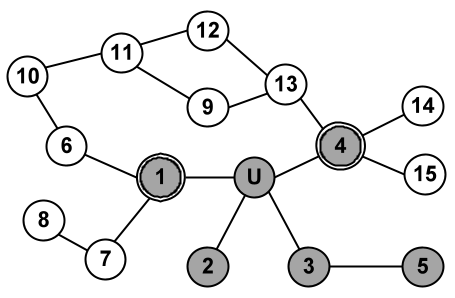 Figure: The DNE algorithm in action, prioritizing local neighborhood expansion to save computation.
Experiments and Insights
The researchers tested their approach on the Gowalla dataset (329k users, 2.9M events).
Key Findings:
- The "Library" Effect: Categories like libraries and theaters showed the highest geo-social influence. Users here are both socially connected (classmates/hobbyists) and geographically clustered.
- The "Airport" Paradox: While airports have high traffic, they have nearly zero geo-social influence. Visitors are strangers and are moving away from the location, not toward it.
- Gender and Apparel: Influential events in the "Apparel" category were dominated by women's brands (e.g., Zara), suggesting that female consumers are more likely to form socially-influenced "fan communities."
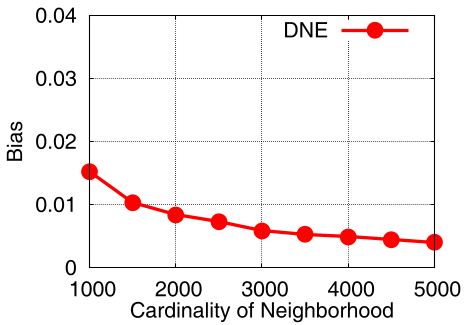 Figure: Performance of GI and DNE vs. Event size. DNE maintains low bias while staying computationally efficient.
Critical Analysis & Conclusion
This work represents a milestone in LBSN mining by moving from descriptive analysis to predictive quantification. The DNE algorithm is particularly impressive for its scalability, making real-time influence ranking possible on mobile hardware.
Limitations: The model currently treats geographical influence as a static power-law. Future work could improve this by considering "semantic distance"—for instance, two users in the same shopping mall are "closer" than two users separated by a highway, even if the Euclidean distance is the same.
Takeaway: For marketers and developers, the message is clear: To drive physical visits, target the "local clusters" of high social proximity, not just the users with the most followers.