
Beyond PageRank: Harvesting the Wisdom of Crowds for Web Retrieval
Evaluating Social Media Information Usage in Ranking the Web
This paper introduces a framework that integrates social media data—such as tags from Delicious and subreddits from Reddit—into the indexing and ranking processes of web search. By expanding document metadata with social information, the study achieves significant improvements in retrieval accuracy using Mean Average Precision (MAP) as the primary metric.
TL;DR
In the era of Web 2.0, user interactions—likes, tags, and shares—offer a goldmine of metadata. This paper explores a framework to integrate these "social signals" directly into the search engine's index. The verdict? Adding social tags from platforms like Delicious can boost retrieval precision by up to 50%, while raw popularity metrics from Facebook still struggle with noise and coverage issues.
The Motivation: Why Link Analysis is No Longer Enough
Traditional search engines like Google and Bing have historically mastered the art of "content matching" and "link authority." However, the static link structure of the web often misses the real-time, human-curated context provided by social media. The authors argue that the "wisdom of the crowd"—specifically how people categorize and share content—can bridge the gap between a user’s query and the relevance of a document.
The challenge lies in the heterogeneity of social data. How do you compare a "Like" on Facebook to a "Tag" on Delicious or a "Subreddit" on Reddit?
Methodology: The Social IR Framework
The researchers proposed a dual-track system consisting of an offline data processing pipeline and an online retrieval/re-ranking component.
1. Document Expansion (The "Secret Sauce")
Instead of just looking at the text on a page, the system expands the document’s representation by adding:
- User Tags: Scraped from social bookmarking sites.
- Contextual Categories: Sourcing subreddits to understand the "topic" of a URL.
2. Multi-Field Indexing
Using Lucene, the authors implemented a multi-field scoring system. They tested seven different query methods, ranging from basic text matching to "Boosted" versions where social tags were given higher mathematical weight during the initial retrieval phase.
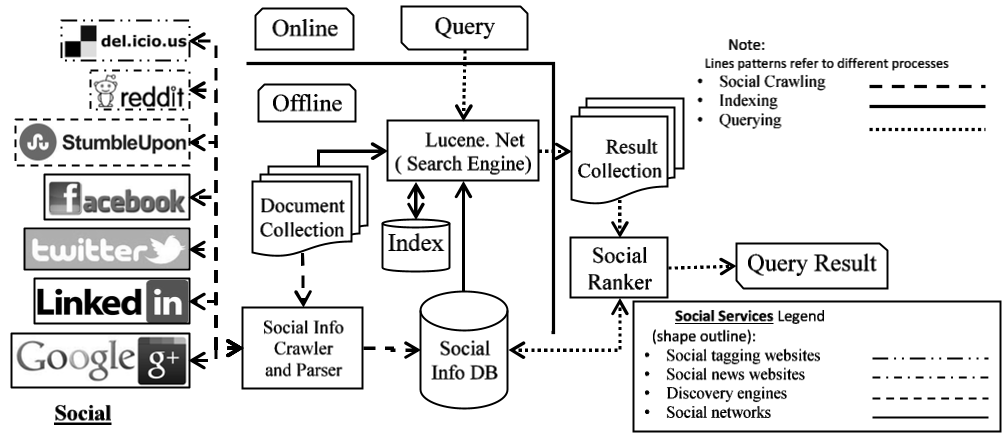 Fig 1: The architecture of the proposed system, showing the interaction between social crawlers and the search index.
3. Rank Aggregation
For the final results, the system employs Weighted Borda-Fuse (WBF) to merge the traditional textual score () with a calculated social score (): This allowed the researchers to fine-tune how much influence "social popularity" should have over "textual relevance."
Experimental Analysis: Successes and Setbacks
The study used a dataset of ~79,000 URLs from the Open Directory Project (ODP). The results provided a fascinating look at which social platforms actually help search.
- The Winner: Delicious. Social tagging proved to be remarkably effective. Because tags are descriptive, they act as high-quality metadata. MAP scores jumped from 6.711 (Text only) to 9.006 (Delicious Boosted) at the Top-10 level.
- The Loser: Raw Interaction Metrics. Surprisingly, re-ranking based on Facebook likes or Twitter shares often lowered the MAP.
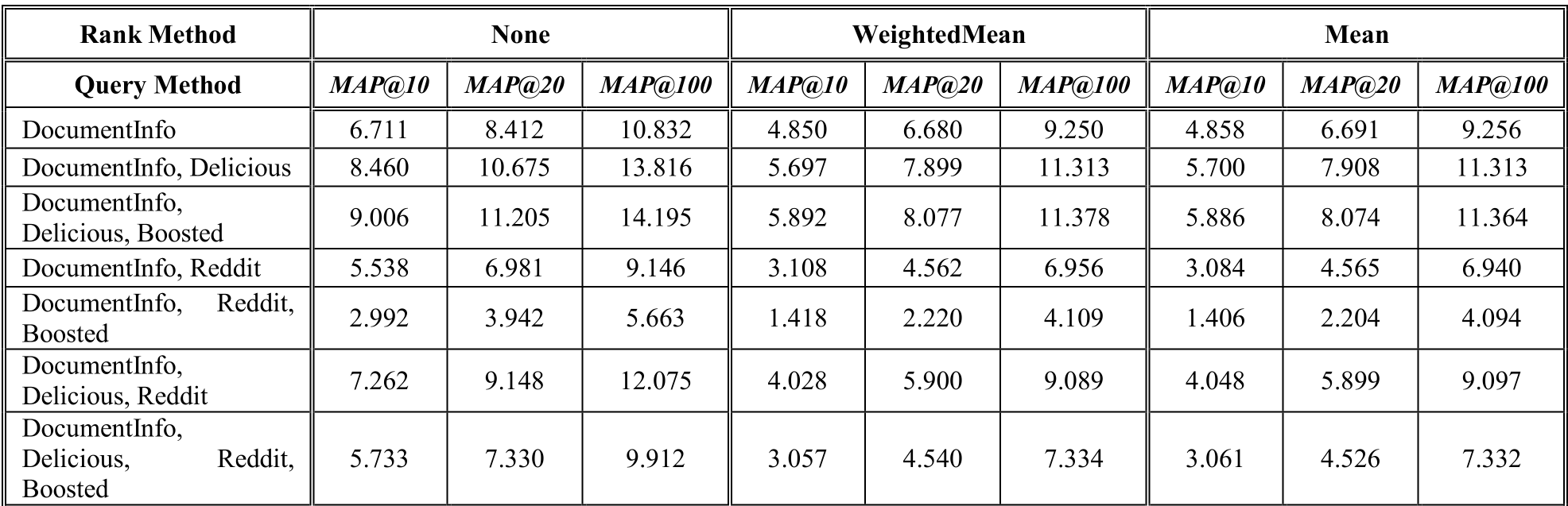 Table 1: Comparison of MAP results across different query and ranking methods.
Why did some social data fail?
- Low Coverage: While Facebook covered 80% of the dataset, Reddit only covered 4.8%, leading to sparse data issues.
- Intent Divergence: What people "Like" on Facebook (often viral or emotional content) might not align with what ODP auditors consider "relevant" for a factual search query.
Critical Insights & Future Outlook
The most striking takeaway is that Folksonomies (social tagging) are far more valuable for IR than Social Graphs (likes/shares). Tags provide semantic depth that helps solve the "vocabulary mismatch" problem in search.
Limitations: The study’s reliance on the ODP as a "Ground Truth" is a double-edged sword; ODP is human-curated and static, whereas social media is dynamic and chaotic.
Future Directions: The authors suggest that future systems should use Machine Learning or Neural Networks to automatically learn the weights of different social services () rather than assigning them manually. As we move toward AI-driven search, integrating these human-curated signals could be the key to moving beyond simple keyword matching.
Final Summary: This research proves that while the "wisdom of the crowd" exists in social media, search engines must be selective about which "crowd" they listen to. Tags are gold; Likes are noise.