
The Trust Factor: Evaluating Community Vulnerability to Fake News
Evaluating Vulnerability to Fake News in Social Networks: A Community Health Assessment Model
The paper introduces a "Community Health Assessment" model to evaluate social network vulnerability to fake news. It characterizes community internal structures (core, boundary, and neighbor nodes) and applies a "Believability" metric derived from Trustingness and Trustworthiness computational trust scores.
TL;DR
Researchers have developed a Community Health Assessment model that quantifies how likely a social group is to "catch" fake news from its neighbors. By analyzing the trust relationships of boundary nodes (users who bridge different groups), the model accurately predicts fake news susceptibility, revealing that false information relies far more on interpersonal trust to spread than factual news does.
Background & Motivation: Beyond Simple Cascades
While most fake news research monitors what is being said (content analysis) or how fast it spreads (topology), few look at the socio-structural health of the communities involved. In social networks, communities are modular: members within a group trust each other deeply. If a single "boundary node" (an individual connecting the group to the outside world) accepts a piece of fake news, the entire community is at risk due to this internal high-trust environment.
The authors' core insight is that fake news lacks mainstream institutional backing, so its spread is almost entirely dependent on whether the receiver trusts the sender. True news, conversely, can rely on external verification.
Methodology: The Anatomy of a Community
The model categorizes nodes based on their position relative to a community:
- Neighbor Nodes (): External actors connected to the community.
- Boundary Nodes (): Members who are the "gatekeepers," receiving information from the outside.
- Core Nodes (): Members only connected to other insiders.
The Vulnerability Metric
The probability of a boundary node believing an external neighbor is defined as Believability:
Summing this up, the vulnerability of a node is the likelihood it believes any of its neighbors. The Community Vulnerability is then calculated as the probability that at least one gatekeeper is compromised.
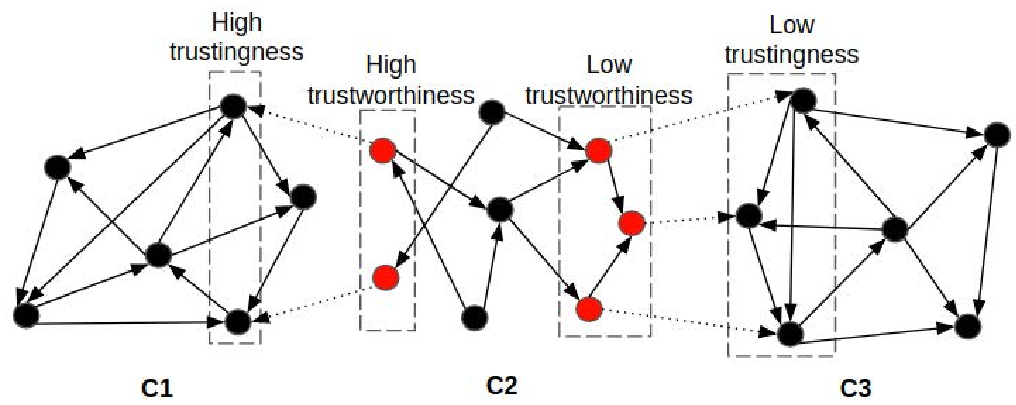 Fig 1: Illustrating that structural connectivity isn't enough; trust scores (Trustworthiness and Trustingness) determine if a community actually falls for the news.
Experimental Setup: Testing on Real-World Twitter Data
The authors tested their model on 12 Twitter datasets categorized by Snopes as False, Mixture, or True. They used three community detection algorithms: Louvain, Infomap, and Label Propagation.
 Table 1: The scale of the networks analyzed, ranging from 500k to 10M nodes.
Key Results: Trust is the Engine of Misinformation
The results were striking. The model's ability to identify real-world spreaders (ranked by Average Precision) was significantly higher in "False" news networks than in "True" news networks.
- False News: AP@1 scores reached as high as 0.999 for some networks.
- True News: AP@1 scores were much lower (avg. 0.459 - 0.740).
- Community Correlation: The model's vulnerability rankings matched the actual community infection rates in fake news networks, but often showed negative correlation in true news networks.
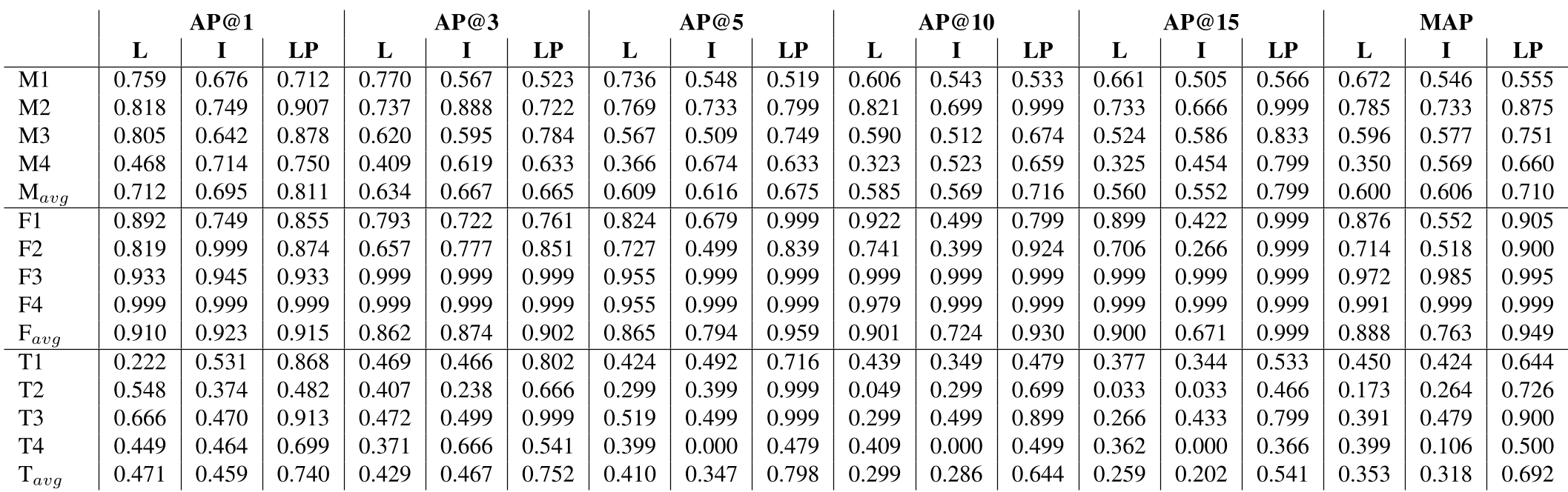 Table 2: Comparison of AP and MAP scores showing superior performance on False (F) vs. True (T) news.
Critical Analysis & Conclusion
The "Community Health Assessment" model proves that vulnerability is not just about who you know, but how much you trust them.
Takeaway: Policies for "decontaminating" social networks should move away from broad censorship and towards identifying high-vulnerability boundary nodes. Protecting these "gatekeepers" could effectively quarantine an entire community from viral misinformation.
Limitations: The model currently ignores the content of the news itself and focuses purely on the trust metadata. Future work could benefit from a hybrid approach combining content sentiment with these structural trust metrics.