
Autonomous WiFi Positioning: Breaking the Scalability Barrier via Crowdsourcing
Evaluation of Two WiFi Positioning Systems Based on Autonomous Crowdsourcing of Handheld Devices for Indoor Navigation
This paper introduces two autonomous crowdsourcing WiFi Positioning Systems (WPS)—fingerprinting and trilateration—that utilize handheld devices and a Trusted Portable Navigator (T-PN) for labor-free indoor localization. By leveraging T-PN's advanced inertial sensor fusion, the systems achieve State-of-the-Art (SOTA) performance without requiring floor plans or GPS.
TL;DR
Indoor positioning has long been plagued by the "Cold Start" problem—the need for intensive manual surveys to build WiFi databases. This paper presents two systems (Fingerprinting and Trilateration) that transform smartphones into autonomous surveyors. By using advanced inertial navigation (T-PN) to auto-label WiFi signals, the authors achieve sub-6-meter accuracy without ever needing a floor plan or GPS.
Background & Positioning
Reliable indoor navigation is the "Holy Grail" of location-based services. While GPS fails behind concrete walls, WiFi is ubiquitous. However, traditional WiFi Positioning Systems (WPS) are rigid: they require a "Radio Map" or precise Access Point (AP) coordinates. This paper sits at the intersection of Crowdsourcing and Sensor Fusion, moving away from manual labor toward a self-healing, adaptive positioning infrastructure.
The Core Challenge: The High Cost of Knowing "Where"
Existing crowdsourcing solutions usually have a "catch." Some need a floor plan to define walkable paths (like the Zee system), while others need occasional GPS signals to anchor the inertial sensors. The authors identify these as significant barriers to mass adoption. Their insight? Use a high-end inertial solution (T-PN) as a "pseudo-ground truth" to link WiFi Signal Strength (RSS) to spatial coordinates automatically.
Methodology: Two Paths to Localization
The authors propose a dual-scheme architecture where a background service silently collects data as the user walks.
1. Fingerprinting Scheme
This method matches current RSS scans against a database of signal "signatures" (fingerprints).
- The Innovation: A 3-meter grid spacing is used to discretize the space. The system solves the "RSS Ambiguity" problem (where identical locations report wildly different signals) by averaging multi-epoch samples.
2. Trilateration Scheme
This method estimates the distance to APs using a propagation model.
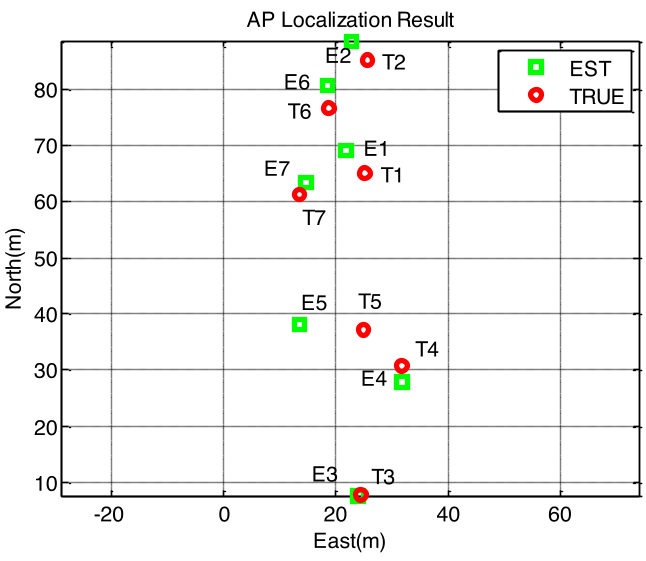
- The Core Algorithm: A Nonlinear Iterative Least Squares (LSQ) approach. The system doesn't just guess the user's position; it simultaneously estimates the AP’s location () and the environment’s Path Loss Exponent ().
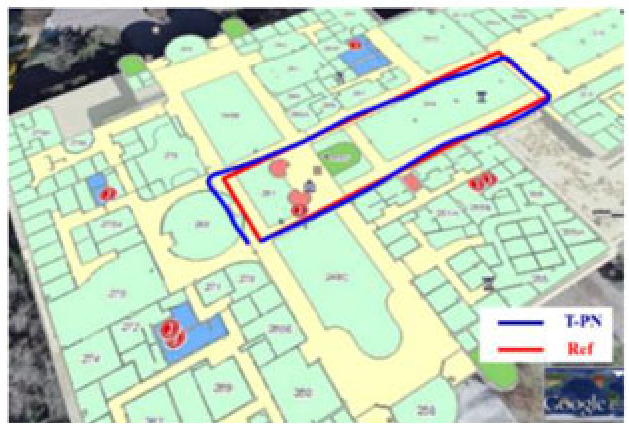
- Visual Logic: The system architecture below highlights how T-PN acts as the foundation for both schemes.
Experimental Battle: Fingerprinting vs. Trilateration
The authors tested the systems in three different buildings. The results provide a fascinating look at the trade-offs in modern localization.
- Accuracy: Fingerprinting won. In "Building E," it achieved 3.45 m error vs. 5.21 m for trilateration.
- Efficiency: Trilateration is the "lean" winner. It required only 22.95 minutes of data to build a functional database, whereas fingerprinting needed nearly 85 minutes.
- Data Footprint: The trilateration database is remarkably tiny (~10 KB), making it ideal for low-bandwidth or memory-constrained IoT devices.
Deep Insights & Analysis
The "Secret Sauce" of this work isn't just the crowdsourcing—it's the Measurement Optimization. WiFi RSSI is notoriously noisy (multipath, fading, human body interference). By introducing a "Response Rate" threshold (-85 dBm) and a 3-point averaging filter, the authors filtered out the "signal junk" that typically degrades autonomous systems.
However, there is an inherent Inductive Bias: the system assumes that the T-PN (Inertial) solution is "good enough" to act as a reference. While T-PN is advanced, it still drifts. The paper smartly suggests a reciprocal relationship: once the WiFi database is mature, it can be used to correct the inertial drift, creating a closed-loop self-correcting system.
Limitations & Future Outlook
While the system avoids floor plans, it still operates predominantly in 2D (horizontal). Multi-floor "vertical" transitions via elevators or stairs remain a complex challenge for autonomous AP localization due to floor attenuation.
Takeaway for the Industry: For rapid deployment in new venues, Trilateration-based crowdsourcing is the best ROI. For high-precision, long-term installations where memory is cheap, Fingerprinting remains the gold standard.
Final Assessment: A robust, practical framework that effectively bridges the gap between high-precision academic PDR and real-world, messy WiFi environments.