
Beyond Static Planning: Balancing Robustness and Utility in Social Event Networks
Event-Participant and Incremental Planning over Event-Based Social Networks
This paper introduces the Global Event Planning with Constraints (GEPC) problem and its incremental variant (IEP) for Event-Based Social Networks (EBSNs). It proposes a two-step approximation framework and a suite of incremental algorithms that handle complex constraints like event participation lower/upper bounds, time conflicts, and user travel budgets while minimizing negative impact during plan updates.
TL;DR
Social event platforms like Meetup are more than just recommendation engines; they are complex logistics coordinators. This paper addresses two major flaws in current Event-Based Social Network (EBSN) systems: the failure to account for minimum participant requirements (participation lower bounds) and the inability to handle real-time changes efficiently. The authors propose GEPC and IEP frameworks that ensure events actually happen while providing a way to update plans incrementally without annoying users.
Background: The Hidden Complexity of EBSNs
In an EBSN, a "plan" isn't just a list of events; it's a massive matching problem involving thousands of users with varying travel budgets, specific time windows, and diverse interests. Most current systems treat this as a static optimization. If the venue changes or a user gets a last-minute work assignment, traditional algorithms would throw away the old plan and start from scratch—a process that is both slow and frustrating for users whose schedules were already "settled."
The Core Challenge: Hard Constraints and Dynamic Shifts
The researchers identify two critical requirements that previous SOTA works missed:
- Lower Bound Constraints: A football game needs 22 players; a seminar needs enough paying guests to cover the venue fee. If a plan assigns 5 people to a 20-person minimum event, that event fails, and those 5 users' utilities drop to zero.
- Incremental Resilience: In the real world, "life happens." Budgets shrink, events get rescheduled, and interests shift. A planning system must adapt locally rather than re-optimizing globally.
Methodology: Two-Step Optimization & Atomic Repairs
1. Solving the GEPC (Global Event Planning with Constraints)
To solve the NP-hard GEPC problem, the authors use a clever two-step strategy:
- Phase A (The Floor): Solve a restricted version where each event's upper bound is capped at its lower bound. This ensures every selected event is "viable."
- Phase B (The Ceiling): Use existing greedy methods to fill the remaining slots up to the actual capacity (upper bounds).
The paper contrasts a GAP-based algorithm (high precision, high cost) with a Greedy-based algorithm (high speed, slightly lower precision).
Figure 1: Conceptual overview of the GEPC planning process involving users, travel costs, and event constraints.
2. The IEP (Incremental Event Planning) Framework
Instead of re-running the heavy GEPC algorithm, the authors break down every possible change into four Atomic Operations:
- Capacity Decrease: Removing users with the lowest interest in an event if the cap drops.
- Lower Bound Increase: "Borrowing" users from events that have surplus participants to save an event that is now under-attended.
- Time/Location Shifts: Local conflict resolution.
- Budget Shrinkage: Iteratively removing the farthest (most expensive) events from a user's plan.
Experimental Insights: Performance that Scales
Using real-world data from Meetup across cities like Beijing and Vancouver, the results were definitive:
- Scalability: While the GAP-based algorithm crashed on large datasets (50k+ users) due to memory limits, the Greedy-based algorithm remained efficient.
- Incremental Efficiency: The IEP algorithms updated plans in a fraction of the time required for a full re-run (Re-Greedy), typically taking milliseconds to seconds.
- Minimal Disruption: The IEP approach minimized "negative impact," meaning fewer users had their existing plans changed unnecessarily compared to a full re-optimization.
 Table 1: Comparing GAP and Greedy approaches. Note the massive disparity in time and memory costs.
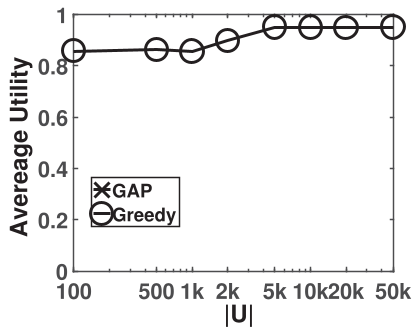 Figure 2: Total utility growth relative to user count, demonstrating the stability of the proposed algorithms.
Critical Analysis & Conclusion
The significance of this work lies in its holistic view of EBSN constraints. By integrating travel budgets with participation lower bounds, it bridges the gap between theoretical optimization and practical platform needs.
Limitations: The model uses Euclidean distance for travel costs, which might not reflect actual city transit times. Furthermore, it assumes user interests (utility scores) are pre-calculated and static, though these often fluctuate based on social context (e.g., "I'll go if my friend goes").
Future Outlook: Integrating Social Relationships (Influence) into the planning algorithm is the next logical step. If the system knows you're more likely to attend an event if a specific peer is scheduled, the planning utility could be significantly enhanced.