
The Physics of Finance: Why Your Income Likely Follows an Exponential Law
Evidence for the exponential distribution of income in the USA
This seminal paper in Econophysics demonstrates that individual income distribution in the USA follows an exponential Boltzmann-Gibbs function. By analyzing tax and census data, the authors derive a parameter-free Lorenz curve and a Gini coefficient of 0.5, achieving a close fit with empirical data from 1947–1997.
TL;DR
Researchers Drăgulescu and Yakovenko apply the laws of statistical mechanics to the U.S. economy, proving that individual income is distributed exponentially—much like the energy of molecules in a gas. While "The 1%" follows Pareto's famous power law, the other 99% are governed by the Boltzmann-Gibbs distribution, leading to a natural Gini coefficient of 0.5.
Background: Beyond the Pareto Myth
For over a century, economists have obsessed over Pareto’s Law, which suggests income follows a power law (). However, this only describes the ultra-wealthy. For the average citizen, Pareto's Law is remarkably inaccurate. Earlier attempts to fix this, like Gibrat’s log-normal distribution, failed because they were mathematically unstable over time. This paper pivots to a physical intuition: in a system where "something" is conserved, the most likely distribution of that "something" is exponential.
The Core Insight: Income as "Social Energy"
The authors argue that if we view the economy as a closed system of interacting agents, money (or income) behaves like energy in a gas. Just as most molecules have low energy and a few have high energy, most individuals have low-to-moderate income.
The Individual Distribution
By analyzing SIPP (Census) and PSID data, the authors show that the probability density of an individual's income is: where is the average income.
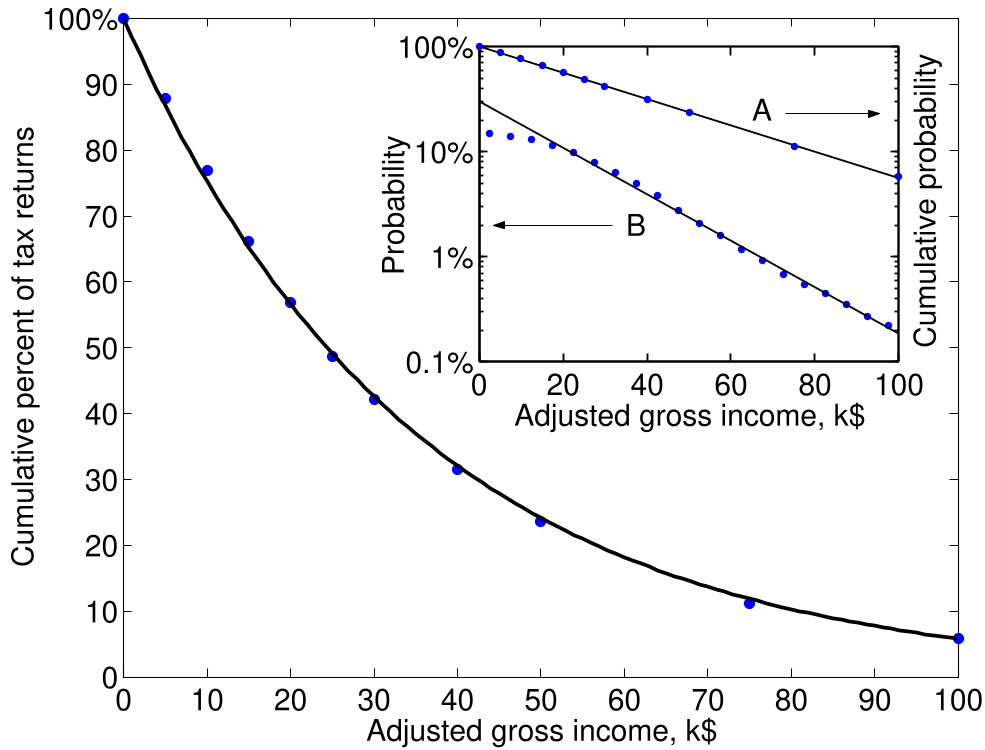 Fig 1: The histogram of U.S. Census data fits the exponential curve (solid line) with startling precision.
Methodology: From Individuals to Families
One of the paper's most elegant contributions is the derivation of family income. If a family has two earners, and both individual incomes are independent exponential variables, the resulting family income distribution is a convolution: This creates a "humped" distribution where the probability is zero at zero income (since it's unlikely both earners make nothing) and peaks at the average income.
Proving the Theory: The Gini Coefficient
The Gini coefficient is the standard measure of inequality (0 being perfect equality, 1 being extreme inequality). The beauty of the exponential model is that it predicts these values theoretically without any "fudge factors":
- Individuals: Predicted .
- Two-Earner Families: Predicted .
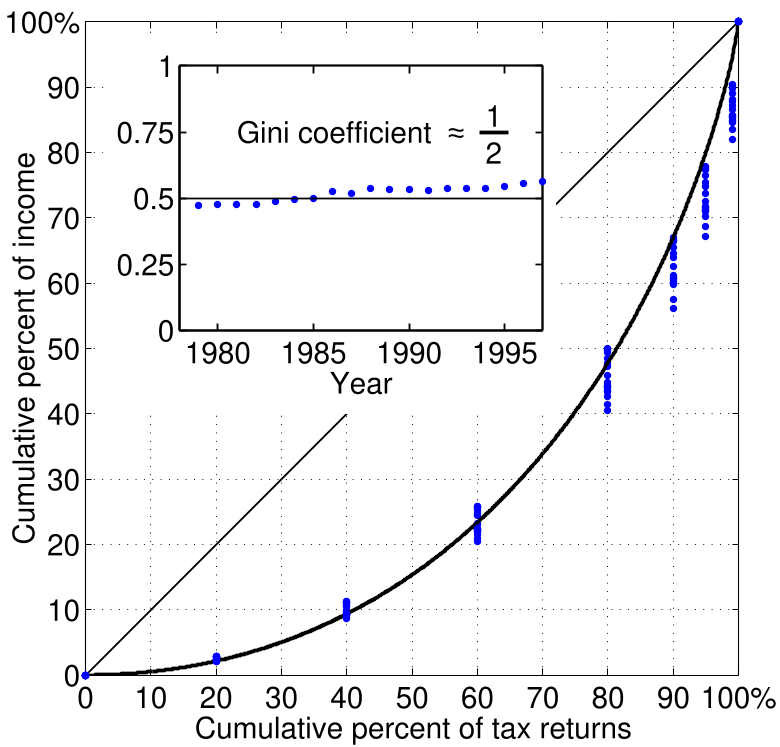 Fig 2: The parameter-free Lorenz curve (solid line) perfectly tracks decades of IRS tax data.
Impact and Technical Constraints
While the exponential law holds for the "great majority," it starts to deviate at the extreme high-income end. This is where the physics of the "bulk" meets the "tail" (Pareto Law). The authors also acknowledge data underreporting at the very low end (below tax-filing thresholds), which explains minor discrepancies near the origin.
Critical Perspective
This work shifted income distribution studies from purely "socio-economic" narratives to "statistical mechanics." It suggests that as long as the underlying stochastic process of income exchange remains similar to a Bernoulli trial or a conserved resource exchange, the Gini coefficient of 0.5 is an almost inevitable "thermal equilibrium" for an individual-based economy.
For modern researchers, the question remains: if a society moves far beyond a for individuals, is it a sign of a "non-equilibrium" state or a fundamental shift in the underlying "physics" of our economic interactions?
Conclusion
The USA data from 1947–1997 provides robust evidence that income is not random or arbitrary; it follows the same laws of entropy and probability that govern the physical universe. This paper remains a cornerstone of Econophysics, providing a rigorous mathematical baseline for what "natural" inequality looks like.