
ELP: Fusing Semantic Attributes and Belief Theory for Robust Link Prediction
Evidential Link Prediction in Uncertain Social Networks Based on Node Attributes
This paper introduces the Evidential Link Prediction (ELP) framework, a novel approach for inferring missing connections in uncertain social networks by fusing node attributes with structural topology. Utilizing Belief Function Theory (BFT), the method achieves superior precision-recall performance over traditional Common Neighbor and baseline evidential approaches on real-world Facebook datasets.
TL;DR
The Evidential Link Prediction (ELP) framework tackles the volatility of social networks by combining "who you know" (topology) with "who you are" (node attributes). By treating social connections as uncertain evidence rather than binary facts, and leveraging Belief Function Theory (BFT), ELP significantly outperforms traditional structural methods in predicting missing links within noisy environments.
Background & Positioning
In the landscape of Social Network Analysis (SNA), link prediction is usually treated as a topological puzzle. Most SOTA methods ask: How many mutual friends do Alice and Bob have? While effective, this ignores the semantic layer (interests, education, location) and the inherent uncertainty of social data (anonymized profiles, sampling errors, or fake accounts). ELP positions itself as a bridge between structural connectivity and semantic reasoning, specifically designed for "Uncertain Social Networks."
The Core Challenge: Noisy Graphs
Existing approaches like Common Neighbors or Adamic/Adar are fragile when data is missing. If a network is sparsely sampled, two very similar individuals might appear to have zero common neighbors. Authors argue that prior works either focus purely on topology or fail to handle the "ambiguity" of the data they do have. They ask a critical question: Can we use similarity to neighbors as a proxy for link existence when the direct evidence is uncertain?
Methodology: The Fusion Architecture
The ELP framework operates through a rigorous mathematical pipeline based on the Dempster-Shafer Theory of Evidence.
1. Similarity as Evidence
Instead of a simple binary match, ELP calculates a similarity score based on categorical attributes (e.g., matching work, school, or location). It looks at the sets of neighbors and . If is highly similar to 's friends, this is treated as a "source of evidence" for a potential link between and .
2. Reliability Discounting
Not all evidence is created equal. The framework applies a discounting operation:
- If a similar node is also a common neighbor, it is considered highly reliable.
- If it is just a similar node without structural overlap, its "vote" is discounted by a coefficient .
3. Conjunctive Fusion
The final step involves the Conjunctive Rule of Combination, which merges belief masses from different sources into a single probability—the Pignistic Probability (BetP)—to rank the most likely new links.
 Above: The Pignistic Probability formula used to make the final decision on whether a link exists.
Experiments: Proving the Semantic Edge
The authors tested ELP against a Facebook dataset consisting of 1,060 nodes and 10,000 edges. They compared ELP against:
- CN (Common Neighbors): The baseline topological method.
- BLP (Belief Link Prediction): An evidential method that uses only structure.
Performance Results
The Precision-Recall (PR) curve highlights a clear hierarchy: ELP > BLP > CN.
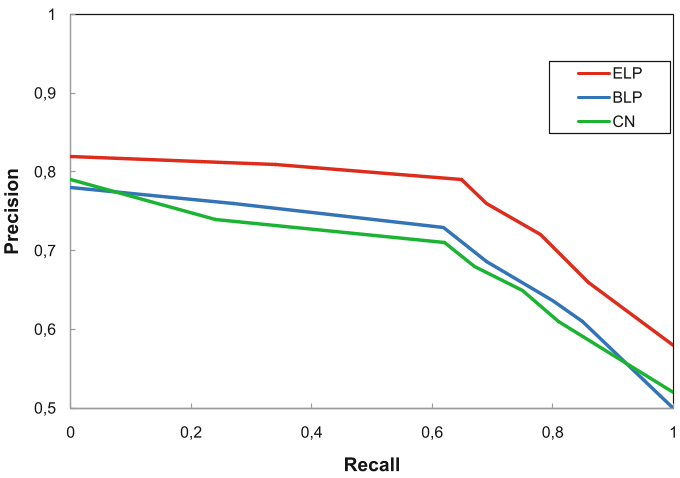
- Finding 1: Semantic attributes provide a safety net. When the topology is sparse, attribute similarity keeps the prediction accurate.
- Finding 2: Handling uncertainty explicitly (BFT) prevents the model from being overconfident about noisy or false-positive connections.
Critical Insight & Conclusion
The true value of ELP lies in its flexibility. Unlike local indices that favor high-degree nodes (the "rich get richer" problem in social graphs), ELP evaluates the quality of the relationship through attributes.
Takeaway: If you are building a recommendation engine (LinkedIn "People You May Know" or Amazon recommendations), relying on "co-occurrence" isn't enough. Integrating a belief-based system that weights the reliability of shared attributes can significantly reduce noise and improve user trust.
Limitations: The current similarity assessment assumes categorical attributes without missing values. Future iterations would need to handle continuous numerical data and the more complex scenario of partially missing node attributes.