
Electric Sheep: Scaling Collective Intelligence through Aesthetic Evolution
Evolution and Collective Intelligence of the Electric Sheep
Electric Sheep is a large-scale collective intelligence system that combines distributed computing with a genetic algorithm to evolve "Fractal Flame" animations. Utilizing a global network of over 40,000 idle computers, it creates a collaborative "render farm" where human aesthetic preferences (votes) serve as the fitness function for artificial life-form evolution.
TL;DR
Electric Sheep is a pioneering project that merges distributed computing, fractal geometry, and genetic algorithms. It turns thousands of idle computers into a global "brain" that dreams in complex, animated fractals. By utilizing user votes as a fitness function, it evolves digital life-forms known as "sheep," creating a unique symbiosis between human aesthetic judgment and machine-driven variation.
Background Positioning: This work is a seminal intersection of Open Source culture, Distributed Systems (P2P), and Evolutionary Art. It moves beyond the narrow optimization of traditional Genetic Algorithms (GA) into the realm of Creative Amplification.
Problem & Motivation: The Bottleneck of Digital Art
The creation of complex, high-fidelity algorithmic art faces two major hurdles:
- The Human Fatigue (The "User Selection" Problem): In interactive evolution, a single user often gets bored or exhausted after rating a few dozen samples. This limits the "population size" and stalls the evolution.
- Resource Scarcity: Rendering high-resolution fractals is computationally expensive. For a central server, the bandwidth required to distribute high-definition video to thousands of users (estimated at 20 TB/day for this project) is economically and technically prohibitive.
Scott Draves’ insight was to treat the screen-saver—an artifact of computer "idleness"—as a space for the computer to "dream," using a distributed "render farm" to solve the computational cost while crowdsourcing the fitness function to a global audience.
Methodology: The Genetic Code of Dreams
1. Fractal Flames and Iterated Function Systems (IFS)
At its core, a "sheep" is defined by its genome: a string of hundreds of floating-point numbers. These parameters drive the Fractal Flame algorithm, which generalizes classic IFS.
While a classic IFS uses linear affine transforms (scale, rotate, skew), Fractal Flames introduce nonlinear variations.
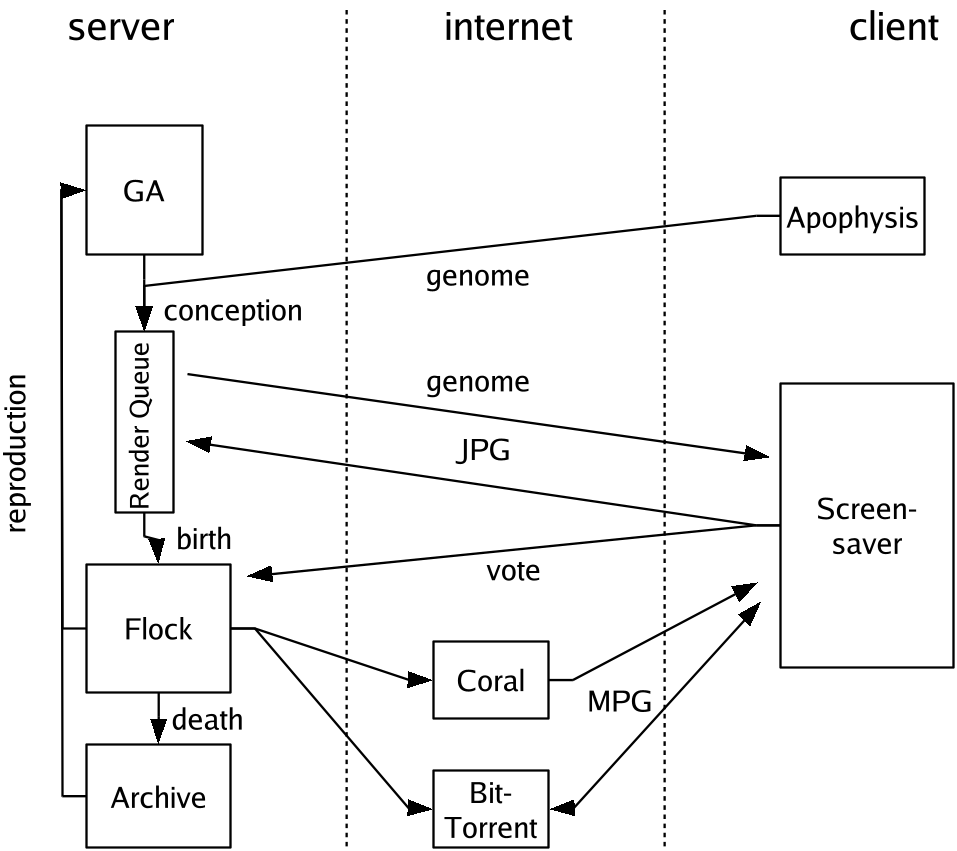 Figure 3.2: The Client/Server Architecture where the server manages the gene pool and the clients perform the rendering.
The transformation equation is defined as: Here, represents nonlinear "variations" (like sinusoidal, spherical, or swirl functions). This mathematical flexibility allows for an incredibly expressive visual language.
2. Distributed Evolution Loop
- Crossover & Mutation: New genomes are produced by blending successful "parents" (those with high ratings) or introducing noise into the parameters.
- The Brood Mechanism: To increase quality, the system uses a "human filter" where a shepherd selects the best candidates from a generated "brood" before they are fully rendered by the network.
- Flow: User Vote Server Database Genetic Operators Distributed Rendering Peer-to-Peer Distribution (BitTorrent).
Experiments & Results: Creative Amplification
The paper introduces a fascinating metric: Creative Amplification Factor. This is the ratio of total content generated versus human-designed content.
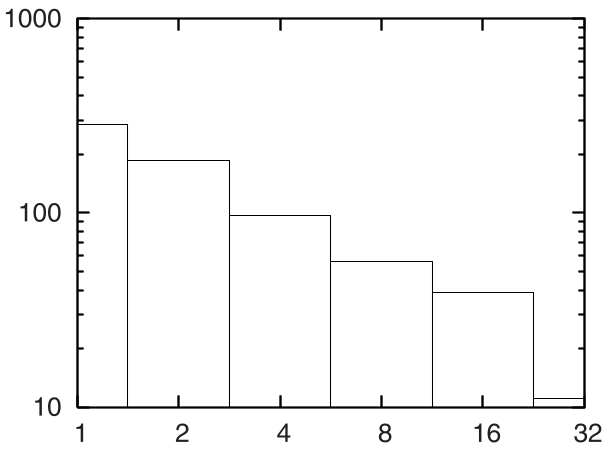 Fig 3.7: Lineage lengths and rating distributions. Note how most lineages are short, suggesting a "winner-take-all" or "fatigue" effect in human interest.
Key Findings:
- Amplification: The GA effectively doubled (2.08x) the creative output of human designers.
- Scaling: The move to BitTorrent allowed the system to deliver 2 TB/day of content, which would have cost thousands of dollars monthly on centralized infrastructure.
- Evolutionary Depth: In later generations (Gen 202), refined filtering (the "brood") allowed lineages to survive up to 30 generations, significantly deeper than early iterations.
Critical Analysis & Conclusion
Takeaway: Electric Sheep proves that a machine can be "supercritical"—a term borrowed from Alan Turing—where an injected human idea doesn't just die out but triggers an ongoing chain reaction of algorithmic creativity.
Limitations:
- Bandwidth Bottleneck: Even with P2P, the "first-time user experience" is hampered by slow initial downloads.
- Aesthetic Homogenization: Using a mathematical fitness function (like fractal dimension) risks making all sheep look the same, losing the "soul" provided by human designers.
Future Outlook: The author envisions moving toward "Dreams in High Fidelity"—using high-end hardware to manifest these "dreams" as evolving paintings. As we enter the era of Generative AI, Electric Sheep remains a foundational case study in how to build Symmetric Networks where every consumer is also a creator and a contributor to the underlying compute.