
The Survival of the Fittest in Spectrum: Bio-Socially Inspired Evolution for DSA
Evolution of bio-socially inspired strategies in support of dynamic spectrum access
This paper introduces an evolutionary framework for Dynamic Spectrum Access (DSA) in Cognitive Radio (CR) networks by defining three bio-socially inspired behavioral models: Always-Consume (ACU), Forage-Consume (FCU), and Social Forage-Consume (SFCU). The study utilizes ns-3 simulations to demonstrate that secondary user populations can evolve toward a stable, optimal strategy, achieving system throughput improvements ranging from 12% to 116%.
TL;DR
Can wireless devices "evolve" like biological species to share the radio spectrum more efficiently? This paper explores an evolutionary framework where Secondary Users (SUs) in Cognitive Radio networks switch between three strategies—Blind Access, Foraging, and Social Deference—based on their performance. The result? A leaderless, self-organizing system that improves throughput by 12% to 116% by matching behavioral complexity to the actual stress of the environment.
Problem & Motivation: Beyond Fixed Protocols
In the world of Dynamic Spectrum Access (DSA), the focus is usually on how unlicensed users (SUs) can dodge licensed owners (PUs). However, the "Elephant in the Room" is the SU-SU interaction. When thousands of devices compete for the same sliver of spectrum without a central controller, they often end up in a "Tragedy of the Commons"—over-congesting high-capacity channels while leaving others empty.
Most existing solutions assume every device follows a pre-defined, static protocol. But in the real world, environments change. The authors argue that SUs should behave like biological agents: observing their peers, imitating success, and adapting their "social etiquette" to survive the harsh realities of network congestion.
Methodology: Three Degrees of Social Complexity
The researchers define three distinct behavioral models inspired by animal foraging and social structures:
- Always-Consume User (ACU): The "Simpleton." No sensing, just random channel selection. Low overhead, but prone to hitting interference.
- Forage-Consume User (FCU): The "Opportunist." It spends time "foraging" (sensing) to find the best channels before "consuming" (transmitting).
- Social Forage-Consume User (SFCU): The "Cooperator." It uses "deference"—meaning if it sees too many peers, it might stop transmitting for the greater good (altruism), allowing others to transmit at higher rates.
The Evolutionary Engine
The paper models a society where these three types coexist. At the end of discrete "phases," users compare their throughput. If an ACU sees that SFCUs are making more "money" (throughput), it might mimic that strategy. This creates an evolutionary pressure where the most efficient strategy for a given environment eventually consumes the entire population.
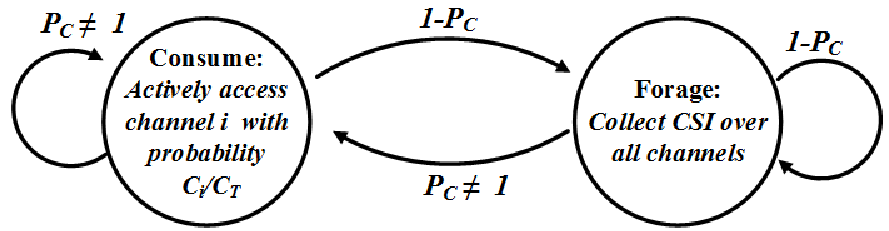 Figure 1: The Finite State Machine (FSM) for the Forage-Consume strategy, illustrating the trade-off between sensing (foraging) and data transmission.
Experiments & Critical Results: Context is King
The most striking finding of the paper is that sophistication does not always win. Through extensive ns-3 simulations, the authors identified three distinct "evolutionary niches":
- Homogeneous/Light Load: ACUs win. Why? When resources are plenty and equal, the time spent "foraging" or being "social" is just wasted overhead.
- Heterogeneous/Intermediate Load: FCUs win. When some channels are 10x better than others, the investment in sensing pays off.
- High Load: SFCUs win. When the network is near collapse, "Social Deference" (altruism) prevents the MAC layer from choking on collisions, leading to the highest collective utility.
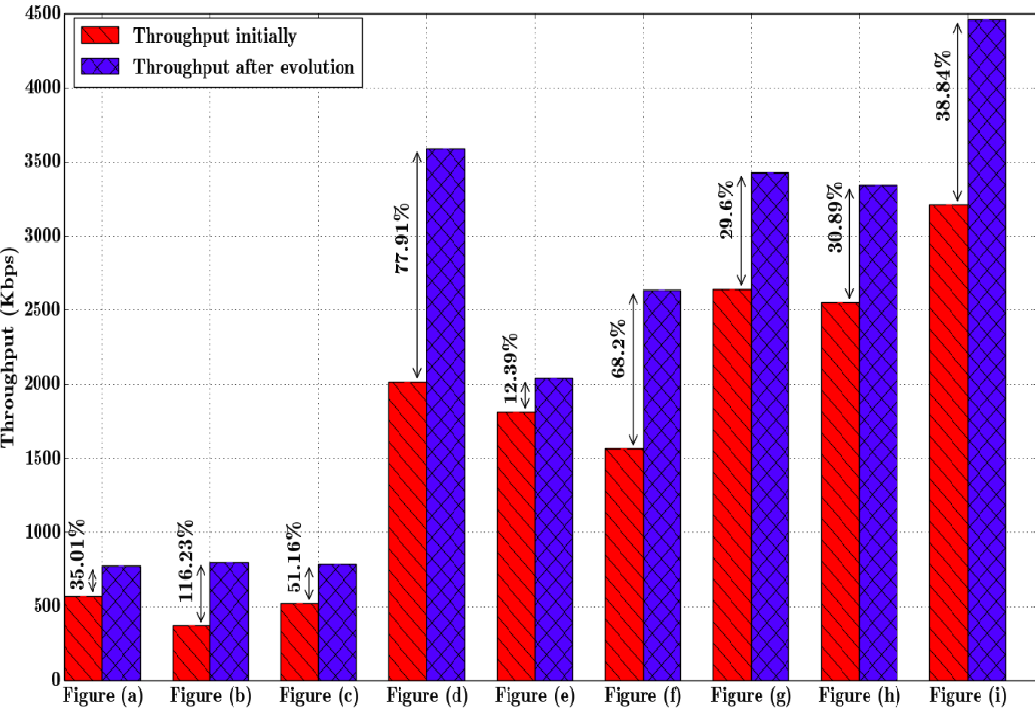 Figure 2: Significant throughput gains achieved by allowing strategies to evolve compared to using a fixed, static strategy.
As shown in the data, this leaderless evolution doesn't just find a stable state; it finds a state that is significantly more efficient (up to 116% improvement) than any single fixed strategy could achieve across all conditions.
Critical Analysis & Conclusion
The value of this work lies in its philosophical shift from "protocol design" to "ecosystem design."
Takeaways:
- Complexity is a Cost: In low-stress environments, a "dumb" random protocol (ACU) is actually the peak of evolutionary efficiency.
- Sociality as a Scalability Tool: Deference isn't just "being nice"—it's a mathematical necessity for maintaining throughput in high-density deployments.
Limitations: The study assumes "truthful sharing" of throughput data among users to drive mimicry. In a truly competitive/adversarial market, users might lie about their success to lead others into sub-optimal strategies. Future work must bridge this with Evolutionary Game Theory to account for "cheaters" in the ecosystem.
Ultimately, this paper serves as a vital proof-of-concept for Bio-Social Spectrum Access, proving that nature’s blueprints for survival are remarkably applicable to the future of the wireless internet.