
The Architecture of Polarization: How Adaptive Networks Sustain Diverse Conventions
Evolution of Conventions and Social Polarization in Dynamical Complex Networks
The paper investigates the co-evolution of agent strategies and network topology in pure coordination games. Using Evolutionary Game Theory (EGT) on dynamical complex networks, it demonstrates that a population can self-organize into stable, polarized clusters where different conventions (strategies) coexist, even when one strategy is Pareto-superior.
TL;DR
Why doesn't the "best" way of doing things always win in a society? By combining Evolutionary Game Theory with dynamic networks, this research reveals that the ability to "unfriend" others allows inferior conventions to survive in isolated, highly stable clusters. Using pure coordination games, the authors show that social networking isn't just a backdrop for interaction—it is a co-evolving entity that moves from randomness to extreme polarization.
Behind the Motivation: The Flaw of Fixed Networks
In classical game theory, a "better" strategy (one with a higher payoff) eventually dominates. However, our world is a mosaic of different religions, languages, and technologies. Previous models used fixed grids or random graphs, but real social networks are plastic.
The authors argue that the mismatch between theory and reality stems from neglecting Network Plasticity. If you don't like who you're playing with, you don't just change your strategy—you change your friends.
Methodology: Strategy meets Topology
The model operates on a directed weighted graph where edges represent "trust" or link force (). The dynamics are governed by two coupled processes:
- Strategy Update: Using a myopic best response rule, agents choose the strategy that maximizes their local payoff, assuming neighbors stay the same.
- Network Rewiring: With probability , an agent can cut a low-satisfaction tie and create a new one. Crucially, they use a "triadic closure" bias—connecting to friends of friends—mimicking real social behavior.
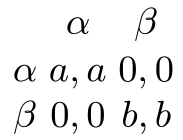 Table 1: The Pure Coordination Game Matrix. While (a,a) is Pareto-superior if a > b, the network structure determines if the population can ever reach it.
The Emergence of Polarization
As the simulation progresses, a fascinating self-organization occurs. Instead of the whole population converging on the superior strategy , the network physically splits.
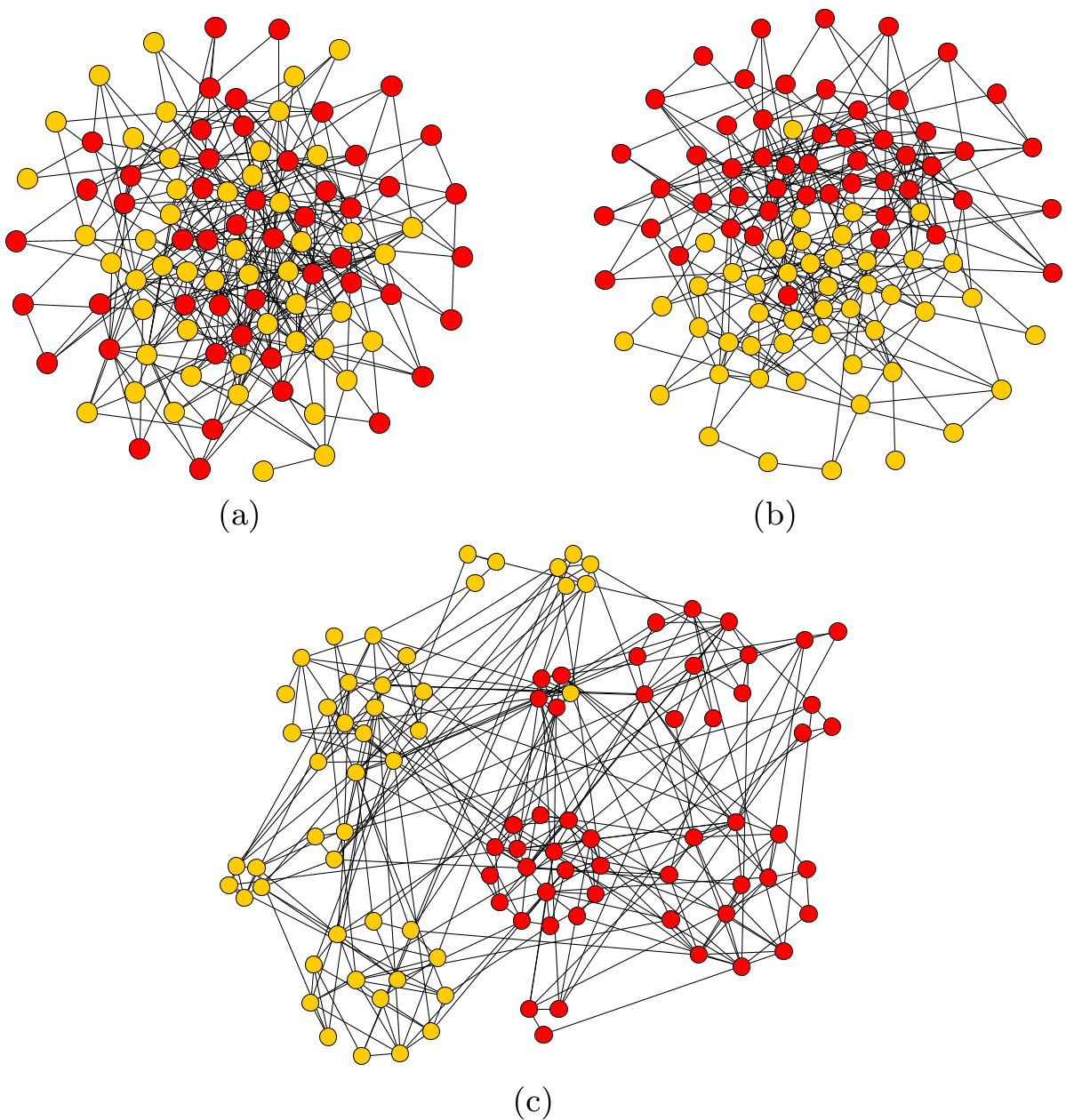 Figure: The visual transition from a random mix (left) to distinct, polarized communities (right).
Key Experimental Insights:
- The Power of Noise: Interestingly, small amounts of decision error (noise) actually help the superior strategy spread further, but they rarely eliminate the clusters of the inferior strategy entirely.
- Modularity Surge: The researchers used the Modularity (Q) metric. A random network starts at . As agents rewire to find "like-minded" partners, climbs to , indicating a strong community structure where internal links far outweigh external ones.
Resilience Against Invasion
What happens if you "inject" a different strategy into a stable cluster? The authors tested this by forcing a group within a pale-strategy cluster to switch to a dark strategy.
- Initial Shock: Modularity drops as the cluster "panics."
- Rapid Adaptation: The network quickly re-wires. Instead of being converted, the "invaders" are either absorbed or, more likely, the network re-segments into a new polarized state.
- Final Result: The system returns to a high-modularity state (), proving that polarization is a robust topological equilibrium.
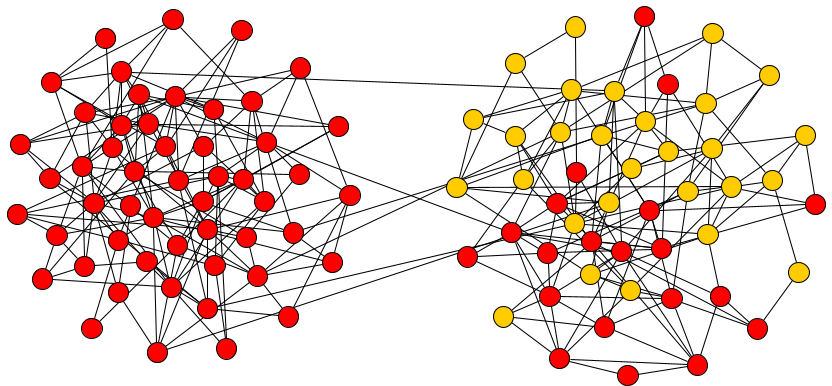 Figure 4: A cluster being invaded. Note how the network bends and breaks to isolate the "foreign" strategy, eventually restoring order through segregation.
Critical Analysis & Conclusion
The value of this paper lies in its bridge between Game Theory and Graph Theory. It provides a mathematical intuition for why "echo chambers" are so difficult to break: they aren't just a result of bad information, but a result of a topological drive for local coordination.
Limitations: The model uses "myopic best response," assuming agents have zero foresight. In the real world, humans might strategically stay in a "hostile" cluster to convert others.
Future Outlook: As we move toward increasingly algorithmic social environments, the "rewiring frequency" () is effectively increasing. This research suggests that as link plasticity increases, we should expect even faster and more resilient social polarization.