
ECDR: Leveraging Circuit Theory for Dynamic Community Evolution Tracking
Evolutionary community discovery in dynamic social networks via resistance distance
The paper introduces ECDR (Evolutionary Community Discovery via Resistance distance), a framework designed to identify and track community structures in dynamic social networks. By modeling networks as electrical circuits and utilizing resistance distance, the method captures complex connectivity beyond simple shortest paths to achieve SOTA accuracy in community evolution tracking.
TL;DR
The paper presents ECDR, a novel approach to discovering how social communities "live, die, and merge" over time. By treating a social network as an electrical circuit and calculating the resistance distance between individuals, the authors provide a more robust metric for community membership than simple neighbor counting. It achieves superior accuracy on dynamic benchmarks by focusing on the "core nodes" that anchor community stability.
Problem & Motivation: The Static Fallacy
Most community detection algorithms treat social networks as frozen in time. However, real networks are fluid: users join, leave, and shift their allegiances.
The authors identify three fatal flaws in prior SOTA:
- Oversimplified Distance: Shortest-path metrics ignore that information can flow through multiple parallel paths.
- Parameter Sensitivity: Methods like DBSCAN require global thresholds () that don't account for varying densities across different sub-communities.
- Node Indistinguishability: They treat every member of a community as equally important, ignoring the "leader" nodes that actually drive evolution.
Methodology: The Physics of Social Closeness
The core innovation lies in the Resistance Network model. By treating every edge as a resistor (where resistance is the inverse of edge weight), the distance between any two nodes and becomes the equivalent resistance ().
1. Resistance Distance vs. Shortest Path
If there are many paths between two people, their resistance distance decreases even if those paths are long. This captures the "strength of many weak ties" and the robustness of communication within a community.
2. Adaptive Core Node Discovery
Instead of a global threshold, ECDR calculates a Local Close Neighbor Threshold () for each node based on the geometric mean of its neighbors' distances. This allows the algorithm to adapt to "dense city" communities and "sparse village" communities simultaneously.
 Fig 1: Illustration of a dynamic network merging process where C1 and C2 evolve into a single community C at time t.
3. Tracking the 7 Stages of Evolution
ECDR tracks how communities transform across time steps and through seven events: Birth, Death, Continuation, Growth, Shrinking, Merging, and Splitting. To optimize speed, the algorithm only compares communities that share at least one "Core Node."
Experiments & Results
The authors validated ECDR against baseline methods like COPRA, SHRINK, and SLAP across five real-world static networks and three massive synthetic dynamic networks (15,000 nodes each).
SOTA Performance
ECDR outperformed competitors in NMI (Normalized Mutual Information) and Modularity, particularly in the "BirthDeath" and "MergeSplit" scenarios where other algorithms often lost track of community identities.
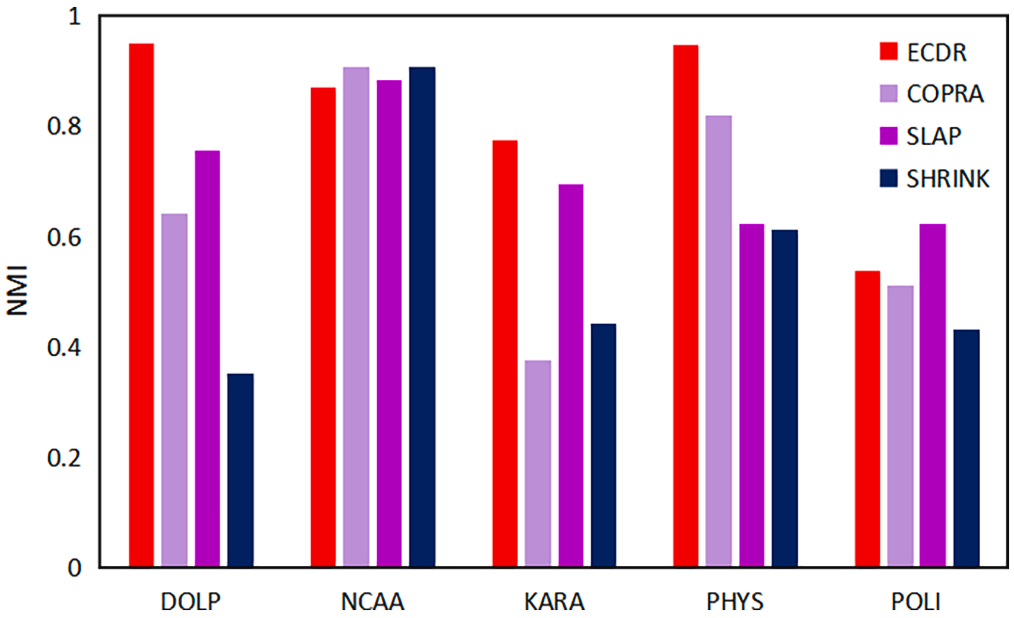 Fig 2: NMI Scores on real networks (KARA, DOLP, etc.). ECDR shows consistently high performance across diverse topologies.
Dynamic Evidence
In the DBLP co-authorship dataset, ECDR demonstrated that academic collaborations are remarkably stable, with "Growing" and "Shrinking" being far more common than "Splitting" or "Death."
Critical Analysis & Conclusion
Takeaway: ECDR succeeds because it acknowledges that not all social ties are equal. By using resistance distance, it mimics how information actually diffuses through a system—not just through one optimal path, but through the cumulative pressure of all available connections.
Limitations: The computational cost of calculating the Laplacian matrix inverse (required for resistance distance) is . While ECDR mitigates this by focusing on local neighbors, it may still struggle with web-scale networks (millions of nodes) without further approximation techniques.
Future Outlook: Integrating this resistance-based approach with Deep Learning (Graph Neural Networks) could allow for predictive evolution—forecasting when a community is about to split before it actually happens.