
Deciphering Viral Dynamics: An Evolutionary Game Perspective on Heterogeneous Social Networks
10543_Evolutionary Information Diffusion Over Heterogeneous Social Networks.
This paper presents a graphical evolutionary game-theoretic framework to model information diffusion over heterogeneous social networks. By categorizing users into multiple types based on interests and influence, the authors derive evolutionary dynamics and Evolutionarily Stable States (ESSs) for two scenarios: "Unknown User Type" and "Known User Type."
TL;DR
Why do some hashtags vanish in minutes while others dominate the global conversation for days? This paper argues that the secret lies in User Heterogeneity. By framing information diffusion as an Evolutionary Game, the authors demonstrate that the interaction between different "types" of users (e.g., influencers vs. casual observers) creates unique "Stable States" (ESS) that dictate the ultimate popularity of content.
The Motivation: Moving Beyond the "Average" User
Most existing models for social network analysis treat the crowd as a monolith. However, empirical data shows a massive skew: a small fraction of users (Type-1) are hyper-active, while the majority (Type-2) are passive.
The researchers identified three core dimensions of heterogeneity:
- Interests: A football fan is more likely to retweet a sports update than a chef.
- Influence: A celebrity's tweet carries more weight than a bot's.
- Activity Strength: Some users check feeds hourly; others, monthly.
By ignoring these differences, traditional models suffer from a "regression to the mean," failing to predict how specific communities or "active minorities" drive viral trends.
Methodology: The Graphical Evolutionary Game
The authors use the Death-Birth (DB) update rule from evolutionary biology to model decision-making. In this game, users choose between two strategies: Forwarding () or Not Forwarding ().
The Core Mechanism
A user’s "fitness" isn't just about the information content; it's a combination of a baseline satisfaction and a payoff derived from social interaction. If many of your neighbors are talking about a topic, your "payoff" for joining the conversation increases.
The paper explores two specific models:
- Unknown User Type: Users don't know their neighbors' preferences and assume others are like them.
- Known User Type: Users recognize their neighbors' types through repeated interaction (e.g., knowing a friend is a "techie"), allowing for more complex, selective strategy adoption.
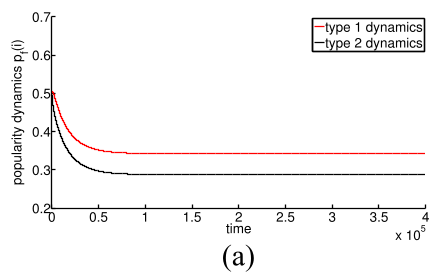 Figure 1: Visual representation of evolutionary dynamics converging toward stable states across different parameter setups.
Mathematical Intuition: The ESS
The breakthrough of this work is the derivation of the Evolutionarily Stable State (ESS). An ESS is a state where, if the population adopts it, no alternative "mutant" strategy (like a new rumor or a sudden change in behavior) can invade.
The authors prove that the system's global state () evolves as a weighted average of type-specific payoffs. If the average utility of forwarding outweighs the utility of staying silent, the information goes viral (). If not, it dies (), or reaches a persistent niche equilibrium.
Experimental Results: Real-World Evidence on Twitter
Using data from millions of tweets, the researchers tested their theory on hashtags like #ThoughtsDuringSchool and #WhenIwasLittle.
Key Findings:
- Superior Fitting: The heterogeneous model tracks the real-world rise and fall of hashtags much more closely than homogeneous models.
- Prediction Advantage: When using early-stage data to predict the future, the heterogeneous model halved the error rate of previous game-theoretic approaches (23% vs 47%).
- Active Minority Pulse: The model correctly identified that active users (top 10%) maintain a higher forwarding rate, which provides the "momentum" for a hashtag to survive even when casual users stop participating.
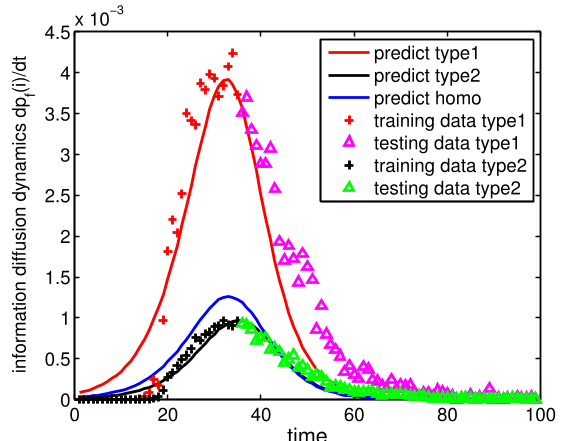 Figure 2: Prediction performance on Twitter hashtags, showing how the model anticipates the trajectory of information spread by accounting for user types.
Critical Analysis & Conclusion
The paper successfully bridges the gap between micro-level decision making (user utility) and macro-level phenomena (viral trends).
Limitations & Future Work:
While the "Unknown Type" model performed robustly, the "Known Type" model was more sensitive to data noise due to its higher parameter count. Furthermore, the study assumes a static network structure (constant degree). In reality, Twitter's "Follower" graph is highly dynamic.
Takeaway: For platforms looking to manage content—from viral advertisements to rumor control—success depends on identifying the hidden utility functions of different user groups. Information doesn't just spread; it evolves based on the payoff of the people who pass it on.