
Decoding Social DNA: Tracking Network Evolution via Triad Transition Matrices
Discovering the Evolutionary Patterns in Local Topology of an E-Mail Social Network
This paper introduces the Triad Transition Matrix (TTM), a novel quantitative method to track local topological changes in dynamic e-mail social networks. By analyzing transitions between 16 possible three-node motifs over time using the Enron dataset, the authors identify stable evolutionary patterns in sparse communication structures.
TL;DR
Social networks are not static graphs; they are living organisms that "burst" with activity. This paper proposes the Triad Transition Matrix (TTM), a framework to quantify how the smallest building blocks of a network—three-node motifs—change over time. By applying this to the Enron email dataset, researchers found that while individual links are fleeting, the "DNA" of how people connect remains remarkably stable.
The Problem: The Chaos of "Activity Bursts"
Modern social networks (email, Slack, Twitter) are defined by discrete events. You don't "have a link" to a colleague; you send an email, then go silent for weeks. This "bursty" behavior creates a nightmare for traditional structural analysis:
- Short Windows: Metrics fluctuate wildly and look like noise.
- Long Windows: You lose the "pulse" of the network's evolution.
The authors argue that we should stop looking at the whole forest and start looking at the triads—the microscopic triangles formed by three people—to see how they evolve from one state to another.
Methodology: The Triad Transition Matrix (TTM)
In a directed graph, there are 16 possible ways three nodes can be connected (ranging from no links to a fully connected internal clique).
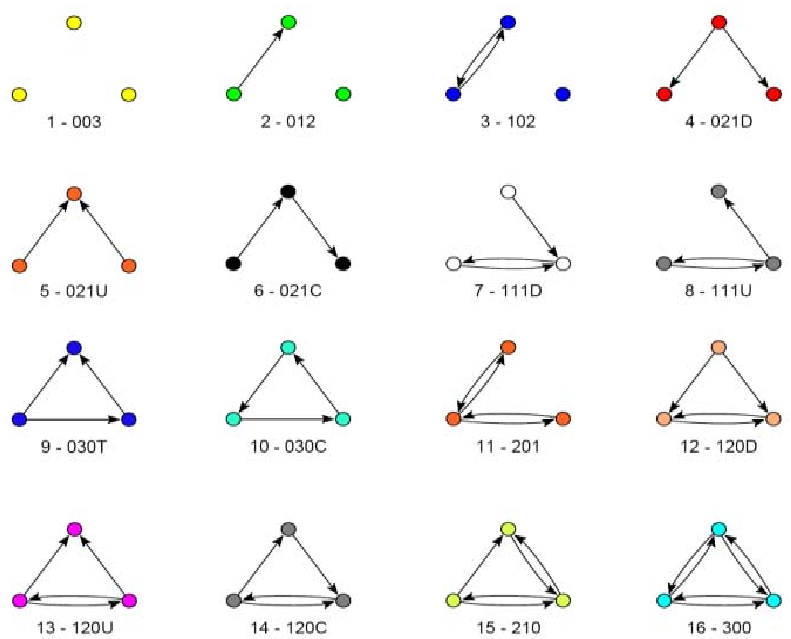
The TTM is a probability matrix. If three people form a specific pattern (Triad ) today, what is the probability they will form pattern tomorrow? This approach transforms static subgraph counting into a dynamic study of Local Topology Evolution.
The Core Insight
The researchers calculated these transitions across 12 time windows of the Enron dataset. They discovered that the network's evolution isn't random. There are "basins of attraction" where certain social structures naturally drift toward stability or dissolution.
Experimental Evidence: The Enron Case Study
Despite the total number of edges in the Enron network swinging from 189 to over 1,000, the underlying patterns of transition remained consistent.
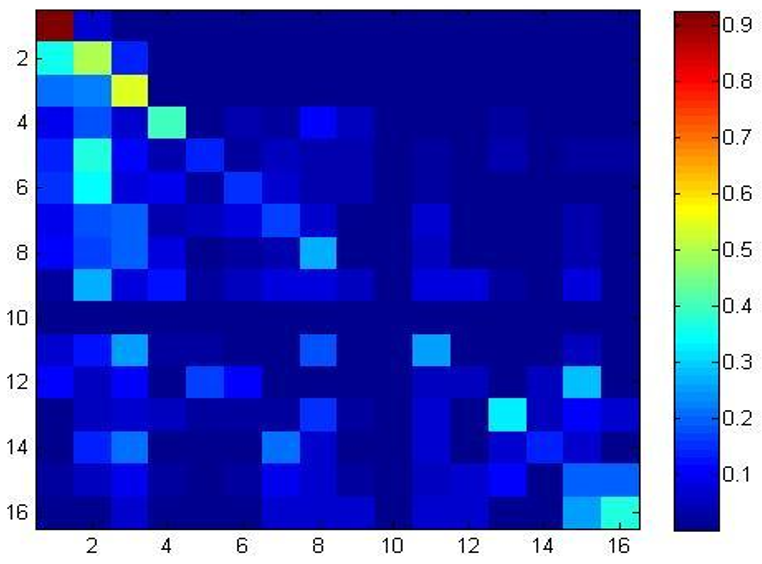
Key Findings from the TTM:
- High-Density Stability (Region C): Densely connected triads (like Triad 16, the complete clique) are highly stable. Once a three-way professional "inner circle" is formed, it tends to persist.
- The "Blinking" Effect (Region A): Loose connections (Triads 1-8) have low link stability. They frequently transition back to empty states or loosely linked pairs, reflecting casual or one-off communications.
- The Rarities: Triad 10 (a unidirectional cycle ) is extremely rare in social contexts—humans simply don't communicate in cycles without reciprocal links.
Critical Analysis & Conclusion
Takeaway
The TTM provides a "probabilistic map" of social change. It proves that while we cannot predict a single email, we can predict the structural fate of a group of three people based on their current motif.
Limitations
- Sparsity: In large networks, most triads are empty (Type 0), which can skew the matrix if not filtered.
- Weighting: This study treats every email the same. In reality, an email with a 10MB attachment might signal a stronger "link" than a "Thanks!" note.
Future Outlook
This work lays the groundwork for Link Prediction. Instead of asking "Will A talk to B?", we can now ask "Will this triangle close?" by looking at the transition probabilities. Integrating link weights and faster subgraph enumeration algorithms will likely make TTMs a standard tool for real-time organizational health monitoring.