
EPF_Social: Bridging Temporal Dynamics and Social Influence in Poisson Factorization
Evolutionary Social Poisson Factorizationfor Temporal Recommendation
The paper introduces Evolutionary Social Poisson Factorization (EPF_Social), a Bayesian temporal recommendation model. It combines Conjugate Gamma–Markov chains to model drifting user/item latent factors with a time-decaying social influence mechanism, achieving SOTA performance on Netflix and Last.fm datasets.
TL;DR
Personalized recommendation is moving beyond static "snapshots" to capture the "flow" of human interest. Evolutionary Social Poisson Factorization (EPF_Social) is a new Bayesian framework that models how our tastes drift over time and how our friends influence us, all while maintaining the elegant mathematical properties of Poisson Factorization. By replacing restrictive Gaussian assumptions with Conjugate Gamma–Markov chains, it achieves a better fit for the high-sparsity, long-tailed data typical of real-world platforms like Netflix.
The "Static Fallacy" in Recommendations
Most collaborative filtering systems treat user-item interactions as a fixed matrix. In reality:
- Tastes Drift: Your interest in a movie genre today might fade in six months.
- Items Evolve: A cult classic might gain popularity slowly, while a blockbuster peaks and crashes.
- Social Decay: A friend’s recommendation is powerful today but irrelevant if you already watched the movie last year.
Previous attempts to solve this, like Dynamic Poisson Factorization (DPF), often forced Gaussian priors onto the model to handle time. However, item-user data is inherently non-negative and "long-tailed" (a few items get most of the clicks). Gaussian models struggle with this skewness and break the "Conjugacy" of the math—making the system slow and less accurate.
Methodology: The GMC Breakthrough
The core innovation of EPF_Social is the Conjugate Gamma–Markov Chain (GMC).
Instead of a simple chain where the current state depends directly on the previous one (which often makes inference hard), the authors introduce auxiliary latent variables (). This "buffers" the transition, allowing the model to stay within the Gamma distribution family. This preserves conjugacy, meaning the math stays "clean," allowing for fast, closed-form updates during training.
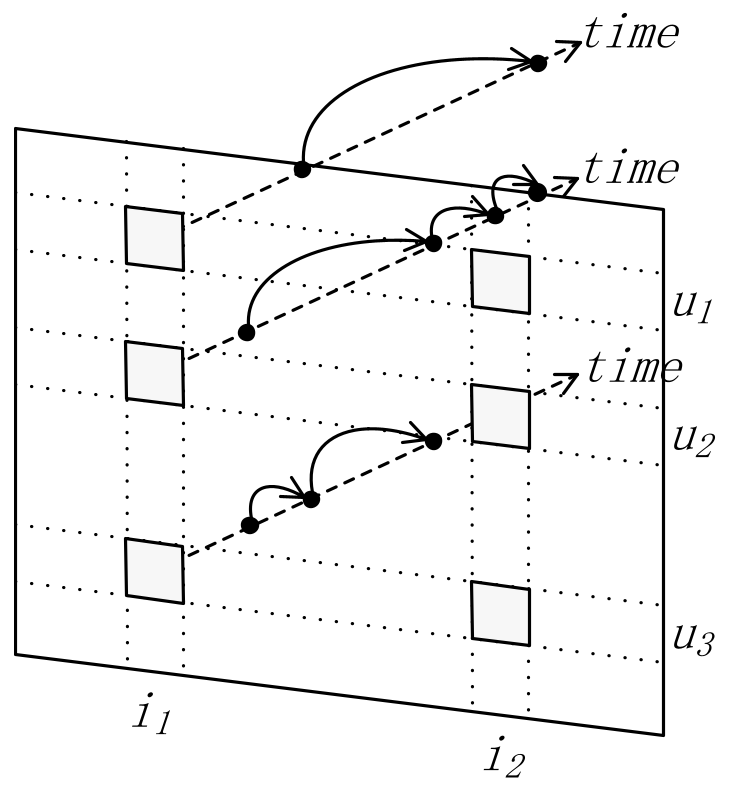 Figure 1: The graphical representation of the EPF_Social model, illustrating the interplay between temporal chains and social network influence.
Capturing Social Influence with Decay
EPF_Social doesn't just look at what your friends liked; it looks at when they liked it. The model uses an exponential decay function to ensure that a friend's action from three years ago has less impact on your current recommendation than one from last week.
Experimental Performance
The researchers tested EPF_Social against heavyweights like DPF (Dynamic) and SPF (Social).
1. Superior Ranking Accuracy
On the Netflix dataset, EPF_Social showed a clear lead in MAP (Mean Average Precision) and NDCG (Normalized Discounted Cumulative Gain). By accurately modeling the "drift," it could better predict what a user would click next.
| Dataset | Model | MAP@10 | NDCG@10 |
|---|---|---|---|
| Netflix | EPF_Social | 0.051 | 0.063 |
| Netflix | DPF | 0.034 | 0.047 |
2. Predicting the "Next Return"
One of the most impressive feats was predicting when a user would return to the platform. By combining social triggers and intrinsic interest drift, the model achieved the lowest Mean Absolute Error (MAE) compared to survival analysis-based baselines.
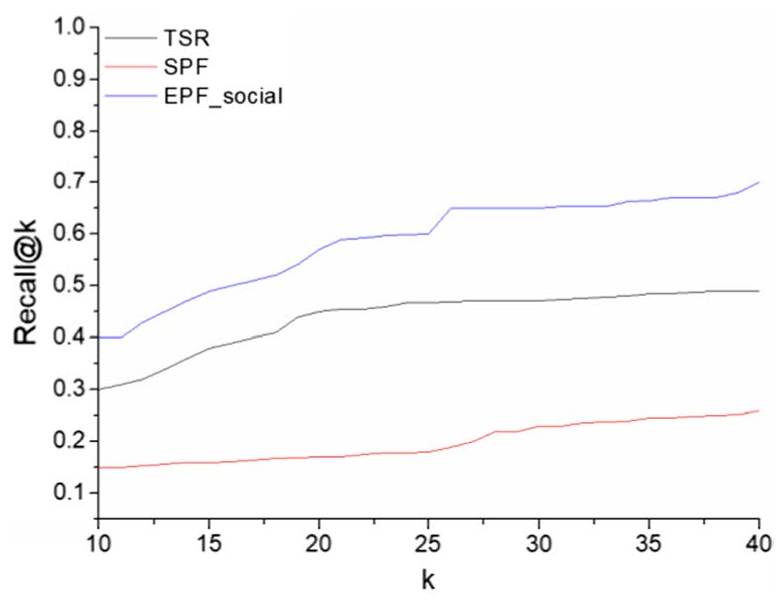 Figure 2: Comparison of Recall and NDCG metrics across Netflix and Last.fm datasets. EPF_Social (blue line) consistently outperforms static and purely social baselines.
Critical Insight & Conclusion
The success of EPF_Social proves that inductive bias matters. By choosing Gamma distributions and Poisson likelihoods, the authors respected the "shape" of recommendation data (sparse, non-negative, long-tailed).
Takeaway for Practitioners: If you are building a recommendation engine for a platform where social interaction and time are factors, avoid forcing "Gaussian" solutions for simplicity. Embracing the complexity of Gamma-Markov chains provides not only better performance but also a more robust theoretical foundation for scaling via Variational Inference.
Limitations: The model assumes social connections are known and static. Future work could explore evolving social graphs, where the network itself changes over time alongside the preferences.