
Evolving Friend Lists: Why Starting Over is Faster Than Fixing
Evolving friend lists in social networks
This paper explores the evolution of friend lists in dynamic social networks, introducing a quantitative framework to measure user effort. The authors compare manual list updates against a "Full Recommendation" approach using a connection-based group creation tool, demonstrating that automated recommendations significantly reduce effort once the social graph grows by more than 1%.
TL;DR
Managing friend lists (or "circles") on social media is a chore that most users ignore, leading to privacy leaks and cluttered feeds. This paper from UNC Chapel Hill proves that as your social circle grows, it's actually less effort to let an AI regenerate your groups from scratch than it is to manually add new friends to existing lists. Specifically, if your friend count grows by just 1%, automated "Full Recommendation" becomes the superior choice.
The Dynamic Graph Problem
Social networks are not static entities; they are "Evolving Graphs." Most research focuses on the initial creation of groups (like Facebook Smart Lists or Google+ Circles). However, the real friction happens later: when you add 10 new colleagues, do you remember to add them to your "Work," "Research," and "Lunch" lists?
The authors argue that the "Maintenance Debt" of social lists is why users stop using them. They categorize the solution space into two parts:
- Member Suggestion: The system asks, "Should Bob be in this list?"
- Group Creation: The system says, "Here are 5 new groups I've built for you."
Methodology: Simulating Growth
Because tracking real-world social evolution over years is difficult, the authors developed a novel Graph-Growth Model. Since small-scale ego networks (your personal friend circle) don't follow the "Power Law" typical of massive networks, they used a randomized subtraction method to simulate how a current graph grew from a smaller past state.
Measuring "Effort"
The core of this study is the Effort Metric. Instead of vague "user satisfaction," they quantified effort as the number of Additions + Deletions a user must perform to make a recommendation perfect.
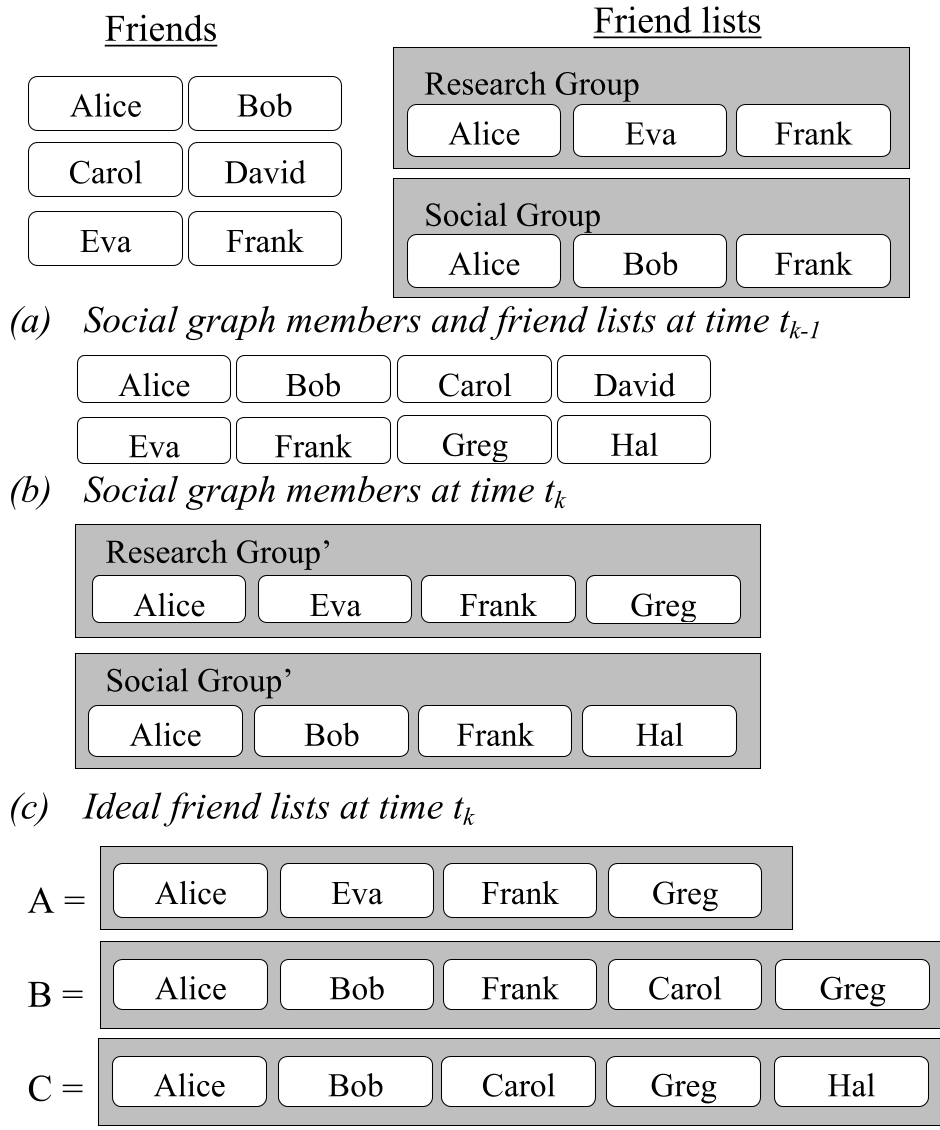 Figure 1: The transition from a static state (a) to a grown state (b), and the challenge of reaching the ideal evolved lists (c) vs. what a recommender provides (d).
Experimental Battle: Manual vs. Full Recommendation
The researchers tested their theory on data from 12 real users, simulating different levels of growth (from 1% to 40%).
The Intuition: You'd think that if you only added one friend, manually clicking "Add to List" would be easier than reviewing a whole new set of AI-generated lists. The Reality: The data shows that "Full Recommendation" (using state-of-the-art connection-based clustering) wins almost immediately.
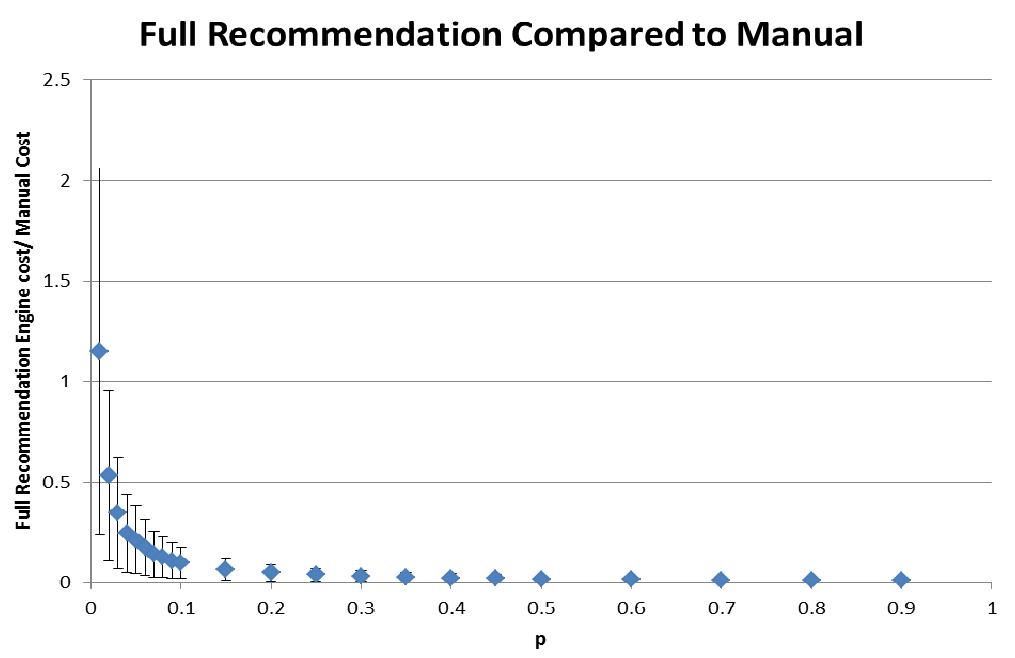 Figure 2: The cost (effort) of Full Recommendation vs. Manual. Lower is better. Full Recommendation stays consistently lower as the graph scales.
Key Insights & Critical Analysis
- The 1% Threshold: The "Manual" approach is only competitive when the graph changes by a negligible amount. This suggests social platforms should be much more aggressive in prompting "Refactoring" of lists.
- The Labeling Burden: A major limitation the authors acknowledge is Renaming. When an AI generates new lists, it doesn't always know that "Cluster A" is the same as your old "Research Group." The cost of re-labeling wasn't fully factored into the primary metric.
- The "Member Suggestion" Hybrid: While this paper focused on "Group Creation," the authors suggest that a hybrid approach—using user feedback from member suggestions to tune the clustering—might be the "Holy Grail" of list evolution.
Conclusion: A Lesson for Product Designers
This work shifts the focus from "how to build a list" to "how to keep a list alive." For developers of social or collaborative software (like Slack or LinkedIn), the message is clear: Don't just give users tools to edit; give them tools to rebuild. As digital social structures become more complex, the only way to keep them accurate is through periodic, automated "refactoring"—much like how software engineers manage evolving codebases.