
Precise Influence: Breaking the Approximation Barrier in Social Networks
An exact almost optimal algorithm for target set selection in social networks
The paper introduces an exact algorithm for the Target Set Selection (TSS) problem in social networks, achieving a time complexity of where is the treewidth. This approach bridges the gap between the polynomial-time solvability in trees and the extreme inapproximability in general graphs.
TL;DR
Researchers have developed a target set selection algorithm that achieves near-optimal performance by leveraging the treewidth of a social network. While the problem is generally impossible to approximate efficiently, this work provides an exact solution, proving that the closer a network is to a tree structure, the more "solvable" the viral marketing challenge becomes.
Background: The Hardness of Viral Marketing
In the context of social networks, the Target Set Selection (TSS) problem asks: "Which small group of people should I influence to trigger a massive domino effect of adoption?"
Mathematically, this is modeled by thresholds: a person adopts a product only if a certain number of their friends do. Despite its importance in medicine and economics, the problem is academically "nightmarish." It is not just NP-hard; it is extremely resistant to approximation. Even in simple bipartite graphs, finding a near-optimal solution has been a long-standing roadblock.
Methodology: Beyond Simple Trees
The authors move beyond simple tree structures (treewidth 1) to investigate graphs with bounded treewidth .
1. The Dynamic Programming Paradigm
The core of the solution lies in a Nice Tree Decomposition. The algorithm processes the graph from the "leaves" of its tree-like decomposition up to the "root." However, standard DP fails here because activating a neighbor in one part of the graph might depend on an activation in a completely different sector.
2. Overcoming Deadlocks
To solve this, the authors introduced two key innovations:
- Threshold Vectors: Instead of simple binary states, boundaries carry vectors representing the number of active neighbors required to trigger a cascade.
- Activation Orders: These ensure that the "timing" of activations across boundaries is consistent, preventing circular dependencies (deadlocks) when merging sub-problems.
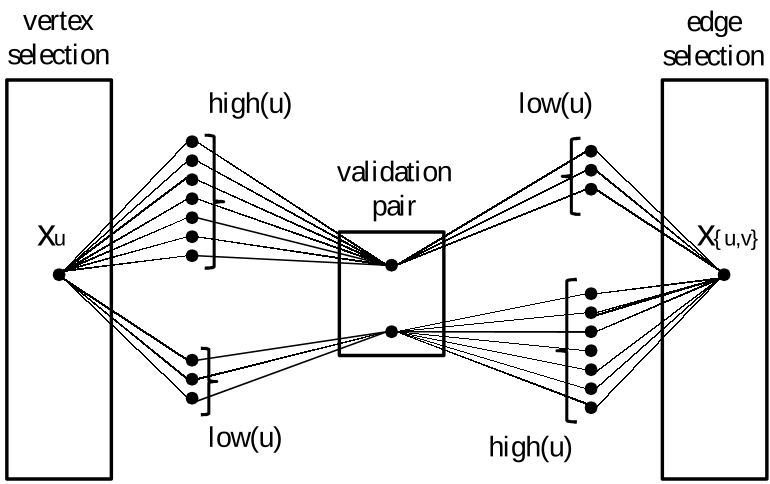 Note: The figure illustrates the complex validation logic required to ensure that local selections globally align with the network's constraints.
Proving Optimality: Is the Best We Can Do?
The paper doesn't just provide an upper bound; it sets a "speed limit." Through a reduction from the Multi-Colored Clique problem, the authors demonstrate that an algorithm would imply a breakthrough in complexity theory (specifically, a sub-exponential solution for all SNP problems).
This suggests that the provided algorithm is almost optimal. The exponential dependency on treewidth is a feature of the problem's inherent complexity, not a flaw in the algorithm.
Key Results & Generalizations
- Performance: The algorithm runs in time, which is effectively polynomial for graphs with small, constant treewidth.
- Robustness: The methodology extends to directed graphs, weighted edges (varying influence levels), and weighted vertices (varying costs to target individuals).
- The Bound: For a graph with vertices and treewidth , the algorithm effectively maps the difficulty of social influence to the topological "thickness" of the network.
Critical Insight & Conclusion
This research changes how we view social network influence. It tells us that we don't need to rely on "hit-or-miss" heuristics if we understand the underlying topology of the network. If a social network is fragmented but follows a core hierarchical or tree-like skeleton, we can find the mathematically perfect set of influencers.
Future Work
The primary limitation remains the exponential growth as increases. Future research could explore whether "average-case" treewidth in real-world social data (like Facebook or Twitter clusters) is low enough to make these exact algorithms practical for massive datasets.