
Unmasking the Power of Few: Identifying Intensive Groups in YouTube Commenter Networks
Examining Intensive Groups in YouTube Commenter Networks
This paper introduces a two-level decomposition optimization method for Focal Structure Analysis (FSA) to identify "intensive groups"—sets of individuals who are collectively influential despite individual insignificance. Applied to a massive YouTube commenter network (4.4M edges), it successfully detects coordinated disinformation actors by maximizing both local degree centrality and global modularity.
TL;DR
Influence on social media isn't always about the "Superstars" with millions of followers. Often, it is the result of small, highly coordinated "intensive groups" known as Focal Structures. This paper presents a bi-level optimization method that successfully identifies these groups within YouTube's conspiracy theory ecosystems—revealing how small "atomic units" of users can dominate information flow and mobilize crowds through disinformation.
Background Positioning
In the landscape of Network Science, we usually look for Influential Spreaders (high-degree nodes) or Large Communities (modularity maximization). This work sits in the crucial intersection: identifying structures that are small enough to be nimble but dense enough to be potent. It specifically addresses the "disinformation" coordinates on YouTube, where commenters link together through shared video targets.
The "Chain Group" Problem: Why Old Methods Failed
Prior Focal Structure Analysis (FSA) relied heavily on greedy algorithms. These suffered from two major technical flaws:
- The Chain Phenomenon: Identifying groups where nodes were loosely connected in a line, leading to an average clustering coefficient of zero—hardly an "intensive" group.
- Mutual Exclusivity: Assigning a node to only one group, which ignores the reality of "power users" who coordinate across multiple strategic fronts.
Methodology: The Bi-Level Max-Max Approach
To solve this, the authors moved from a simple search to a sophisticated Bi-Level Optimization problem.
Level 1: Local Node-Level Scrutiny
The algorithm starts at the microscopic level, calculating Degree Centrality for every node. It defines a "sphere of influence" for each node and filters these candidates based on their Average Clustering Coefficient (ACC). This ensures that only tight-knit clusters—rather than random chains—are considered.
Level 2: Global Modularity Optimization
The second level takes these local groups and tests them against the global network structure using Spectral Modularity.
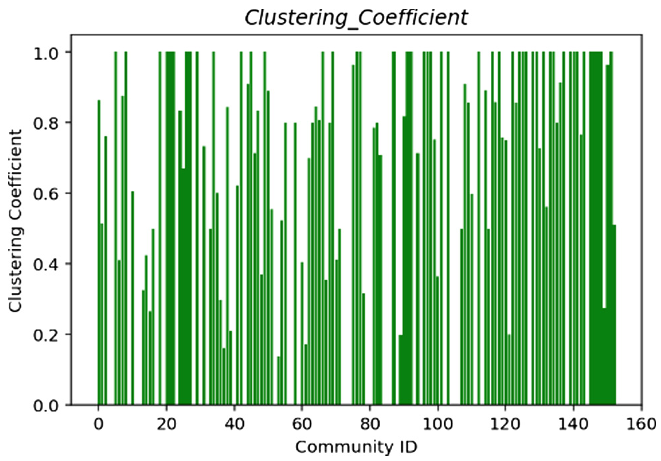 Fig 1: Degree centrality measures used to seed the initial focal structure candidates.
The math revolves around the Modularity Matrix : By maximizing , the algorithm ensures that the identified groups aren't just locally dense, but are statistically significant within the context of the entire 4.4-million-edge network.
Experimental Insights: YouTube’s Conspiracy Echo Chambers
The scholars tested their model on a real-world dataset of users commenting on conspiracy theory videos.
Key Findings:
- Atomic Influence: The model found "triads" (3-node groups) that acted as the smallest possible intensive units.
- Overlapping Roles: Unlike traditional community detection, this method allows for "FSA candidates" to be non-mutually exclusive. A single influential commenter can belong to multiple focal structures, amplifying their reach.
- Ranking for Investigation: Using a multi-criteria optimization (Equations 5 & 6 in the paper), the authors ranked groups based on density and path length. High-ranked groups (like FSA5) act as the "backbone" of disinformation, possessing the resources to influence the whole network rapidly.
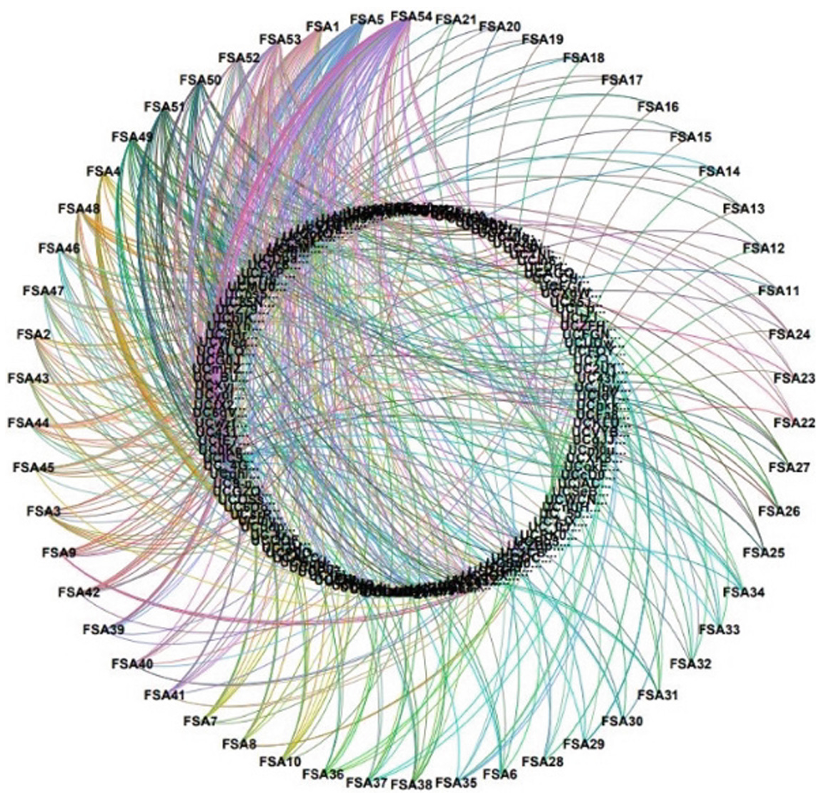 Fig 2: Visualization of the identified YouTube focal structures. Small colored clusters represent coordinated groups capable of massive information diffusion.
Critical Analysis & Takeaways
The brilliance of this work lies in its Decomposition-Optimization strategy. By decoupling the search into local "Centrality" and global "Modularity," it handles the resolution limit of traditional modularity (which often hides small groups inside larger ones).
Limitations: While mathematically sound, the model’s "tunable thresholds" for Jaccard similarity and weight parameters require domain expertise to set correctly. Future work could benefit from automating these thresholds.
Conclusion: For those fighting disinformation, this paper suggests we should stop looking for the "loudest" voice and start looking for the "tightest" group. These intensive groups are the true architects of social media mobilization.