
The Expanding Focus of HCI: Why "Culture" is More Than a Variable
The expanding focus of HCI: case culture
This paper presents a systematic meta-review of cultural research within Human-Computer Interaction (HCI) from 1990 to 2005. By analyzing 28 full-length articles from five premier forums, it identifies a significant shift from "expert-novice" gaps to "cultural tradition" gaps in globalized software markets.
Executive Summary
TL;DR: This seminal meta-review explores the evolution of "Cultural HCI" over a 16-year period. It reveals that while interest in national and ethnic culture is growing rapidly, the field remains trapped in a Western-centric "comparative" mindset that often treats culture as a static user characteristic rather than a dynamic context.
Background: Published in 2006 at the NordiCHI conference, this work acts as a "mid-point" audit for the field, documenting the transition from localized Western software to globalized digital ecosystems.
Problem & Motivation: The Western Bias
For decades, User Interface (UI) design followed Jonathan Grudin’s expansion framework, moving from hardware to social organizations. However, as the Internet bridged borders, designers realized that a "usable" interface in the US might be "nonsensical" in Japan or India.
The authors argue that the "cultural gap" is no longer just about experts vs. novices; it is about conflicting traditions. Yet, the field lacks a systematic way to categorize these cultural efforts, leading to fragmented research that often fails to inform actual design.
Methodology: Auditing 16 Years of Research
The authors conducted a rigorous content analysis of 3,286 full-length articles. They focused on:
- Technological Context: Is culture studied in the context of the Web, Groupware, or Mobile?
- Theoretical Pedigree: Where do HCI researchers get their definitions of "culture"?
- Geographic Coverage: Which nations are being studied?
 Figure 1: The sharp rise in cultural HCI interest post-1998, with the journal "Interacting with Computers" (IwC) leading the charge.
Key Insights: The "Hofstede" Trap
The review found a heavy reliance on Geert Hofstede’s Cultural Dimensions (e.g., Power Distance, Individualism). While these provide easy-to-measure metrics for quantitative studies, the authors critique them for being "abstract and empty" as design models.
Categorization of Approaches:
- Culture as User Trait: Studying cognitive styles and attitudes (57% of papers).
- Culture as Context: Using Activity Theory and Contextual Design (18%).
- Culture as System: High-level discussions on technology adaptation (18%).
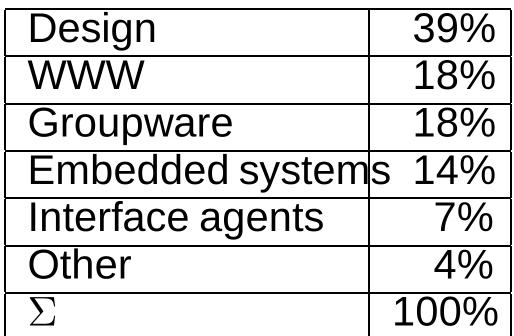 Table 1: Distribution of technological areas in cultural studies, showing "General Design" and "WWW" as dominant topics.
Critical Analysis & Future Outlook
The authors' most stinging critique is directed at the "Comparison" bias. Most studies compare a non-Western culture against a Western baseline (usually American), which reinforces a colonial mindset where "Internationalization" simply means "adapting existing Western versions."
Takeaway for Today's Researchers:
- Beyond Dimensions: Stop relying solely on 30-year-old psychological metrics (like Hofstede) to justify design choices.
- Context is King: Use "second-wave" HCI methods—ethnography and longitudinal observation—to understand how culture and technology interplay.
- End the Western Baseline: We need more "within-culture" studies that don't treat the Western experience as the "default" user experience.
Conclusion
Though published in 2006, the paper’s warning remains relevant: until HCI embraces a deeper, context-driven understanding of culture, global products will continue to be "usable" in a technical sense, but "culturally illiterate" in practice.