
Expanding Telecommunication Social Networks: Turning Billing Data into Social Capital
Expansion of Telecommunication Social Networks
The paper proposes a framework for automatically extracting and expanding Telecommunication Social Networks (TSN) by mining call detail records and user profiles. It introduces the SNEC algorithm and three specific strategies—Group Conjunction, Internal Expansion, and External Transfer—to stimulate new interpersonal relationships and increase network density and traffic.
TL;DR
This paper explores how telecommunication companies can move beyond being simple "pipes" for data to becoming architects of social ecosystems. By mining call records and applying the SNEC algorithm, providers can recommend new contacts to users, bridging separate social clusters and densifying internal group relationships to increase total network activity.
The Core Motivation: From Raw Data to Social Links
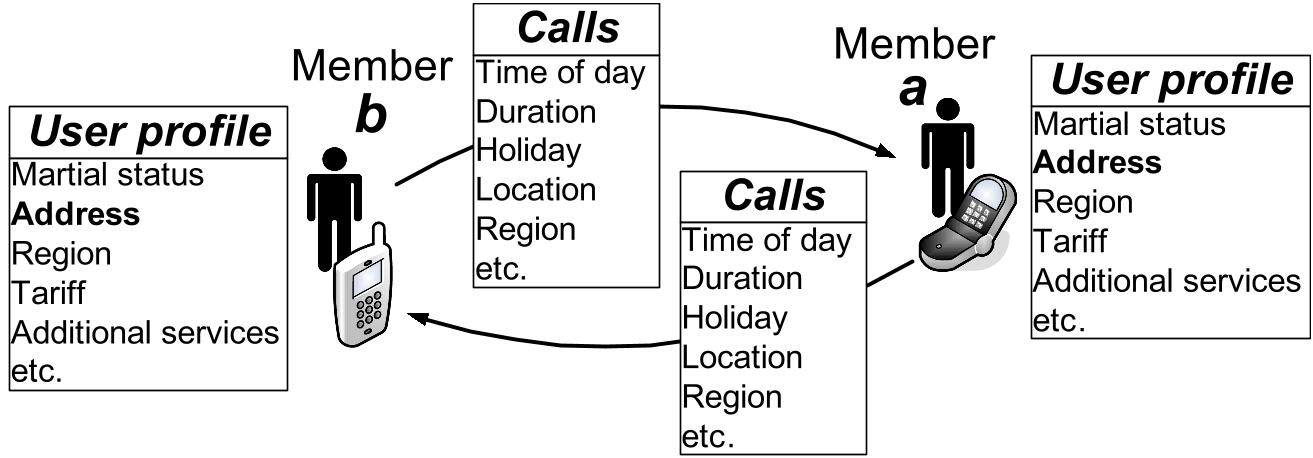
Telecommunication companies sit on a goldmine of interaction data. However, a single phone call doesn't necessarily equal a "relationship." Prior methods often failed to distinguish between a cold call to a business and a deep social tie. The author's insight is that social relationships are multi-dimensional—they are defined not just by frequency, but by timing (evening vs. work hours), context (holidays), and reciprocity.
Methodology: The Math of Social Ties
The author proposes a relationship function that serves as the foundation for the expansion strategies.
1. Extracting the Relationship
The formula for a relationship score incorporates both profile similarity and call patterns:
The calls(a,b) component is particularly sophisticated, penalizing old interactions and favoring "high-quality" social indicators like long-distance or holiday calls.
2. The SNEC Algorithm (Social Network Expansion)
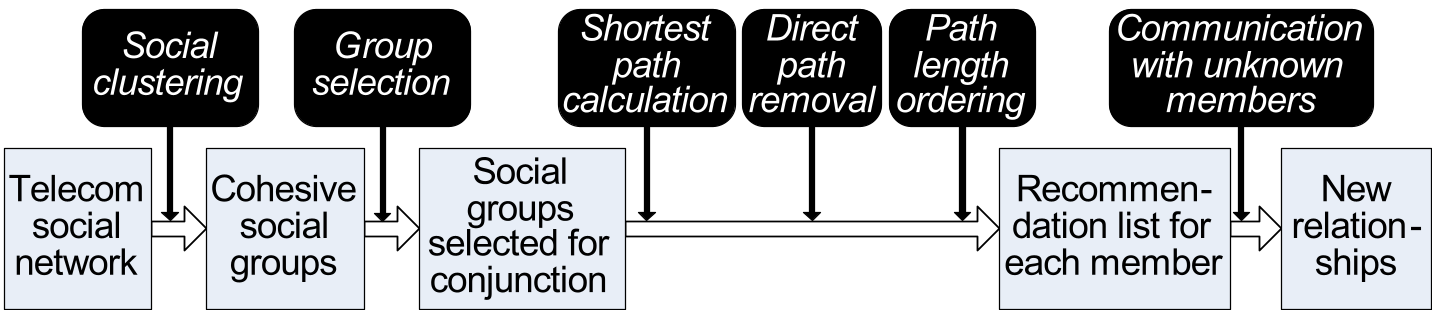
The primary tool for expansion is the SNEC Algorithm. Once the network is clustered into cohesive groups, SNEC identifies members in different groups who are "close" in the graph (e.g., separated by only 2 or 3 hops) but don't yet have a direct link.
Three Strategies for Growth:
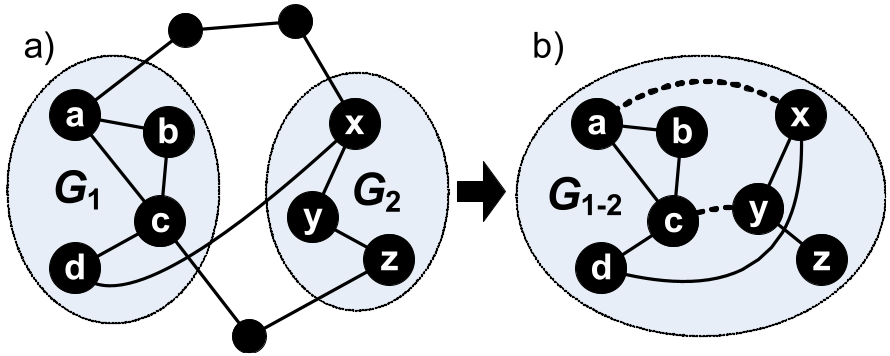
- Group Conjunction: Connecting two homogeneous but separate groups (Bridging).
- Internal Expansion: Recommending contacts within the same cluster to increase density (Bonding).
- External Transfer: Importing relationships from other services (email, blogs) into the telecom network.
Experiments and Results
Through illustrative graph examples, the paper demonstrates how the SNEC algorithm produces recommendation lists ().
- Shortest Path Advantage: By recommending users at a distance of 2 (friends of friends), the system has a higher probability of successful "re-connection" than random suggestions.
- Visual Proof: The transition from Figure 4a to 4b shows how targeted recommendations (dotted lines) effectively merge two disparate communities into a single, larger, and more resilient communication cluster.
Critical Analysis & Conclusion
Key Insights:
The emphasis on asymmetric relationships () is a vital observation. In social reality, one person may value a relationship more than the other, and the telecom data reflects this through call initiation patterns.
Limitations:
- Privacy: The paper acknowledges but does not fully solve the privacy hurdles of matching users across external data sources.
- Breadth vs. Depth: While the "shortest path" is a good proxy for similarity, it doesn't account for "capacity." The author's future work suggests using Maximum Flow to better understand the communication potential between nodes.
Future Impact:
As data privacy regulations (like GDPR) evolve, the "External Transfer" method becomes harder. However, the "Internal Expansion" and "Group Conjunction" methods remain powerful tools for any platform-based business trying to foster "sticky" communities.
Final Takeaway: Telecommunication social networks are dynamic organisms. By applying algorithmic recommendations, providers can actively steer the evolution of these networks rather than just observing them.