
When Experience Counts Most: Breaking the Gender Barrier in Social Support
When experience counts most: effects of experiential similarity on men's and women's receipt of support during bereavement ଝ
This study investigates how experiential similarity—having gone through a matching life event—affects the receipt of social support for men and women during bereavement. Using longitudinal data from 59 caregivers and 863 network members, the authors demonstrate that while men rarely seek support based on shared experience during active caregiving, experiential similarity becomes a critical predictor of emotional support for both genders following the death of a relative.
TL;DR
Is the "strong silent type" a permanent fixture of male psychology? This classic study by Suitor and Pillemer suggests otherwise. By tracking caregivers through the transition of bereavement, the researchers discovered that while men may ignore "shared experience" in gendered roles like caregiving, they rely on it just as much as women do when facing the universal, non-gendered reality of death.
Academic Positioning: This work serves as a critical bridge between Homophily Theory (the idea that like attracts like) and Gender Socialization, proving that context dictates how gender influences social network dynamics.
The Problem: The "Empathy Gap" in Men’s Support
For decades, social science has noted a stark disparity: women build robust emotional support networks, while men’s networks often dwindle to just their spouses. Prior theories suggested men are simply less willing to admit need or less proficient at soliciting help.
The authors hypothesized that the type of event matters. If an event is seen as "women's work" (like domestic caregiving), men might not value talking to others who have done it. But what happens when the event is a universal human experience, like the loss of a parent or spouse?
Methodology: A Two-Phase Natural Experiment
The study followed 59 primary caregivers (46 women, 13 men) through two critical periods:
- Time 1 (T1): Active caregiving for a relative with dementia.
- Bereavement (B1): Following the death of that relative.
The researchers analyzed the caregivers' social networks (863 associates) to see who provided support and why. They specifically looked for Experiential Similarity—did the friend or family member also have experience with caregiving or loss?
Core Findings: The Mid-Transition Pivot
The data revealed a fascinating shift in how men utilize their networks.
1. The Gendered Phase (Caregiving)
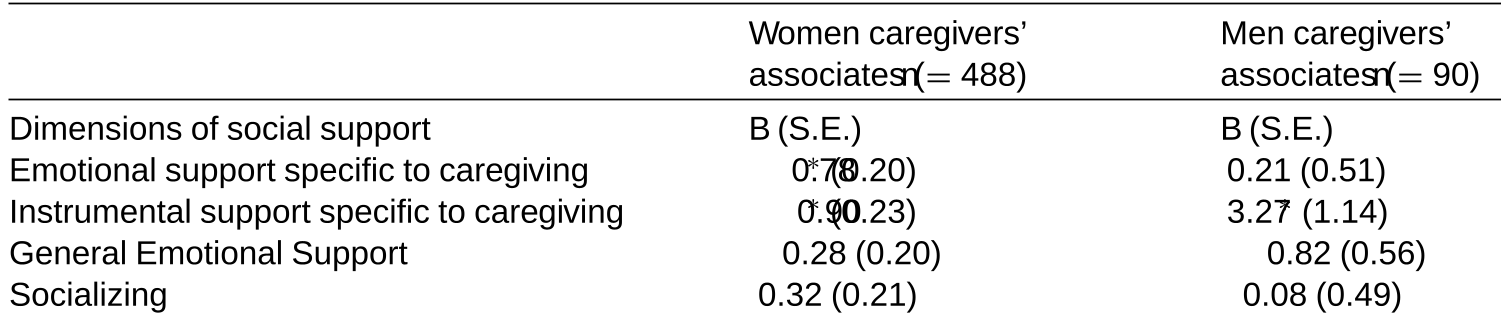
As shown in Table 1, for women, having a friend who was also a caregiver was a strong predictor of receiving emotional support. For men, it meant nothing. In active caregiving, men didn't care if their friends had "been there"; they didn't seek emotional resonance based on that shared role.
2. The Universal Phase (Bereavement)
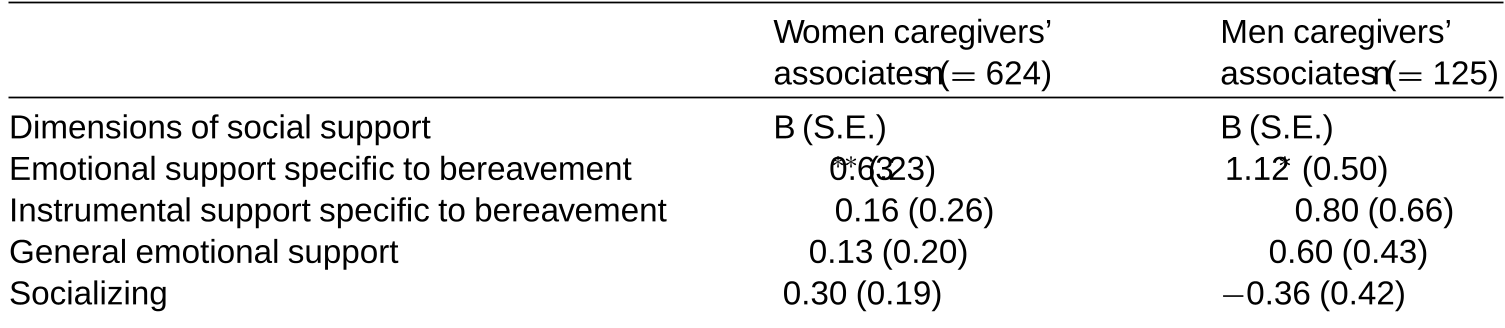
Everything changed after the relative died. As Table 2 illustrates, the "Importance of Similarity" coefficient for men jumped from near-zero to 1.12—actually surpassing the effect size for women in this specific sample.
3. Qualitative Insight: "He Understood"
Men who were previously silent about their struggles began to vocalize the value of shared experience. One male respondent noted the help of friends who had also lost parents: "It’s good having others who have experienced similar situations!" This indicates that when the event is perceived as highly salient and non-gendered, men utilize "experiential homophily" just as effectively as women.
Deep Insight: Why Why Does This Work?
The authors dismiss the idea that men lack the capacity for deep emotional connection. Instead, they propose a Salience Model:
- Gendered Events: Men may distance themselves from "experiential similarity" in roles that feel traditionally feminine (like "kinkeeping" and caregiving), perhaps as a way of maintaining gender identity.
- Universal Events: Bereavement is a "human" event, not a "gendered" one. In this space, the psychological barrier to seeking help drops, and the practical value of talking to someone who "knows the road" becomes undeniable.
Conclusion and Future Outlook
This paper is a masterclass in why "average" gender differences can be misleading. Men are not inherently "support-allergic"; they are context-sensitive.
Takeaway for Practitioners: When designing support systems (like apps or therapy groups) for men, focusing on universal transitions (job loss, fatherhood, bereavement) rather than specific domestic roles may unlock higher engagement by leveraging the power of experiential similarity.
Limitations: The sample was exclusively white and non-Hispanic, and the male sample size (n=13) for the longitudinal bereavement phase was small, though the results strongly mirrored patterns found in larger cross-sectional datasets.