
Decoding Human Rhythm: Why Semi-Markov Models Redefine Mobility in Social Networks
Experimental analysis of user mobility pattern in mobile social networks
The paper presents an experimental analysis of user mobility in Mobile Social Networks (MSNets) using real-world traces from Infocom 06 and MIT Reality. It introduces the concept of "geo-communities"—geographical locations with stable social member structures—and demonstrates that a semi-Markov model significantly outperforms standard Markov chains in predicting user movement by accounting for non-exponential sojourn time distributions.
TL;DR
Predicting where a user goes next is the "Holy Grail" for data forwarding and proximity advertising. This paper proves that humans don't move like particles in a gas (Random Waypoint); instead, we move between geo-communities (offices, dorms, gyms) where our stay duration follows a power-law distribution. By replacing standard Markov chains with semi-Markov models, the authors achieved a significant leap in location prediction accuracy.
The Flaw in the "Memoryless" Assumption
In the world of Mobile Social Networks (MSNets), connectivity is a luxury. Nodes (people) meet opportunistically. For years, researchers relied on Standard Markov Chains to model these transitions.
The fatal flaw? Markov chains assume the "Memoryless" property—that the probability of leaving a location depends only on the current state, implying an exponential distribution of stay durations. In reality, human behavior is "bursty." We stay in one place for a very long time (sleep) or move through many places quickly (commute). This discrepancy leads to poor prediction performance in traditional MANET models.
The Core Innovation: Geo-Communities
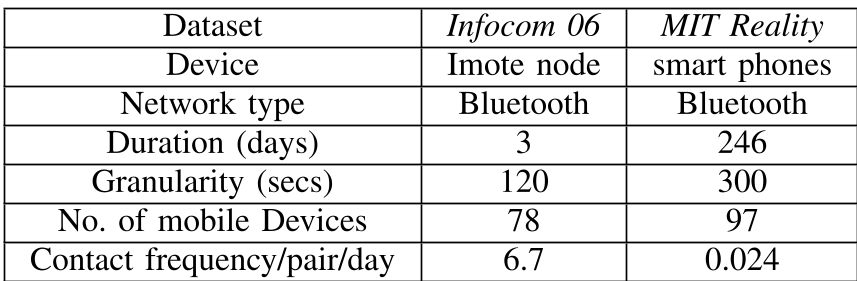
The authors bridge the gap between social relationships and physical geography. By analyzing the Infocom 06 and MIT Reality traces, they discovered that the social structure at specific geographic locations (APs) is remarkably stable.
- Member Stability: Using cosine distance, they found the similarity of people visiting the same location over different days exceeds 0.95.
- Physical Intuition: An office remains an "office" because the same group of colleagues (community) congregates at the same geographic coordinates (geo-location).
Methodology: From Markov to Semi-Markov
The mathematical heart of the paper lies in the shift to a semi-Markov process. Unlike a standard Markov chain, a semi-Markov process allows the time spent in a state to be a random variable with any distribution.
This formula accounts for the sojourn time—the specific duration a user spends in a geo-community. The authors observed that this duration follows a power-law distribution (heavy-tailed), meaning a user who has stayed in a lounge for 10 minutes is likely to stay even longer, rather than having a constant probability of leaving.
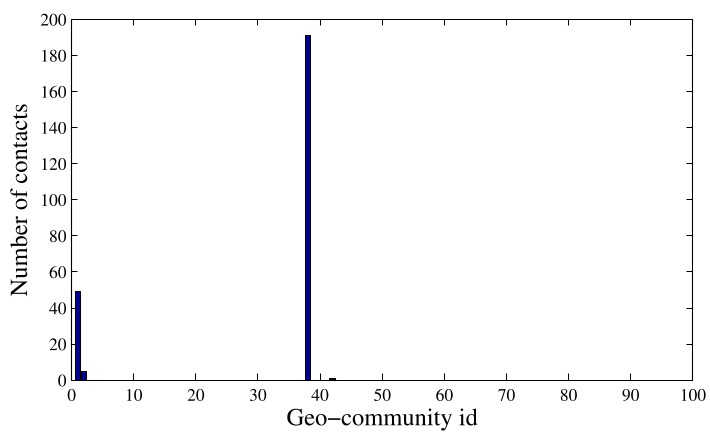 Figure 5 clearly shows the power-law characteristics (linear on a log-log scale) of sojourn times in both datasets.
Experimental Results: Precision Matters
The performance evaluation was conducted across different "prediction horizons" (from 360s to 2880s). The results consistently favored the semi-Markov approach:
- Prediction Accuracy: In the MIT dataset, the semi-Markov model maintained a persistent edge (approx. 7-10% higher accuracy) over the standard Markov model.
- Robustness: While standard Markov accuracy fluctuated wildly, the semi-Markov model showed a more stable decay as the prediction time increased.
- 2-Community Strategy: By predicting the top two most likely locations, accuracy jumped over 80%, providing a practical buffer for opportunistic networking protocols.

Critical Analysis & Takeaways
The brilliance of this work is its grounding in reality. Instead of creating a complex theoretical model in a vacuum, the authors used massive trace data to disprove a common academic simplification (exponential stay times).
Limitations:
- The model assumes a fixed set of geo-communities. In a dynamic city environment, new "pop-up" communities might form.
- The granularity of Bluetooth scanning (every few minutes) might miss micro-movements.
Future Outlook: This research lays the groundwork for Social-Aware Routing. If a device knows a user is currently in a "Long-Sojourn" state in a specific geo-community, it can make smarter decisions about when to transmit data or when to go into power-saving mode.