
Beyond Friend Lists: The Power of Implicit Social Signals in Recommendation
An experimental study on implicit social recommendation
This paper presents a comprehensive experimental study on "Implicit Social Recommendation," utilizing a Matrix Factorization (MF) framework with Social Regularization. The authors introduce methods to improve recommendation quality using computer-generated implicit social information (similar/dissimilar users and items) when explicit social networks are unavailable, achieving SOTA results on MovieLens and EachMovie datasets.
TL;DR
Social recommendation is powerful, but what if your platform doesn't have a "Friend" button? This classic SIGIR '13 paper by Hao Ma (Microsoft Research) proves that you don't need an explicit social graph to build a social recommender. By extracting implicit social relationships from user-item interactions and incorporating dissimilarity as a signal, the authors significantly boost Matrix Factorization performance.
Problem & Motivation: The "Social Gap"
The recommendation world is split:
- Social Recommender Systems: Highly effective but require explicit social graphs (rare).
- Collaborative Filtering (CF): Ubiquitous but suffers from data sparsity.
The author's intuition was simple: if we don't have a friend list, can we manufacture one? Furthermore, can we use people who are unlike us to refine our profile? This work bridges the gap by treating highly similar or dissimilar users/items as an "implicit social network."
Methodology: The Unified Social Regularization Model
The core of the paper is an extension of Social Regularization (SR). In a standard Matrix Factorization, we minimize the error between observed and predicted ratings. Ma adds a regularization term that forces the latent vectors () of "social" neighbors to be closer (if similar) or further apart (if dissimilar).
1. Finding Implicit Friends
Using Pearson Correlation Coefficient (PCC), the system identifies the Top-N similar and dissimilar users.
- Similar users: Minimize (Bring taste vectors together).
- Dissimilar users: Maximize the distance (using negative coefficients) to push taste vectors apart.
2. Item-Side Socialization
Innovation doesn't stop at users. The paper applies the same logic to items. If two movies are implicitly "related" (e.g., people rate them similarly), their latent vectors should be regularized together.
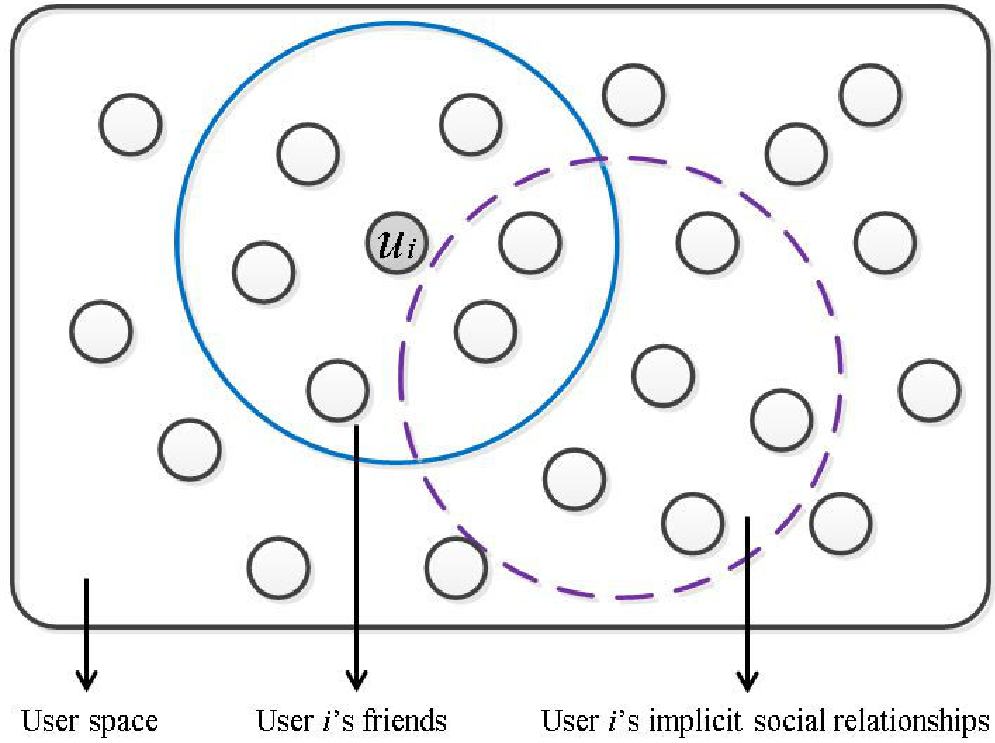 Figure 1: Visual comparison between explicit social circles and the calculated implicit circles used for regularization.
Experiments & Results
The authors tested their unified model across three datasets: MovieLens, EachMovie, and Douban (which has a real social network).
Key Findings:
- Implicit > Baseline: The
SRu+(Implicit User) andSRi+(Implicit Item) models consistently beat theRSVDbaseline. - The Power of Dissimilarity: Adding "dissimilar" neighbors (
SRu+-) provided a consistent marginal gain, proving that knowing what a user doesn't like is valuable. - The "Explicit" Edge: On the Douban dataset, using the real friend list (
SRexp) performed slightly better than the computer-generated implicit list.
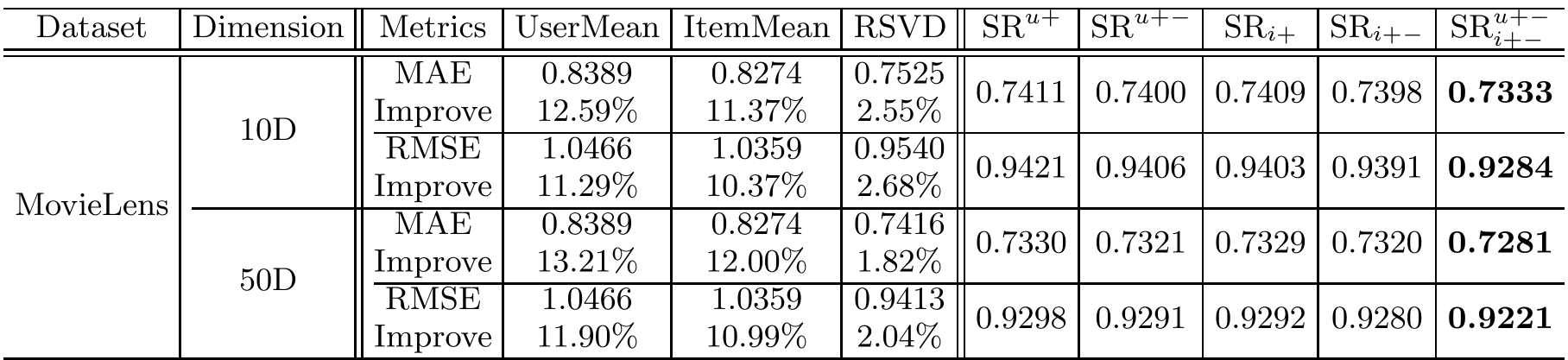 Table 1: Results on MovieLens showing that the unified model (SRu+-i+-) achieves the lowest error.
Deep Insight: Friend Diversity vs. Consistency
Why does the real friend list beat the implicit one? The paper analyzes RMSD (Root Mean Square Distance) of similarities.
- Implicit neighbors are "too similar" (highly consistent).
- Explicit friends are "diverse" (more variance in tastes).
The takeaway for ML practitioners is profound: Diversity in your regularization neighbors is more valuable than pure similarity. A friend who likes some of what you like, but also introduces new domains, provides a stronger signal for the model to learn complex latent features.
Conclusion
This study democratizes social recommendation. It proves that even in "cold" environments without social features, we can leverage the mathematical shadows of social behavior—similarity and dissimilarity—to build smarter, more robust latent factor models.
Limitations & Future Work
- Scalability: Calculating PCC for all user/item pairs in real-time is computationally expensive (O(N²)).
- Future Scope: Modern GNN-based approaches have largely superseded MF, but the core principle of using implicit graph structures remains a cornerstone of current SOTA Graph Collaborative Filtering.