
Decoding Human Connection: Insights from a 2.5 Million User Mobile Social Network
An experimental study of large-scale mobile social network
This paper presents an experimental study of a large-scale mobile social network using real-world call logs from 2.59 million users in a Chinese city. It identifies the network as a scale-free system with small-world properties, uncovering unique correlations between social activity and user demographics (age and gender).
TL;DR
This study analyzes one of the first massive-scale mobile social networks, comprising over 2.5 million users. By mapping call logs to demographic data, the researchers confirmed the "Six Degrees of Separation" in a real-world urban environment and discovered that our social connectivity peaks in middle age, with surprising gender shifts in our later years.
Contextual Positioning
Published during the rise of massive data analytics, this paper moves beyond theoretical graph models and niche datasets (like academic citations). It provides a high-resolution snapshot of how an entire city communicates, bridging the gap between graph theory and sociology.
Motivation: The Privacy Barrier
Most social network studies before this were limited by data accessibility. While we knew how researchers cited each other, we didn't truly understand how the average citizen navigated their social world through the most ubiquitous device: the mobile phone. The authors aimed to prove that mobile networks are not just random connections but structured "scale-free" systems that follow predictable human behaviors.
Methodology: Graph Theory at Scale
The researchers transformed a month of call logs into a graph where:
- Nodes: 2,590,361 unique users.
- Edges: A connection exists if two users had at least one conversation.
- Metadata: Integrated age (15–70) and gender via resident ID numbers.
Because calculating metrics for 2.5 million nodes is computationally "expensive," they employed specific approximation algorithms for Diameter and Betweenness Centrality, ensuring the study remained feasible without sacrificing statistical integrity.
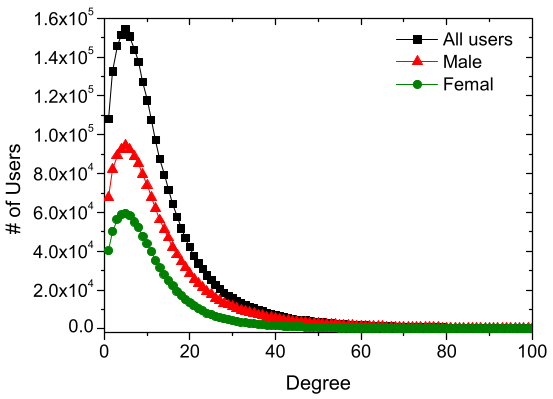 Figure 1: While the paper utilizes massive data, sub-graph visualizations (like 1f) demonstrate the heterogeneity of age and gender within the network.
Key Findings & Visual Evidence
1. The "Peak 5" Discovery
While most scale-free networks (like the Web) show the highest frequency at a degree of 1, this mobile network showed a peak at degree 5.
- Insight: In real life, humans generally maintain a core group of contacts. We don't just "exist" with zero or one connection; our social "baseline" involves a small cluster of family or friends.
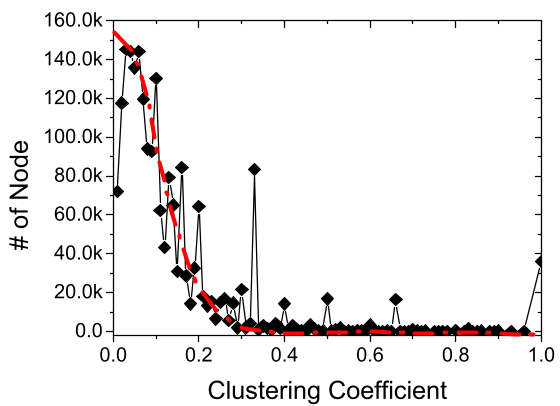 Figure 2: The degree distribution follows a power law, but notice the non-trivial peak shifting away from the y-axis, representing meaningful social baselines.
2. The Lifespan of Sociality
The data suggests a clear "social lifecycle":
- Youth (20s): Entering the workforce, connectivity begins to climb.
- Middle Age (40s): Peak connectivity. This is attributed to the intersection of professional demands and family management.
- Senescence (60s+): A sharp decline in the number of contacts.
3. The Gender Paradox
The study found that while men are generally more "active" (higher degree) than women throughout most of their lives, the trend reverses in old age. In the 60-70 age bracket, females become more socially active than males. The authors point to sociology theories (Fischer & Oliker) suggesting that lifestyle stages and marital roles heavily dictate network size as we age.
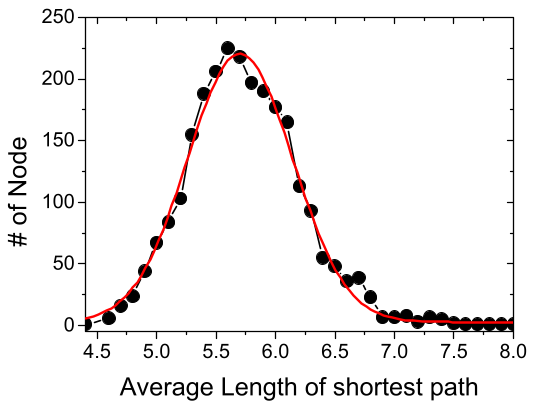 Figure 3: Comparison of social activity across lifespans, highlighting the crossover point in later years.
Critical Analysis & Takeaways
The study confirms that the Small-World Phenomenon is alive and well in urban China, with an average path length of 5.75. This is a remarkable empirical validation of the "Six Degrees" theory.
Limitations: The study uses an "undirected binary graph," meaning it doesn't distinguish between a 1-second accidental call and a 2-hour conversation. Future work would benefit from "weighted edges" to measure the strength of social ties rather than just their existence.
Future Outlook: This work paved the way for modern "Social Computing." By understanding that middle-aged users are the "hubs" of a city's communication, telecommunications companies and public health officials can better model how information—or even misinformation—spreads through a population.