
Decoding Digital Play: Markov Models vs. RNNs in Gamified Marketing
Experimental Study on Predictive Modeling in the Gamification Marketing Application
2021-01-01
Summary
Problem
Method
Results
Takeaways
Abstract
This paper investigates predictive modeling for user navigation patterns in gamification marketing applications. By comparing a first-order Markov model and a Recurrent Neural Network (RNN), the study identifies the Markov model as the superior approach for small-scale datasets, achieving up to 61.61% accuracy in predicting subsequent user actions.
## TL;DR
Modern digital marketing is shifting from passive billboards to interactive gamification. But how do we know if these "mini-games" are actually working? This study evaluates whether we can predict a user's next move using **Markov Models** and **Recurrent Neural Networks (RNNs)**. The surprising verdict: In the world of specialized marketing apps, the "old-school" Markov model reigns supreme over deep learning.
## Positioning the Research
In the taxonomy of AI research, this paper sits at the intersection of **Behavioral Analytics** and **Predictive Modeling**. It moves beyond simple descriptive statistics (like "how many people clicked X") toward proactive strategy (predicting "what will they click after X").
## The Motivation: Moving Beyond Passive Ads
The authors argue that traditional digital ads lack engagement. Gamification—using points, leaderboards, and badges—provides a "sense of control." However, the effectiveness of these systems is a black box unless we can map the **Navigation Pattern**. By understanding these patterns, companies can place ads where users linger and fix "bottlenecks" where users drop off.
## Methodology: The Battle of Architectures
### 1. The Data Pipeline
The study tracked 148 users over 8 days, generating 8,669 records. The key was converting raw logs into **Action Sequences** (e.g., `Start -> Main Page -> Game -> Score -> Shop`).
### 2. Markov Model: The Probabilistic Expert
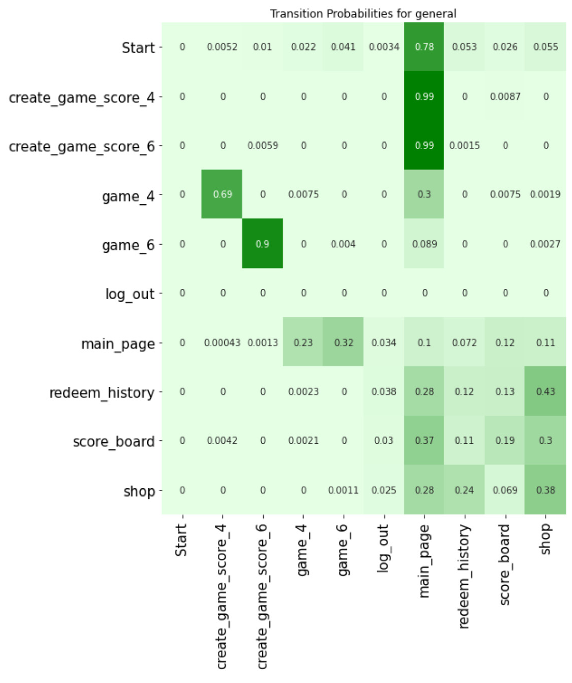
The Markov model builds a **Transition Probability Matrix**. It assumes the next state depends only on the current state.
* **Physical Intuition**: If 80% of people go to the 'Shop' after 'Game Score', the model predicts 'Shop'.

### 3. RNN: The Deep Learning Contender
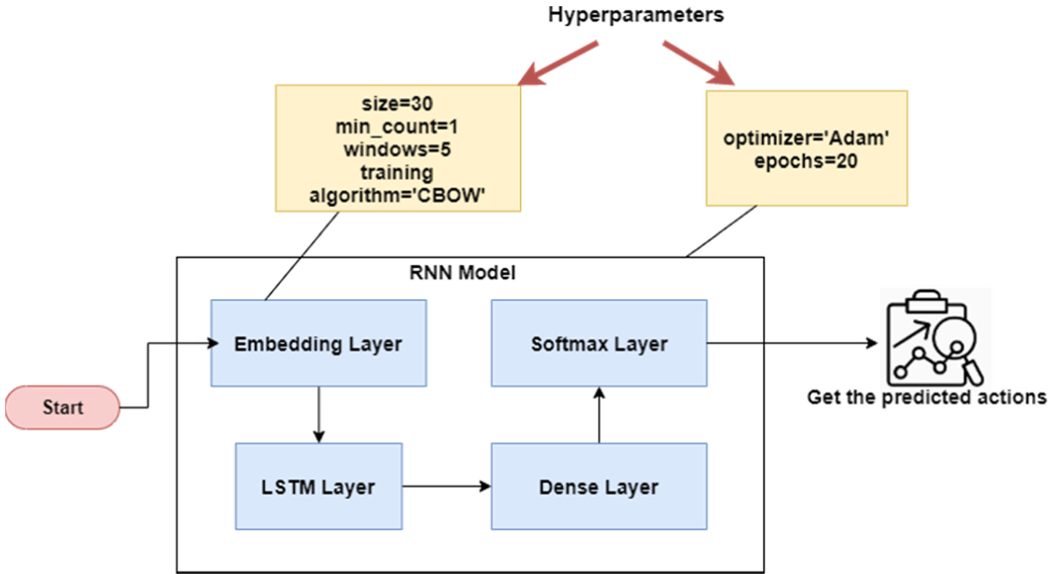
The authors used an **LSTM (Long Short-Term Memory)** network with **Word2Vec (CBOW)** embeddings. This treats user actions like "words" in a sentence, attempting to learn the "grammar" of navigation.
## Experiments & Results: Simplicity Wins
The results provided a reality check for deep learning enthusiasts.
| Model | Overall Accuracy | User-Specific Max Accuracy |
| :--- | :--- | :--- |
| **Markov Model** | **61.61%** | **100.00%** |
| **RNN (LSTM)** | 22.76% (Testing) | 33.33% |
### Why did the RNN fail?
The study reveals a critical insight: **Data Scarcity vs. Complexity**. RNNs require massive datasets to learn long-term dependencies. With only 727 sequences and 9 possible pages, the RNN "overfit" or failed to find meaningful patterns. The Markov model, however, excelled by simply capturing the most frequent transitions.
### Visualizing Behavior: The Heatmap
The transition heatmaps below reveal two types of users:
1. **Consistent Navigators**: Users who follow a rigid path (high probability cells).
2. **Randomized Navigators**: Users who jump between pages sporadically (diffuse probabilities), making them harder to predict.
## Critical Analysis & Conclusion
**Takeaway**: This paper is a vital reminder that **SOTA (State-of-the-Art) deep learning is not a silver bullet**. For specialized, closed-loop applications (like a specific brand's loyalty app), the inductive bias of a Markov Model—focusing on the immediate transition—is often more robust than a neural network.
**Limitations**: The study’s dataset is relatively small. The RNN's failure to respect "logical structures" (e.g., predicting 'Logout' three times in a row) suggests that the model needed **constrained decoding** or more training epochs.
**Future Outlook**: The authors suggest a hybrid approach—**Clustering Users** first (by age or habits) and then applying specific models to each cluster. In the next generation of gami-marketing, your app won't just react to you; it will anticipate your next "move" before you even think of it.