
The Human in the Loop: Redefining the Experimenter's Role in Autism-Robot Interaction
16511_The Role of the Experimenter in HRI Research - A Case Study Evaluation of Children with Autism Interacting with a Robotic Toy.
This paper explores the role of the experimenter in Human-Robot Interaction (HRI) for children with autism, utilizing "Robota," a humanoid robotic doll. The study demonstrates how a robot acts as a social mediator, facilitating triadic interactions between the child, the robot, and the experimenter through a "passive participation" approach.
TL;DR
This study challenges the traditional "invisible experimenter" dogma in Human-Robot Interaction (HRI). By positioning the experimenter as a "passive participant" during trials with children with autism and the humanoid robot Robota, the researchers demonstrate that the robot's true power lies in its ability to mediate—not replace—human-to-human social connection.
Contextual Positioning
In the landscape of assistive robotics, this work by Robins and Dautenhahn serves as a foundational pedagogical shift. While most HRI studies strive for clinical isolation to ensure statistical significance, this paper argues for Ecological Validity and Therapeutic Intuition, placing it firmly in the niche of Robot-Assisted Therapy (RAT) rather than pure mechanical engineering.
The "Invisible" Barrier: Why Standard HRI Fails Autism
The "triad of impairment" (social interaction, communication, and imagination) makes the world a frighteningly unpredictable place for autistic children. Traditional research designs often place the experimenter behind a one-way mirror. However, when a child with autism—who rarely initiates contact—finally reaches out to a co-present adult, ignoring that gesture for the sake of "experimental purity" is a missed therapeutic goldmine.
The authors argue that the experimenter must be an active instrument of the trial, ready to capture and reward social "bids" from the child.
Methodology: The Robot as a Social Bridge
The researchers used Robota, a humanoid doll capable of autonomous "dancing" or "puppet" mode (controlled via a Wizard-of-Oz setup).
The "Creative Error" Strategy
One of the most profound insights in the methodology was the use of deliberate mistakes. By making the robot move the "wrong" arm during an imitation game, the experimenter broke the child’s expectation. This "violation of expectation" directed the child's attention away from the mechanical object and toward the human controller, turning a dyadic interaction (Child-Robot) into a triadic one (Child-Robot-Experimenter).
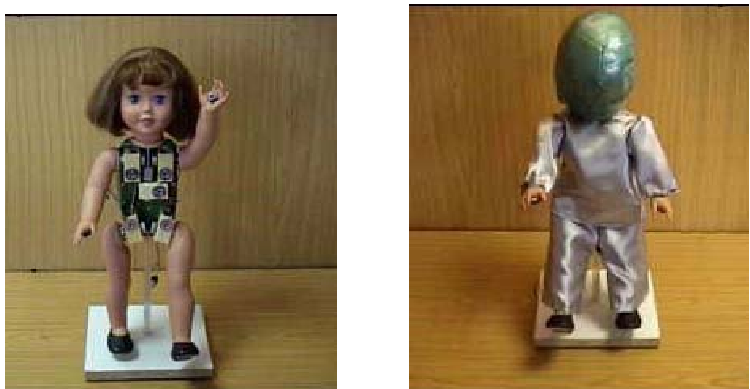 Figure 1: The Robota doll, showing both its internal mechanics and its "clothed" humanoid appearance used to engage children.
Experimental Insights: Breaking the Shell
The paper presents three compelling case studies:
- Indirect Mediation (Jack): Jack laughed at the robot’s "mistakes," eventually turning to the experimenter to share the joke. The robot acted as a channel for humor.
- Spontaneous Initiation (Andy): Andy, normally non-verbal and isolated, pulled the experimenter to the floor to play. The experimenter used this opportunity to redirect Andy's attention back to the robot, teaching him joint attention through the robot's movements.
- Physical Bonding (Billy): Billy, who had ignored humans for several trials, ended up sitting on the experimenter’s lap to watch the robot—a massive leap in social proximity and trust.
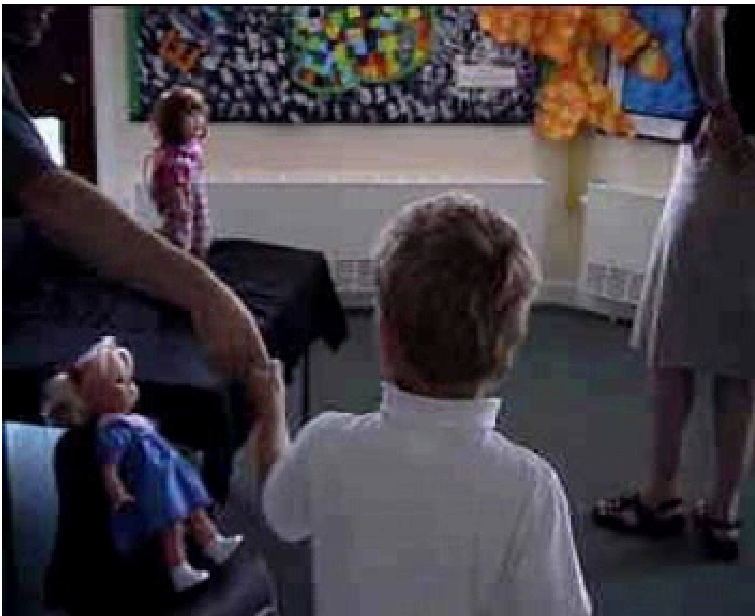 Figure 2: A breakthrough moment where the child (Andy) uses non-verbal cues to point out a robot malfunction to the experimenter, demonstrating Joint Attention.
Critical Analysis & Conclusion
Takeaways
- The Robot is a Tool, Not a Cure: The robot provides a predictable, low-stress environment that acts as a "scaffold" for more complex human interaction.
- Clinical Intuition Matters: An HRI experimenter in this field needs more than technical skills; they need the "gut feeling" of a therapist to know when to deviate from the protocol to support a child's social breakthrough.
Limitations & Future Work
The study relies on case-by-case qualitative analysis. While this is necessary given the high variance in the autism spectrum, it lacks the scalability of quantitative metrics. Future research should look at how to formalize these "passive participation" rules into a framework that can be taught to less experienced operators or even automated into the robot’s AI to recognize and facilitate these triadic moments.
Ultimately, Robins and Dautenhahn remind us that in the world of assistive tech, the goal of the robot is to eventually make itself unnecessary—by handing the child's hand back to the human.