
eCSAAP: Bridging the Gap Between Meteorology and AI via Expert Crowdsourcing
Using Expert Crowdsourcing to Annotate Extreme Weather Events
The paper introduces eCSAAP-ACAEWE, a service-oriented architecture designed to facilitate the semantic annotation of Extreme Weather Events (EWE) through expert crowdsourcing. It bridges the gap between raw meteorological data and machine-learning-ready datasets by integrating human expertise into the data labeling pipeline.
TL;DR
Predicting Extreme Weather Events (EWE) is one of the most significant challenges in modern climate science because these events are, by definition, anomalies. The eCSAAP-ACAEWE architecture addresses this by creating a specialized platform where weather experts can annotate complex atmospheric phenomena. By transforming raw meteorological data into semantically labeled maps, the system provides the high-quality data necessary to train more accurate automated forecasting algorithms.
The "Anomalous" Problem: Why AI Struggles with Extremes
Most state-of-the-art climate models are trained on historical norms. When a "once-in-a-century" cyclone or unprecedented heatwave occurs, automated systems often fail to recognize the early signatures.
The core bottleneck isn't just a lack of data; it's a lack of labeled data. While projects like mPING allow the general public to report local weather, they don't capture the expert "intuition" needed to identify the origin or structural evolution of a storm. There is a distinct lack of tools that allow a PhD-level meteorologist to look at a Potential Vorticity map and say, "The event starts exactly here."
Methodology: The eCSAAP-ACAEWE Architecture
The researchers developed a service-oriented architecture designed for interoperability and scalability. The workflow follows an end-to-end pipeline:
- Data Ingestion: Fetching multi-metric data (wind, temperature, pressure) from the European Centre for Medium-Range Weather Forecasts (ECMWF).
- Expert Visualization: A React-based frontend allows users to configure "Wizard" forms to generate specific weather maps using Matplotlib.
- Semantic Annotation: Integrating with PYBOSSA, the system presents these maps to experts who use a "Task Presenter" to define areas of interest via bounding boxes and filter weather value ranges.
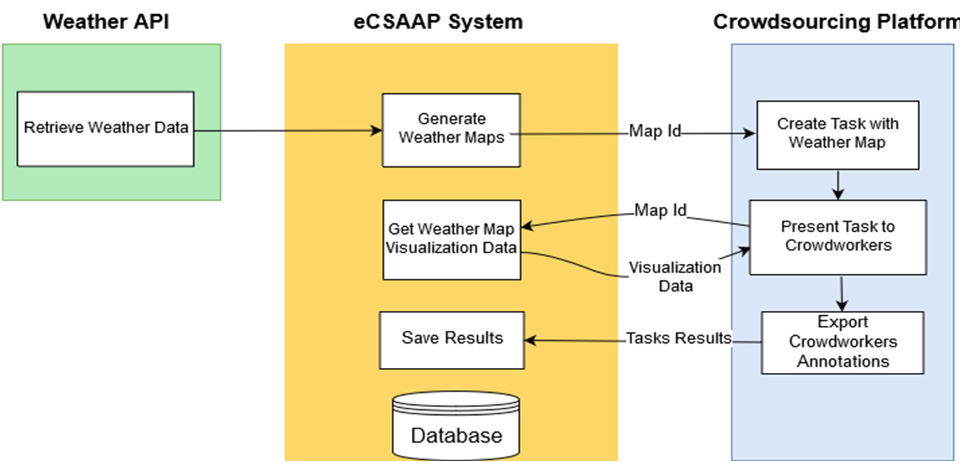 Figure 1: The eCSAAP-ACAEWE architecture, showcasing the flow from Weather APIs to the Crowdsourcing Task Presenter.
Turning Visual Intuition into Machine Data
The "magic" happens in the Task Presenter. Unlike existing tools that only show static images, this architecture uses the Leaflet JS library to create interactive weather overlays.
Experts aren't just looking at a picture; they are interacting with the underlying data. They can:
- Customize the range of weather values (e.g., only show wind speeds above a certain threshold).
- Draw rectangular annotations that are saved with precise geographical coordinates.
- Tag specific layers with semantic metadata.
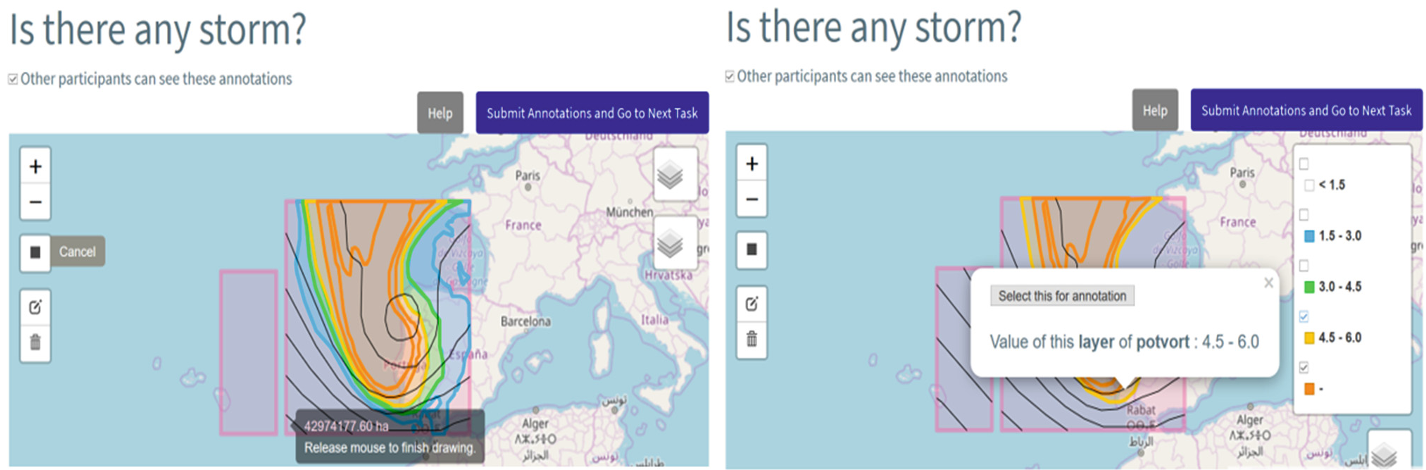 Figure 2: The expert annotation interface, allowing for precise geographical and value-based selection of weather events.
Critical Analysis & Results
The study demonstrates that it is technically feasible to build an integrated environment that supports the high precision required by professional meteorologists. By utilizing a microservices model (Django/Python), the system remains flexible enough to incorporate new libraries or different weather data sources in the future.
Key Findings:
- Contextual Accuracy: Unlike amateur crowdsourcing (e.g., Cyclone Center), this system focuses on the nature and origin of events, not just their intensity.
- Automation Potential: The output (JSON/machine-readable polygons) is directly compatible with Deep Convolutional Neural Networks (CNNs) used for atmospheric pattern recognition.
Limitations & Future Work
The primary hurdle remains the "Expert Bottleneck." While the crowd is large, the expert crowd is small and their time is expensive. Future iterations of this work will need to explore Active Learning—where the AI identifies the most "confusing" cases and only requests expert intervention for those specific frames—and game-theoretic incentives to keep experts engaged.
Conclusion
The eCSAAP architecture moves human computation in meteorology from "passive reporting" to "active semantic modeling." As extreme weather becomes the new global constant, such systems will be vital for translating human scientific expertise into the training sets of the future.