
From Explanation to Prediction: Boosting the Accuracy of Population Dynamics Models
Expert Systems With Applications
The paper introduces a methodology for building ensembles (Bagging and Boosting) of process-based models (PBMs) to simulate dynamic systems. Evaluated on aquatic population dynamics in Lakes Bled, Kasumigaura, and Zurich, the approach achieves significant SOTA improvements in long-term predictive accuracy compared to single PBMs.
TL;DR
Researchers have developed a breakthrough methodology that applies Bagging and Boosting to Process-Based Models (PBMs). Traditionally, these models were great for "explaining" nature but poor at "predicting" it. By combining multiple ODE-based models and using a novel dynamic pruning technique, this approach improves long-term prediction accuracy by up to 35% in complex aquatic ecosystems.
Background: The Interpretability-Predictability Trade-off
In ecological modeling, we often face a dilemma: use a "black box" machine learning model (high accuracy, zero transparency) or a "process-based model" (high transparency, often lower accuracy). PBMs use Ordinary Differential Equations (ODEs) to describe biological interactions like growth and respiration. However, because they are so grounded in physical laws, they are often rigid and struggle to generalize to future "unseen" data.
The Core Insight: Ensembles of Equations
The authors' central thesis is that the predictive power of PBMs can be salvaged using Ensemble Learning. While ensembles are common in classification (e.g., Random Forests), applying them to ODEs is non-trivial because:
- Temporal Dependency: You cannot simply shuffle time-series data; the order matters.
- Divergence: A single bad parameter in an ODE can cause the simulation to explode to infinity, ruining the ensemble average.
Methodology: Opening the Black Box
The researchers extended the ProBMoT platform to support two major strategies:
- Bagging (Bootstrap Aggregation): Learning models from different weighted samples of the training data.
- Boosting: Iteratively training models and and assigning higher weights to time points that the previous model struggled to predict.
 Figure 1: The standard workflow for learning a process-based model from domain knowledge and data.
A critical innovation here is Dynamic Pruning. Before averaging results, the system checks if a model’s trajectory stays within "physically plausible" bounds (e.g., phytoplankton cannot have a negative concentration). If a model diverges, it is automatically discarded from that specific time-step's calculation.
Experimental Results: Lakes under the Microscope
The team tested their methods on seven-year datasets from three distinct lakes: Bled (Slovenia), Kasumigaura (Japan), and Zurich (Switzerland).
Key Findings:
- Bagging is King: Bagged ensembles outperformed single models in 13 out of 15 experiments.
- The Power of Average: Surprisingly, simple unweighted averaging outperformed complex weighting schemes, adhering to the principle of parsimony.
- Validation Matters: Selecting base models based on a separate validation set was crucial to prevent overfitting—a common pitfall when "regular" training selection was used.
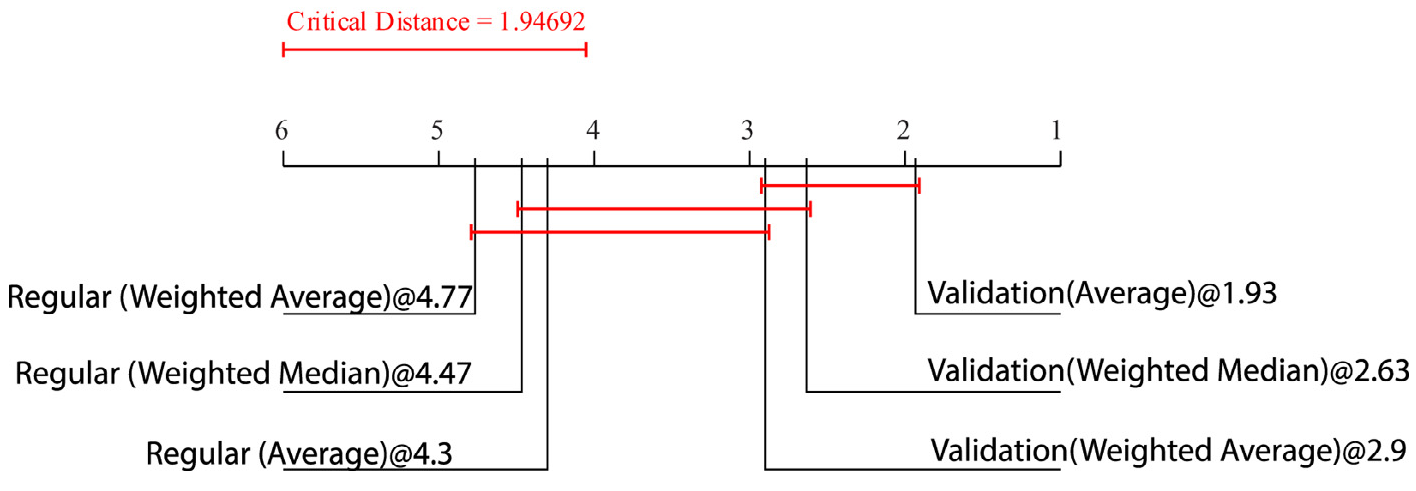 Figure 2: Statistical comparison showing Bagging (Avg. Rank 1.47) significantly outperforming single models (Avg. Rank 2.67).
Deep Insight: Diversity vs. Accuracy
The study analyzed the correlation between Ensemble Diversity (how different the constituent models are) and Improvement. While a positive correlation was found, it was weaker than expected. This suggests that even "modest" diversity in the underlying mathematical structures of the ODEs is enough to stabilize long-term predictions significantly.
Critical Analysis & Future Outlook
Limitations: The study used a simplified library of model fragments to save on computation. Using a full library with tens of thousands of potential structures might yield even higher diversity and better results.
The Takeaway: This work proves that we don't have to sacrifice the "Why" (explanation) for the "How much" (prediction). By ensembling process-based models, we can create systems that are both scientifically rigorous and practically useful for environmental management.
Future Work: The authors suggest moving toward "Super-models"—ensembles where models don't just work in parallel but "talk" to each other during the simulation to correct errors in real-time.