
MCIM: Balancing Influence and Coverage via TOPSIS
Expert Systems With Applications
The paper proposes MCIM (Multi-Criteria Influence Maximization), an algorithm based on the TOPSIS method to identify influential seed nodes in social networks. It focuses on balancing individual node influence with minimal spatial overlap to ensure maximum information coverage.
TL;DR
Identifying the "cool kids" in a social network is easy, but picking a group of them that doesn't all hang out in the same circle is hard. This paper introduces MCIM (Multi-Criteria Influence Maximization), which uses the TOPSIS decision-making framework to select seed nodes that are both highly influential and strategically spread out, preventing "influence overlap" and maximizing the viral reach of messages.
The "Influencer Cluster" Problem
In viral marketing, you have a limited budget to pick k "seed" users to start a trend. Most algorithms look for nodes with high Centrality (lots of friends). However, high-centrality nodes tend to be neighbors. If you pick five best friends as your seeds, their influence overlaps heavily, and you waste your budget on the same audience.
The challenge is a classic Multi-Criteria Decision-Making (MCDM) problem:
- Maximize Individual Power: Pick nodes that can reach many people.
- Minimize Redundancy: Ensure new seeds don't cover the same ground as seeds already chosen.
Methodology: The MCIM Architecture
The authors treat influence maximization as a geometric problem in the criteria space. They use TOPSIS, an approach that identifies a solution closest to the "Positive Ideal" (highest influence, zero overlap) and furthest from the "Negative Ideal" (lowest influence, total overlap).
The Four Pillars of Selection
Instead of just looking at degree, MCIM calculates four metrics for every potential node :
- Direct Spreading (DS): The node's immediate degree.
- Indirect Spreading (IDS): Calculated using Entropy, looking at how influential the node's neighbors and "neighbors of neighbors" are.
- Direct Overlap (DO): How many of the node’s friends are already in the seed set.
- Indirect Overlap (IDO): The shared neighborhood size between the node and the current seed set.
 The Decision Matrix (A) represents the heart of the selection process, balancing gain (DS, IDS) against cost (DO, IDO).
Experiments: How it Stacks Up
The authors tested MCIM across six real-world networks (including Twitter and Gnutella) and several synthetic LFR benchmarks. They used the SIR (Susceptible-Infected-Recovered) model to simulate actual information flow.
Key Findings:
- Superior Reach: In almost all datasets, MCIM outperformed traditional methods like K-shell and even advanced heuristics like IMSN.
- Scalability: Unlike Greedy algorithms (like CELF) that require thousands of simulations, MCIM relies on structural calculations, making it much faster for larger networks.
- Robustness: Whether the network is dense (like Astro Physics) or sparse (like Twitter), the balance between spreading and overlap remains consistent.
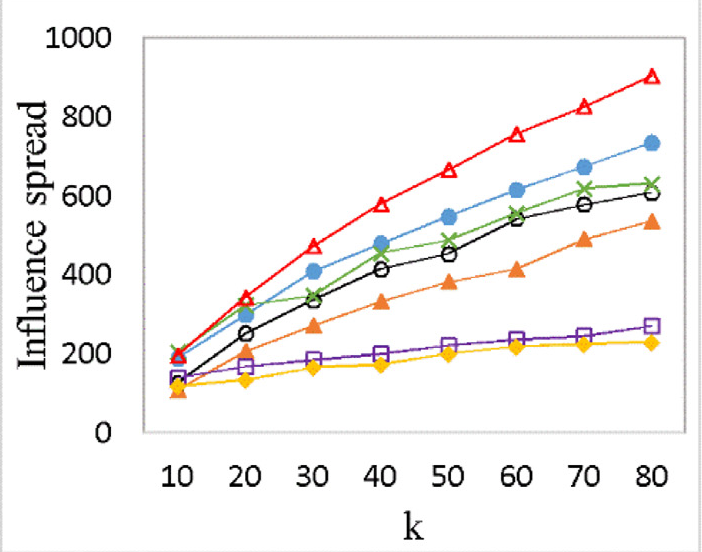 Influence spread results across different spreading probabilities (β). MCIM (often the pink or top-most line) consistently maintains high coverage.
Critical Insight: Why Entropy Matters
The use of Entropy in calculating Indirect Spreading (IDS) is a masterstroke. It doesn't just ask "are your neighbors powerful?" but "how is that power distributed?" A node connected to a few diverse "gatekeepers" is often more valuable than one connected to a monolithic cluster of high-degree nodes.
Conclusion & Future Outlook
MCIM proves that you don't need heavy simulations to solve Influence Maximization effectively. By framing it as a multi-criteria optimization, the authors provide a bridge between graph theory and operational research.
Limitations: The current model treats all edges as equal. Future iterations could integrate Edge Weights (relationship strength) or Directed Edges (one-way following) to better reflect platforms like Instagram or LinkedIn.
Takeaway for Practitioners: When selecting seeds for a campaign, don't just look for high numbers. Look for "Structural Diversity"—nodes that provide a unique bridge to untouched parts of the network.