
AIRank: Why Groups and Conformity Define the New SOTA in Social Influence
Expert Systems With Applications
This paper introduces AIRank and AIRank', novel node ranking methods that integrate social conformity theory and community features to identify influential spreaders in social networks. By improving upon the VoteRank algorithm, the authors leverage individual attractive power and group-based initiating power to achieve higher resolution and better coverage in information dissemination.
TL;DR
Identifying the most influential nodes in a social network is a classic "needle in a haystack" problem. In their paper, Zhang et al. propose AIRank, a method that moves beyond simple connectivity. By blending Social Conformity Theory (individual level) with Community Structure (group level), they demonstrate that a node's power is not just about how many friends it has, but where it stands between groups and how much its neighbors "trust" the majority.
Problem & Motivation: The Resolution Trap
Most traditional algorithms like Degree Centrality or K-shell suffer from a "resolution" crisis: in large networks, thousands of nodes might have the exact same score. This makes selecting a top-k seed set nearly arbitrary.
More importantly, these methods often ignore influence overlapping. If you pick two highly influential nodes that happen to be in the same tight-knit circle, their efforts are redundant. The author's insight is that to maximize spread, we must find "bridge" nodes that connect disparate communities and leverage the psychological tendency of individuals to follow the crowd (conformity).
Methodology: Individual Attraction vs. Group Initiation
The AIRank framework splits influence into two distinct vectors:
1. Attractive Power (AP) - The Individual View
Inspired by Social Conformity Theory, AP suggests that an individual is more likely to be attracted to a node if that node's "influence" (followers) is significant relative to others. It distinguishes between nodes of the same degree by analyzing the quality of their neighborhood.
u \in N _ {o u t} (j)} | N _ {i n} ( u) |}$$ ### 2. Initiating Power (IP) - The Group View IP focuses on the **Bridge Effect**. If a node moves information from a small community to a massive one, or links two separate groups, its initiating power is high. This prevents the algorithm from getting stuck in local optima. 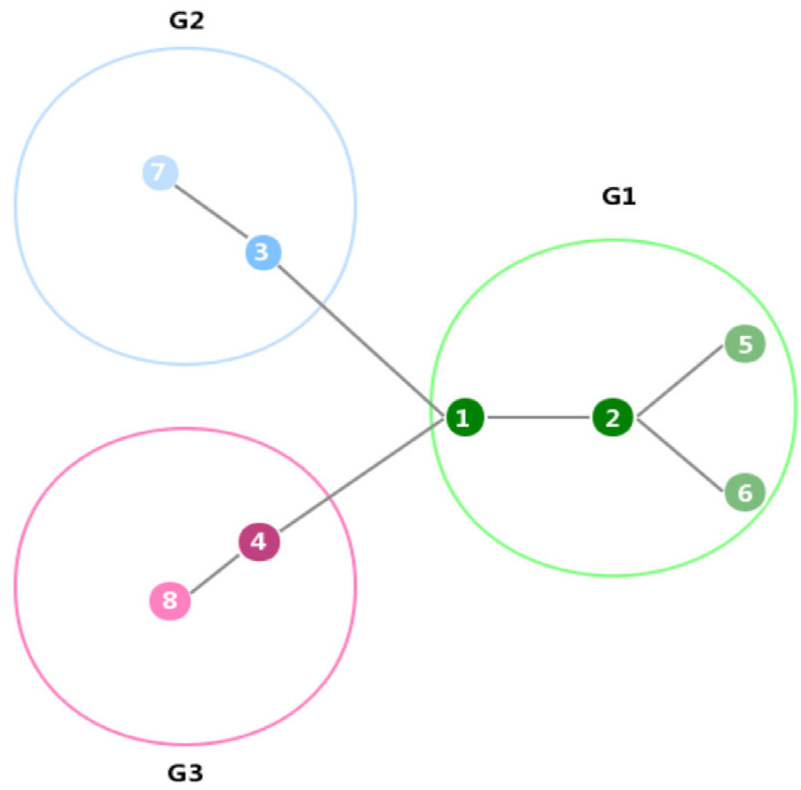 ### 3. Community Tightness (CT) - Solving the Overlap To ensure the seed nodes are distributed properly, the authors introduce **AIRank'**. This variant uses a 0-1 threshold for "community tightness." If a potential new seed is too "tight" with an already selected seed's community, it is skipped. This ensures that the message spreads across the entire network manifold rather than saturating a single cluster. ## Experiments & Results: Real-World Dominance The researchers tested their methods on three major datasets: **Eu-core** (email network), **soc-Epinions** (trust network), and **Notre Dame** (web hyperlinks). * **The Winner**: AIRank' consistently achieved the largest **Final Infected Scale ($F(t_c)$)** across both SIR (Susceptible-Infected-Removed) and IC (Independent Cascade) models. * **Efficiency**: While AIRank maintains a linear complexity **O(n)**, the superior AIRank' scales at **O(n²)**, representing a trade-off between accuracy and computational speed. 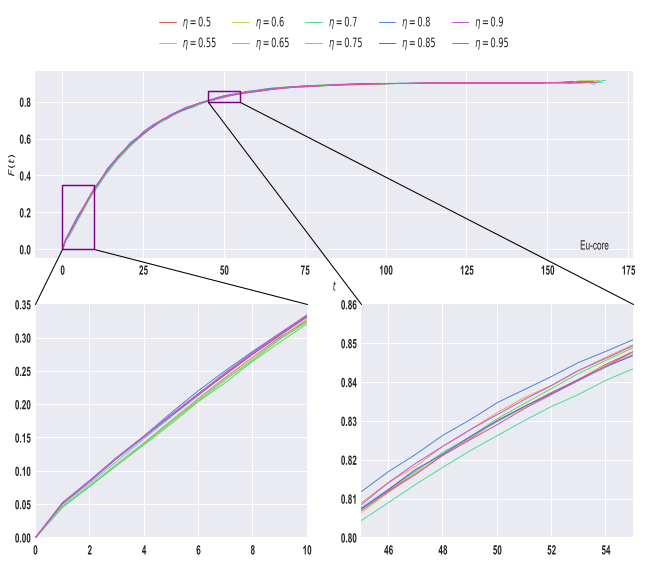 *Fig: The final infected scale of AIRank' with different community tightness values (η). Note the "sweet spot" at η = 0.85.* ## Critical Insight: The Power of the Bridge The study highlights that **bridge nodes** (nodes that connect different communities) are the secret sauce of viral propagation. While a high-degree node inside a dense cluster is "loud," its reach is physically limited by the cluster's boundaries. AIRank's ability to prioritize nodes by their **Initiating Power** ensures that the "information fire" jumps from one community to another efficiently. ## Conclusion & Limitations AIRank represents a significant step forward in making node ranking more "sociologically aware." However, the **O(n²)** complexity of the AIRank' variant might prove challenging for trillion-edge social graphs (like Facebook or X). Future work should focus on approximating community tightness to bring AIRank' back to linear time. **Takeaway for Practitioners**: When aiming for viral growth, don't just look for the most popular users. Look for the "connectors"—the users who belong to diverse groups—and leverage the social conformity of their neighbors to trigger a cascade.