
UAM: Solving the Social Emotion Sparsity Problem in Short Texts
Expert Systems With Applications
The paper introduces the Universal Affective Model (UAM), a hybrid supervised topic model designed to classify readers' emotions in short texts. By integrating a Biterm Topic Model (BTM) at the topic level and an emotional lexicon at the term level, UAM achieves SOTA or competitive performance across multiple datasets (SemEval, Digg, Sinanews).
TL;DR
Researchers have developed the Universal Affective Model (UAM), a specialized framework that bridges the gap between topic modeling and affective computing. By shifting focus to "biterms" (word pairs) and separating "keywords" from "background noise" using a new ATF-IDF metric, UAM accurately predicts how readers will react emotionally to headlines and tweets, significantly outperforming traditional LDA-based methods and matching the performance of complex deep learning architectures on sparse data.
The Problem: The Sparsity Barrier in Affective Computing
Most social media content—the primary source for "social emotion" data—is short. Whether it's a news headline or a tweet, the lack of sufficient word co-occurrence (the "sparsity problem") makes standard Latent Dirichlet Allocation (LDA) fail. Furthermore, a single word can have multiple emotional meanings (ambiguity) depending on the topic.
The authors argue that previous SOTA methods failed because they either focused solely on the author’s perspective or ignored the rich semantic relationships available in global word-pair co-occurrences.
Methodology: The Dual-Layered Bridge
The genius of UAM lies in its structural split into Topic-level and Term-level sub-models.
1. Topic-Level: The Power of Biterms
Instead of modeling individual word tokens, UAM utilizes Biterm Topic Modeling (BTM). This approach assumes that two words co-occurring in a short text share a topic. By aggregating these "biterms" globally across the entire corpus, UAM overcomes the sparsity of individual documents.
2. Term-Level: Lexical Fusion
To handle words that don't fit into distinct topics (background words), UAM integrates an emotion lexicon (like SWAT). This ensures that even if a word isn't part of a strong "topic," its inherent emotional weight is still calculated.
3. The ATF-IDF Paradigm
To decide what constitutes a "keyword" versus "background," the paper introduces Average Term Frequency-Inverse Document Frequency (ATF-IDF). Unlike standard TF-IDF (which is local to one document), ATF-IDF looks at the global behavior of terms to identify those with the highest "emotional potential."
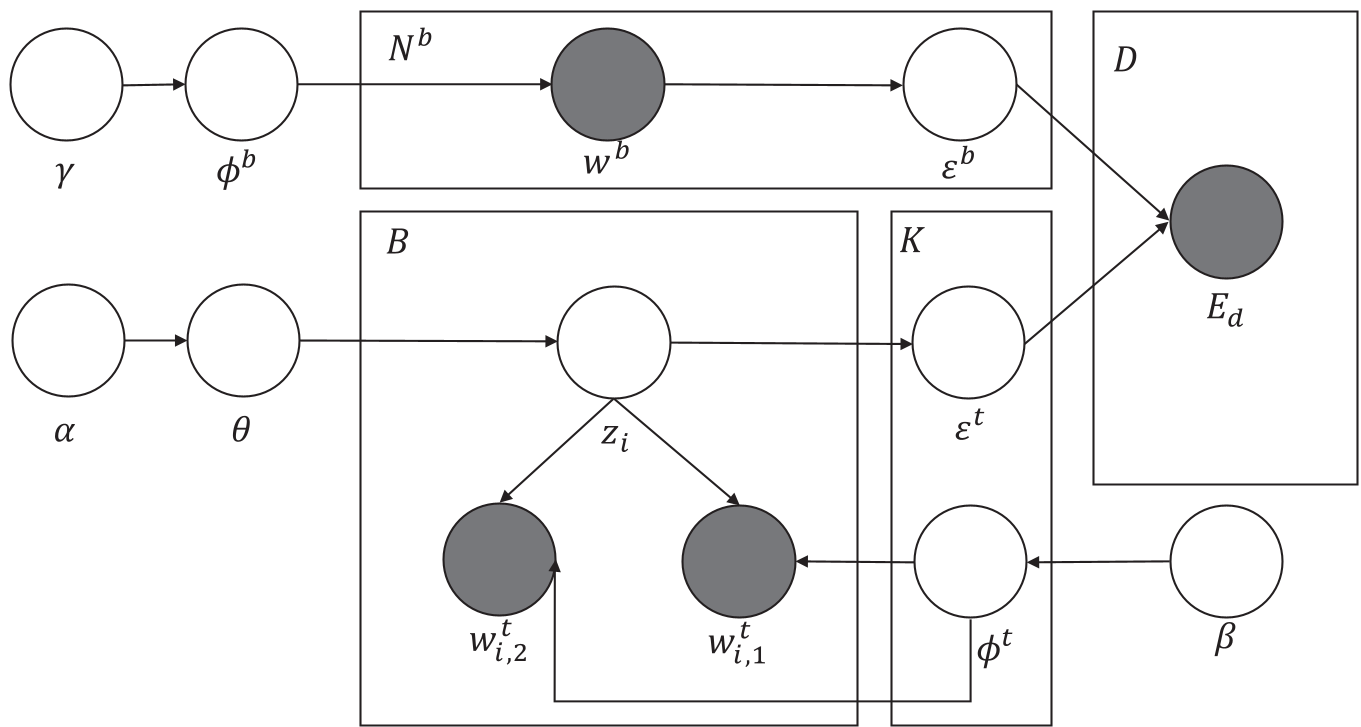 Figure 1: The graphical representation of UAM, showing the convergence of latent topics and emotion rating distributions.
Performance: Deciphering the Human Response
The researchers tested UAM against three distinct datasets: SemEval-2007 (Headlines), Six (Short messages), and Sinanews (Long-form news).
Key Breakthroughs:
- Sparse Superiority: On the highly sparse SemEval dataset, UAM outperformed the previous Affective Topic Model (ATM) and Labeled LDA variations across almost all metrics (Average Precision and Accuracy).
- Stability: The "Variance" of UAM's results was consistently lower than its peers, suggesting it is less sensitive to the specific number of topics () chosen by the user.
- Competitive with Deep Learning: When compared against CharSCNN (a deep convolutional neural network), UAM provided better fine-grained emotion correlation (AP-emotion), proving that statistical models still hold an edge in logic-based affective mapping.
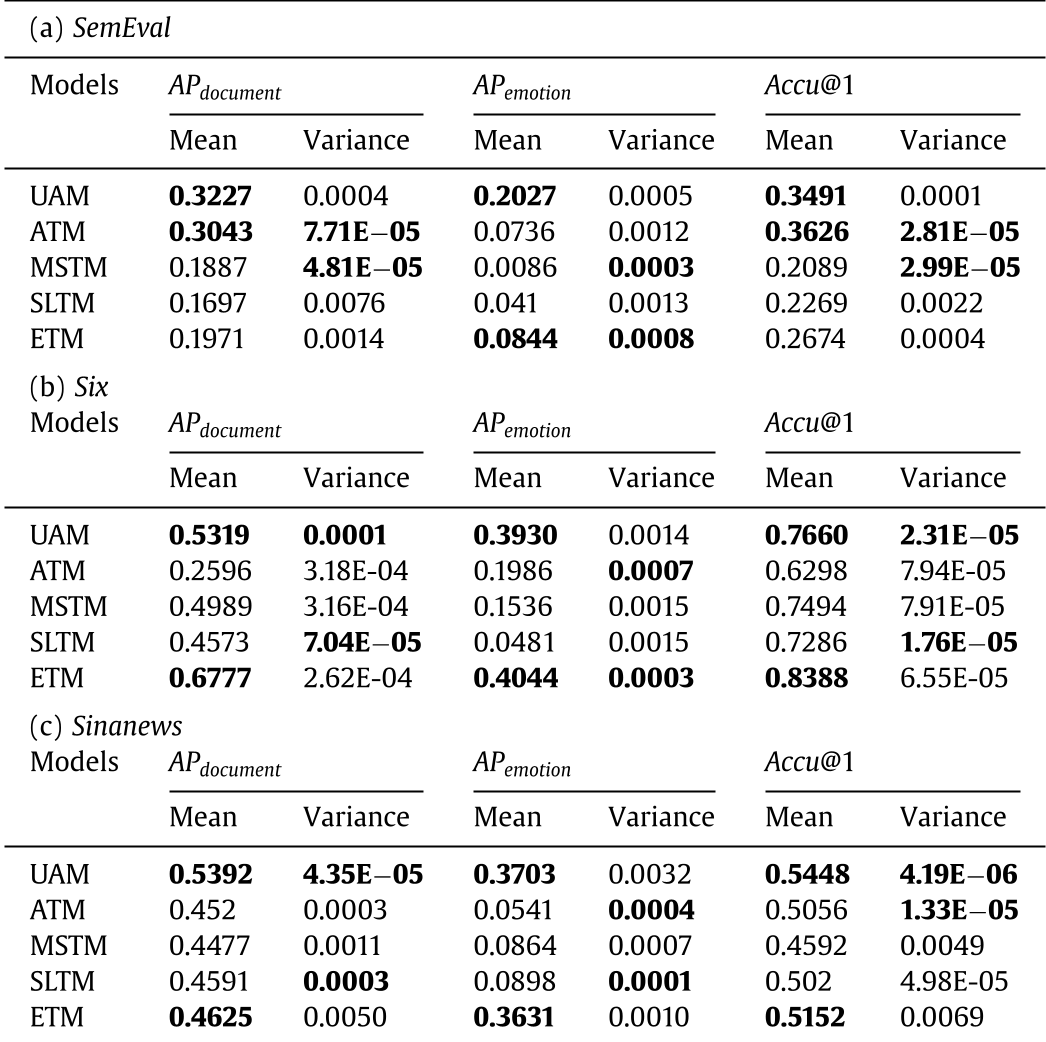 Table 1: Performance metrics across SemEval, Six, and Sinanews datasets. Bold values indicate UAM's leadership in stability and accuracy.
Critical Insight: Why UAM Works
The "Secret Sauce" is the transition from Author Perspective () to Reader Perspective (). By modeling emotion as an exponential distribution linked to latent topics, UAM mimics the "memoryless" property of user voting—each reader's reaction is treated as an independent but topic-influenced event.
Conclusion & Limitations
UAM provides a robust, interpretable alternative to "black-box" deep learning for social emotion detection. It is particularly valuable for industries like finance (market sentiment) and social monitoring.
Limitations: The model currently relies on pre-defined lexicons (SWAT) for its term-level analysis. Future iterations could benefit from replacing these with dynamic, context-aware embeddings (like BERT or GPT-based latents) to further refine the background word mapping.
Takeaways for the Industry:
- Don't ignore the noise: Background words carry emotional weight that topic models often throw away.
- Biterms > Unigrams: For short-text analysis, the relationship between word pairs is more valuable than individual word frequencies.