
Preserving the Social Fabric: A Neighborhood-Centric Approach to Graph Anonymization
Expert Systems With Applications
The paper presents a data-driven anonymization system for Online Social Networks (OSNs) that integrates a synthetic data generator with a local neighborhood-preserving anonymizer. The core method, "NoInt", combines k-anonymity for topology and t-closeness for sensitive attributes, achieving state-of-the-art information loss reduction in complex graph structures.
TL;DR
This research introduces a sophisticated framework for anonymizing Online Social Networks (OSNs) that prioritizes the "local neighborhood" of users. By combining a synthetic data generator with a novel "NoInt" (Non-Intersecting) anonymization strategy, the authors manage to satisfy strict privacy guarantees (k-anonymity and t-closeness) while drastically reducing information loss compared to traditional node-by-node modification techniques.
Background: The Privacy-Utility Trade-off
As OSNs like Facebook and LinkedIn scale, the demand for user behavior analysis grows. However, releasing this data publicly poses a massive privacy risk. The fundamental challenge is the Privacy-Utility Trade-off: the more you anonymize a graph to protect users, the more "utility" (structural information) you lose.
Current SOTA methods often fail because they focus on individual nodes, effectively "deleting" the local social context that makes graph data valuable. The authors argue that a user's local neighborhood is the most significant aspect of their social identity and must be preserved during the transformation.
Methodology: The "NoInt" Framework
The system's innovation lies in its three-stage process: Synthetic Generation, Neighborhood Matching, and Attribute Perturbation.
1. Strategic Seed Assignment
To avoid the "ripple effect" where modifying one node affects dozens of others, the system selects Seeds that are at least 3 steps apart. This creates distinct, non-overlapping subgraphs that can be anonymized in isolation.
2. Sub-graph Anonymization (The Matcher)
Instead of changing nodes randomly, the system uses a sophisticated similarity metric (taking into account topology, quasi-identifiers, and weights) to group the most similar subgraphs. It then transforms them all to match a central "prototype" subgraph.
 Figure 1: Overview of the Data Generation and Anonymization System.
3. T-Closeness via Simulated Annealing
For sensitive attributes (like "likes" or "interests"), the system goes beyond simple diversity. It uses t-closeness, ensuring the distribution of sensitive data in any -group is close to the total population's distribution. They solve this optimization problem using Simulated Annealing to find the minimum possible change required to hit the threshold.
Experimental Results: Proving the Insight
The authors tested their "NoInt" method against two baselines:
- Int: Overlapping neighborhoods.
- NoS: Global modification without clusters (similar to prior work by Zhou & Pei).
Scalability and Information Loss
Surprisingly, the method actually performs better as the graph gets larger. In the 100K node graph, the information loss "Cost" was lower than in the 1K node graph. This is because a larger pool of nodes provides a higher probability of finding "near-perfect" matches for -groups.
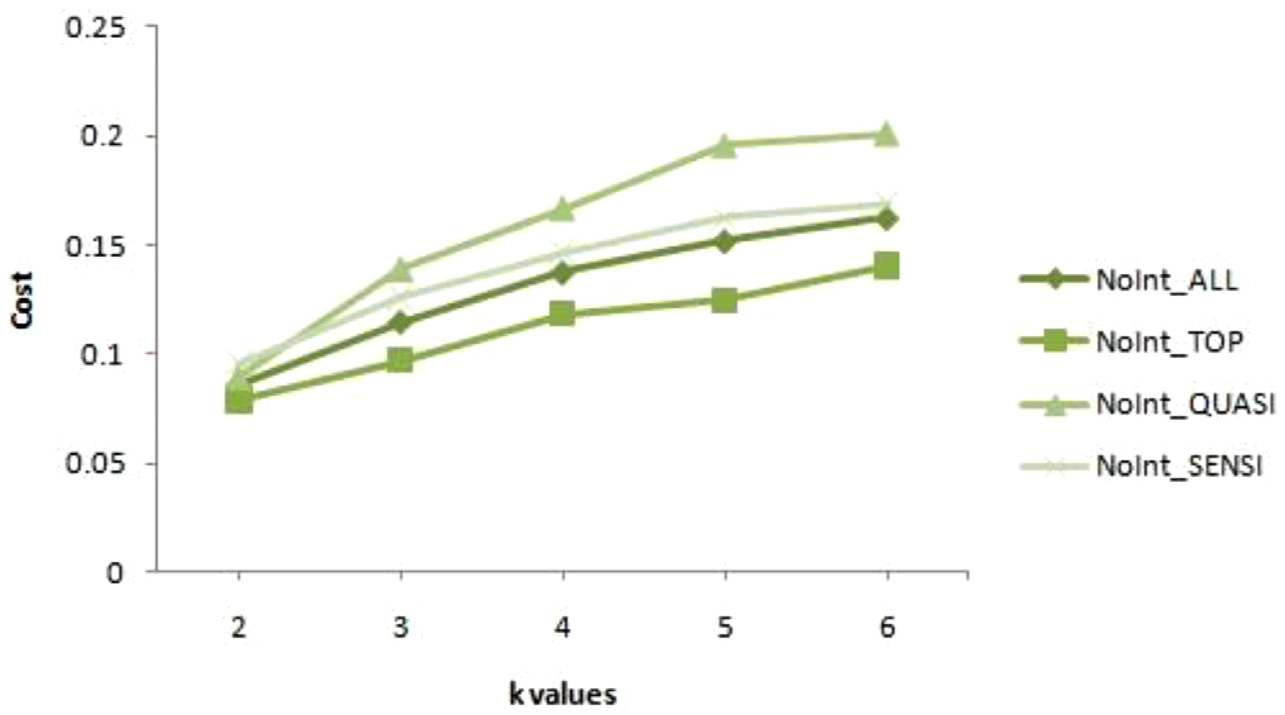 Figure 2: Information Loss (Cost) vs. Privacy Level . Note the lower cost compared to traditional approaches.
Critical Analysis & Takeaways
The brilliance of this work is the physical intuition that sparsity is a gift. By enforcing distance between seeds, the researchers effectively decentralized the anonymization problem.
Key Takeaways:
- Context Matters: Protecting a node in a vacuum is useless if its edges reveal its identity; protect the neighborhood.
- Global vs. Local: Global optimization in graphs is computationally expensive (NP-hard). Local heuristics with non-overlapping constraints offer a scalable, "good enough" alternative that preserves macro-level statistics.
- Tooling Gap: The inclusion of a synthetic generator that mimics OSN properties (like "power-law distributions" and "homophily rules") makes this a practical toolkit for real-world analysts.
Limitations: The system current struggle with "hub nodes" (users with thousands of friends) as they are difficult to isolate within a distance of 3. Future work into overlapping communities will be necessary to tackle the core of modern, hyper-connected social graphs.