
MOEA for Viral Marketing: Balancing Revenue and Costs via Agent-Based Influence Maximization
Expert Systems With Applications
This paper introduces a multiobjective evolutionary optimization (EMO) framework to solve the Influence Maximization (IM) problem in viral marketing. By integrating Agent-Based Modeling (ABM) with NSGA-II and MOEA/D algorithms, the approach simultaneously maximizes sales revenue (NPV) and minimizes marketing costs, achieving a set of non-dominated solutions that significantly outperform traditional greedy and single-objective genetic algorithms.
TL;DR
This research shifts the "Influence Maximization" (IM) paradigm from a pure graph-theory problem to a realistic business optimization task. By combining Evolutionary Multiobjective Optimization (EMO) with Agent-Based Modeling (ABM), the authors demonstrate how to target social media influentials to maximize sales revenue while strictly controlling the costs of free product samples.
Problem & Motivation: Beyond "Maximum Spread"
In the classic IM problem, the goal is simple: find nodes to maximize the spread of information. However, real-world marketing faces two harsh realities:
- Budget Constraints: Targeting "hubs" (highly connected users) isn't free; it often involves discounts or free samples.
- Human Complexity: Real consumers aren't just "active/inactive" nodes. They have preferences, they get bored (awareness deactivation), and they experience uncertainty.
Existing SOTA methods often treat the number of seeds as a fixed input and ignore the cost-revenue trade-off. This paper argues that the "best" marketing strategy is actually a Pareto front of solutions, allowing a brand to choose between a "high-risk, high-reward" aggressive campaign or a "low-cost, conservative" one.
Methodology: The Core Engine
The framework stands on two legs: Evolutionary Search and Simulated Market Dynamics.
1. The Decision Space
Instead of selecting specific node IDs, the algorithm optimizes the criteria for what makes an influential. It evolves weights () for local network metrics:
- Degree: Direct reach.
- 2-steps: Proximity to the "friend-of-a-friend" network.
- Clustering Coefficient: Local density, which affects the speed of "word-of-mouth."
- Seed Count (): Dynamically determining how many people to target.
2. The Simulation (ABM)
The fitness of a strategy is evaluated through a 365-day simulation. Agents (consumers) use four heuristics to decide whether to buy: Repetition, Deliberation, Imitation, and Social Comparison.
 Figure 1: Conceptual overview of the viral marketing optimization process.
Experiments & SOTA Comparison
The authors tested their approach on various topologies, from Scale-Free (SF) networks to a real-world APP network with 20,000 users.
- MOEA/D vs. NSGA-II: Both outperformed greedy baselines. MOEA/D showed a slight edge in networks with high diffusion potential (like Scale-Free networks), while NSGA-II was more robust in regular lattices where information travels slowly.
- The "Greedy" Failure: Traditional greedy algorithms, which pick nodes based on degree alone, were consistently dominated. They are too "eager" and fail to find the nuanced trade-off between targeting one global hub vs. several local influencers.
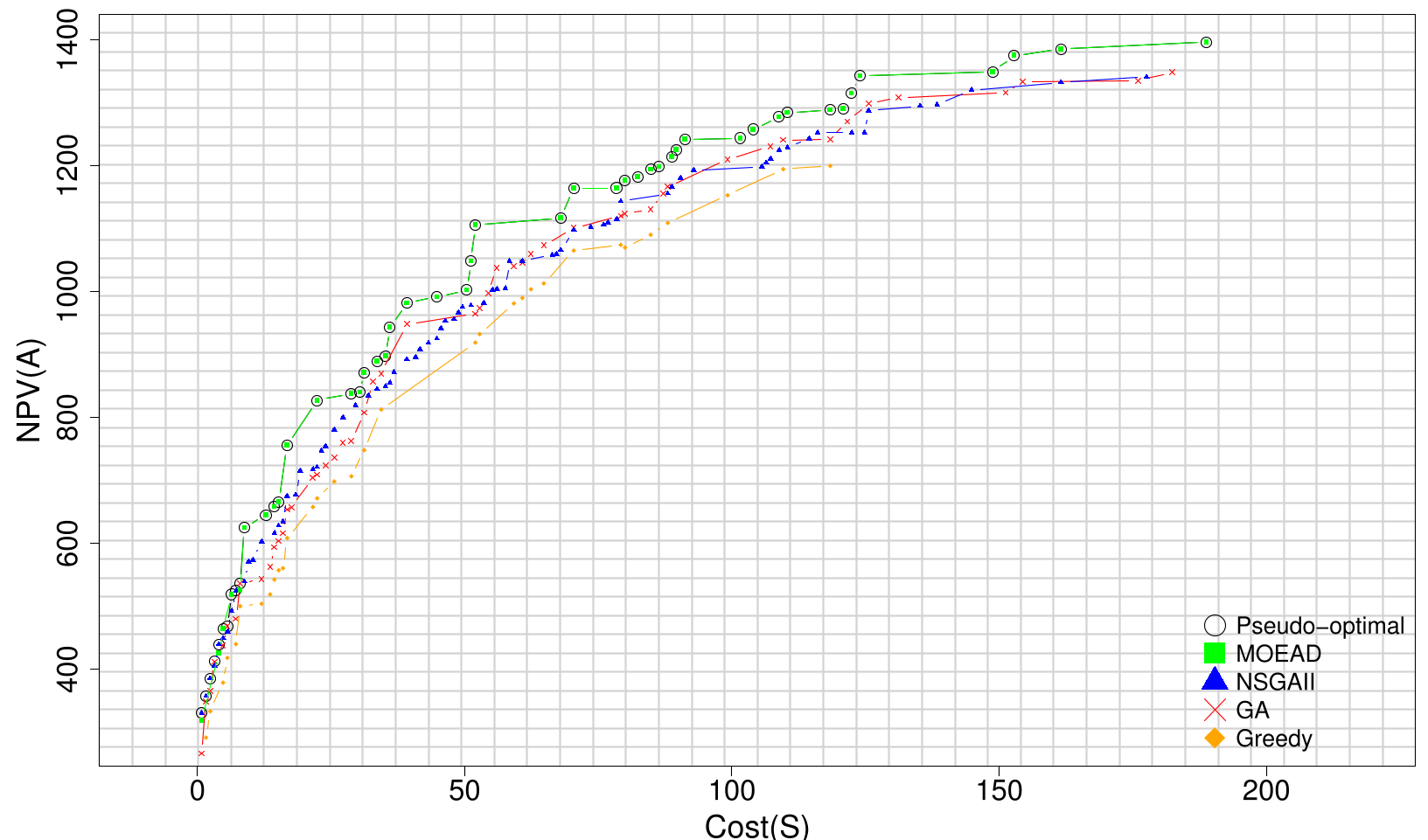 Figure 2: The Pareto front for a Scale-Free network, illustrating the trade-off between Revenue (NPV) and Costs.
Critical Insight: Who are the Influentials?
The study reveals a fascinating "topological dependency." In "Email-style" networks, the optimal strategy heavily weights Degree (finding hubs). In "Regular Lattice" networks (where everyone has similar local connections), the strategy shifts toward increasing the number of seeds () because a single node's reach is physically limited by the network's diameter.
Conclusion & Future Outlook
This work provides a professional blueprint for Decision Support Systems in marketing. While highly effective, the study highlights its own limitation: it treats seeding as a "one-shot" event at . The next frontier is Sequential Seeding, where marketers adaptively release samples over time as they observe the cascade's progress.
For practitioners, the message is clear: Stop looking for the "single best" influencer. Start evolving a portfolio of targeting strategies that respect your budget.