
Triadic Co-Clustering: Unveiling the Hidden Sentiment Dynamics of Brexit
Expert Systems With Applications
The paper introduces a novel Triadic Co-Clustering algorithm designed to simultaneously cluster three dimensions—Users, Issues, and Sentimental Keywords—represented as a signed tripartite hypergraph. Unlike traditional spectral methods, it handles overlapping clusters, ignores non-contributing nodes, and optimizes for high positive edge density while minimizing negative edge density, specifically applied to Brexit-related Twitter data.
TL;DR
Researchers have developed a new way to analyze social media by simultaneously clustering Users, Issues, and Sentimental Keywords. By treating Twitter data as a signed tripartite hypergraph, the Triadic Co-Clustering algorithm identifies dense pockets of "agreement" (positive edges) while filtering out "disagreement" (negative edges). Applied to the Brexit referendum, it revealed that politicians across different parties often share surprisingly similar negative terminologies when discussing specific hot-button issues like taxation and EU borders.
The "Noise" Problem in Social Networks
Classical community detection assumes that everyone belongs somewhere. In the messy world of Twitter, this is rarely true. Most users are "lurkers" or have weak connections, and forcing them into clusters dilutes the results.
Existing SOTA methods like Tucker Decomposition or Spectral Clustering face three major hurdles:
- The Membership Trap: They try to partition every node, regardless of its relevance.
- Dimension Blindness: They struggle to balance three different types of entities at once.
- Sentiment Ignorance: They often ignore whether an edge is "positive" (support) or "negative" (opposition), treating all interactions as equal.
Methodology: The Greedy Trimming Intuition
The authors' core insight is simple: Start big and trim the fat. Instead of building clusters from the bottom up, the Triadic Co-Clustering algorithm starts with the entire graph and iteratively removes the "Least Effective Node."
What makes a node "effective"?
Effectiveness is calculated using the following logic:
- If a node is connected by many positive hyperedges, it is valuable.
- If it is connected by negative hyperedges or is loosely connected, it is a candidate for removal.
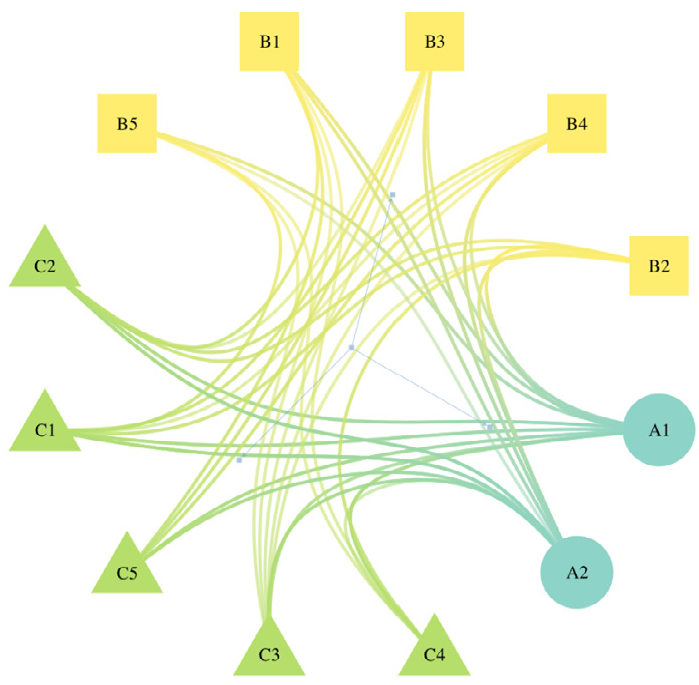 The algorithm uses a 3D matrix representation where cells represent hyperedges between a User, an Issue, and a Keyword.
The process follows a strict constraint check:
- Density Constraint (): Ensures a minimum ratio of positive edges and a maximum ratio of negative edges.
- Size Constraint (): Prevents the algorithm from collapsing into trivial, tiny clusters.
Experiments: Brexit as a Battleground
The researchers crawled tweets from 411 UK politicians during the Brexit referendum. They focused on 48 issues (e.g., NHS, Immigration, Tax) and 1,000 sentiment-expressing keywords.
Key Findings vs. Baselines
- Tucker Decomposition Failure: As shown in the study, Tucker decomposition produced clusters with very low purity. It struggled to separate the "Leave" and "Remain" camps because it couldn't handle the signed nature of the sentiment data effectively.
- Cross-Party Ideology: The Triadic method discovered clusters containing members from UKIP, Conservatives, and Labour in the same group. Why? Because they all used identical negative framing—words like "crisis", "threat", and "risk"—when discussing the EU.
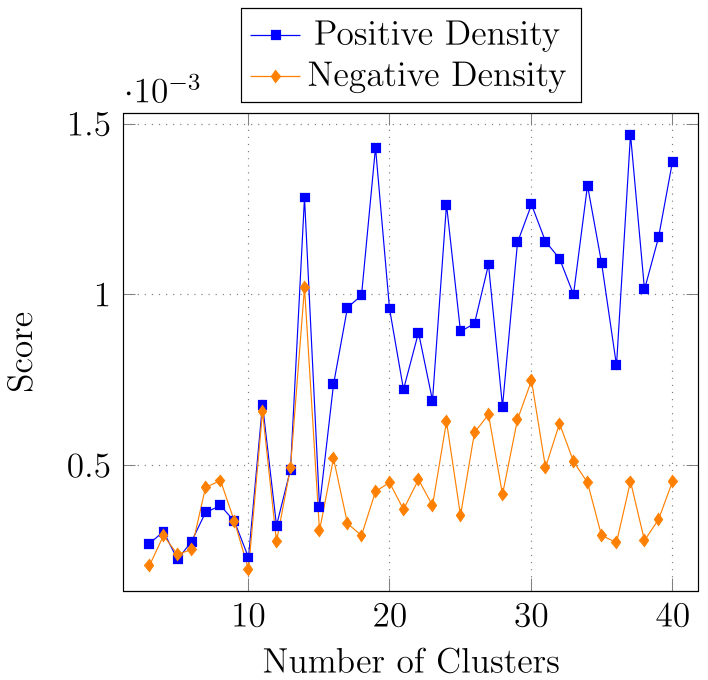 Density and purity comparison: The Triadic method maintains high density in hyper-clusters compared to traditional tensor decomposition.
Deep Insight: Beyond Party Lines
The most profound takeaway is the Inductive Bias of the algorithm. By allowing nodes to overlap, the study proves that a politician can belong to a "Financial Skeptic" cluster (focusing on tax risks) while simultaneously being part of a "Security Concern" cluster (focusing on border threats).
This "many-to-many" relationship is much closer to human reality than the binary "Community A vs. Community B" approach used in older social network analysis.
Strategic Conclusion
The Triadic Co-Clustering algorithm is a powerful tool for any domain where relationships are multi-modal and signed—such as e-commerce (Users-Products-Reviews) or biomedicine (Patients-Genes-Diseases).
Limitations: The current heuristic can be computationally expensive () if the graph is extremely dense, and it currently lacks a deep semantic understanding of natural language, relying instead on keyword matching. However, for structured sentiment analysis, it sets a new bar for precision in multidimensional data mining.