
Beyond Binary Logic: Fusing Fraud Evidence with Intuitionistic Fuzzy Reasoning
Expert Systems With Applications
The paper introduces a novel unsupervised fraud detection method for banking transactions that fuzes multiple behavioral evidence sources using Multi-Criteria Decision Making (MCDM), Intuitionistic Fuzzy Sets (IFS), and Evidential Reasoning. By modeling epistemic uncertainty through hesitation margins, the system outperforms the traditional Dempster-Shafer (DS) method in detecting sophisticated fraud patterns.
TL;DR
To combat banking fraud in environments where labeled data is scarce and behavior is ambiguous, this research moves beyond simple "fraud vs. non-fraud" classification. By implementing a Multi-Criteria Decision Making (MCDM) framework powered by Intuitionistic Fuzzy Sets (IFS) and Evidential Reasoning, the authors managed to increase fraud detection rates (True Positives) by nearly 20% compared to traditional evidence fusion methods, while simultaneously reducing false alarms.
Problem & Motivation: The Fog of Epistemic Uncertainty
Most modern fraud detection systems (FDS) struggle because they assume clear-cut boundaries between "good" and "bad" behaviors. However, in the real world:
- Labeled Data is Rare: Supervised learning is often impossible in banking due to privacy and the lack of ground-truth labels.
- Epistemic Uncertainty: We simply don't have enough information about every customer. A sudden large transaction might be fraud, or it might just be a rare but legitimate purchase.
- Static Thresholds Fail: Fraudsters constantly evolve, making rule-based systems or static outlier detection obsolete.
The authors argue that we must model not just the probability of fraud, but the degree of uncertainty or "hesitation" we have about that probability.
Methodology: The Three Pillars of Evidence Fusion
The proposed model treats the decision as a multi-level committee process where three distinct perspectives (Individual, Business, and General) act as decision-makers.
1. Behavioral Trend Modeling
The system extracts 192 raw and aggregated features, tracking trends across different time windows. Deviation from these trends serves as the "evidence."
2. Intuitionistic Fuzzy Sets (IFS)
Unlike standard fuzzy sets, IFS uses three parameters:
- (Membership): Degree of belief it is fraud.
- (Non-membership): Degree of belief it is legitimate.
- (Hesitation): The "I don't know" factor ().
3. Evidential Reasoning (ER)
The system uses an ER algorithm to aggregate these fuzzy opinions from the three decision-making levels. Unlike the traditional Dempster-Shafer (DS) theory, which can struggle with conflicting evidence, the ER approach provides a more stable way to handle hierarchical weights.
 Figure: The block diagram of the proposed evidence fusion model.
Experimental Validation
Using a real-world dataset from an Iranian private bank, the authors generated synthetic fraudulent transactions (using Gaussian Distribution modules) to test the system against the standard Dempster-Shafer (DS) method.
Performance Gains
The results demonstrate a clear superiority in accuracy. At a high-security threshold (0.8):
- MCDM-IFS (Proposed): True Positive Rate of 0.73
- DS (Baseline): True Positive Rate of 0.54
- False Alarms: The proposed method slightly outperformed in keeping false alerts lower than DS (0.0101 vs. 0.0116).
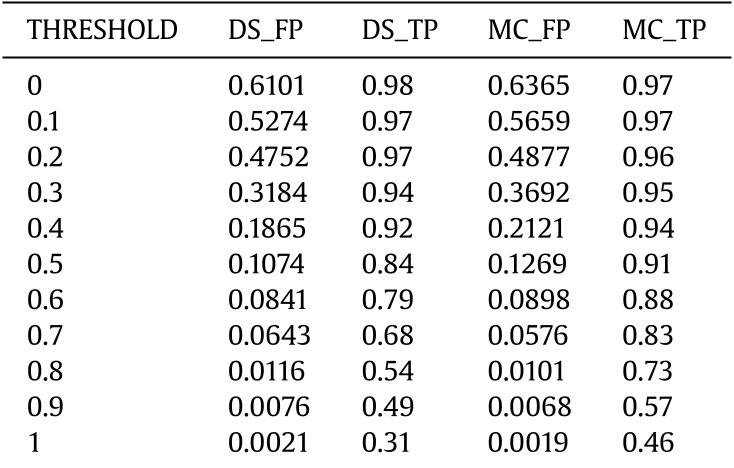 Table: Comparison of True Positives and False Positives at varied thresholds.
The Trade-off: Computational Speed
The depth of the fuzzy calculation comes at a cost. Measurement of Transactions Per Second (TPS) shows that the MCDM approach is computationally heavier than the DS method. As the number of transactions increases, the processing time for the proposed method grows faster, suggesting a need for parallelization in high-volume production environments.
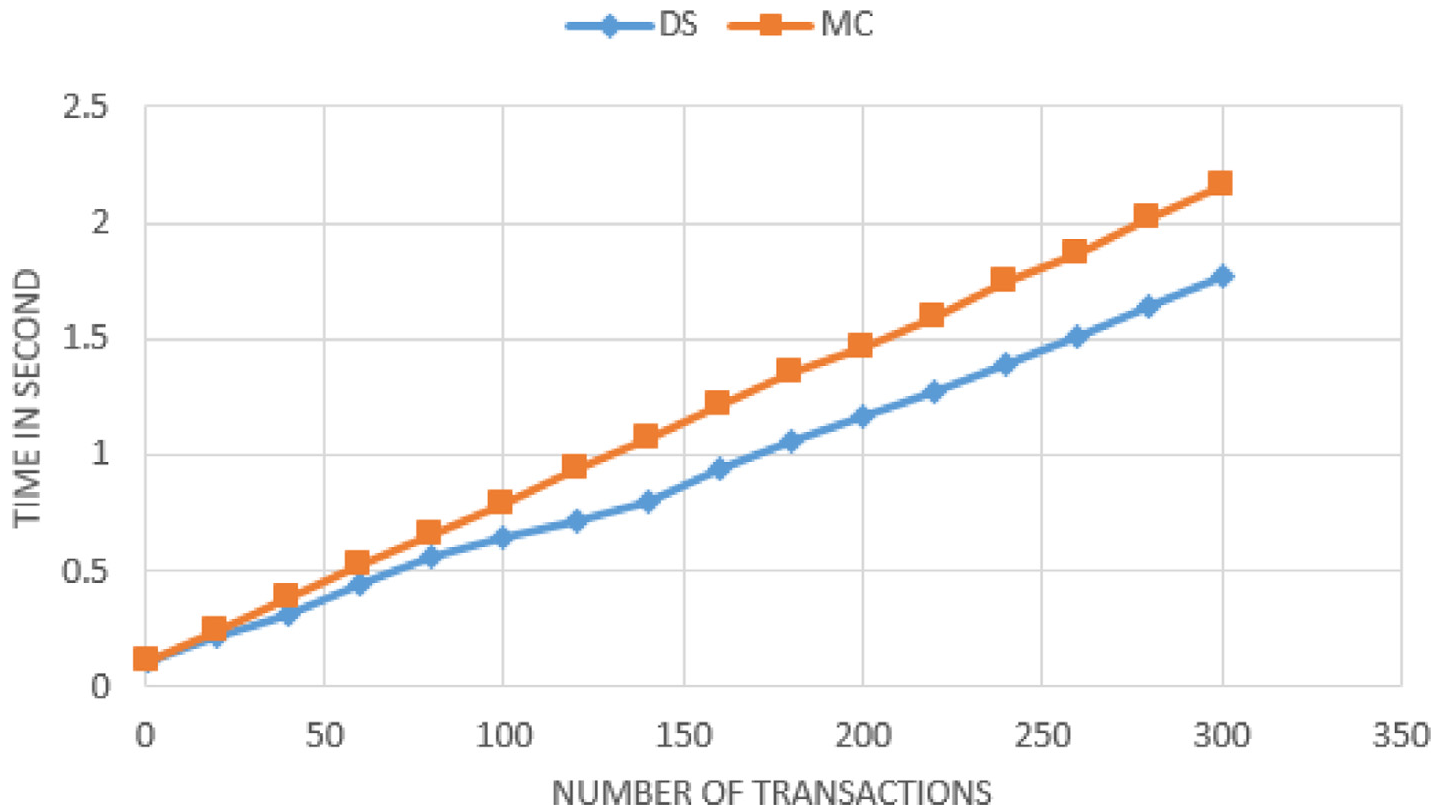 Figure: TPS latency comparison between MCDM and DS methods.
Critical Insight & Conclusion
This paper proves that uncertainty is a feature, not a bug. By quantifying the "hesitation margin," the FDS can make much more nuanced decisions. While the computational overhead is a concern, the move toward unsupervised, evidence-based fusion is the correct trajectory for banking systems dealing with "cold start" problems for new customers or rapidly shifting fraud patterns.
Future Work: The authors highlight that integrating artificial immune systems or customer churn prediction data could further refine the weight assignment for decision-makers, reducing the reliance on manual expert tuning.